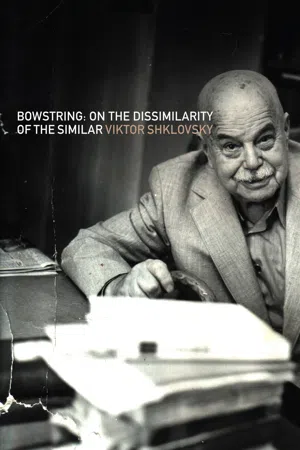
"Myths do not flow through the pipes of history, " writes Viktor Shklovsky, "they change and splinter, they contrast and refute one another. The similar turns out to be dissimilar." Published in Moscow in 1970 and appearing in English translation for the first time, Bowstring is a seminal work, in which Shklovsky redefines estrangement ( ostranenie ) as a device of the literary comparatist—the "person out of place, " who has turned up in a period where he does not belong and who must search for meaning with a strained sensibility. As Shklovsky experiments with different genres, employing a technique of textual montage, he mixes autobiography, biography, memoir, history, and literary criticism in a book that boldly refutes mechanical repetition, mediocrity, and cultural parochialism in the name of art that dares to be different and innovative. Bowstring is a brilliant and provocative book that spares no one in its unapologetic project to free art from conventionality.
- 456 pages
- English
- ePUB (mobile friendly)
- Available on iOS & Android
eBook - ePub
About this book
Information
Topic
LetteraturaSubtopic
Critica letteraria russaFRANÇOIS RABELAIS
AND MIKHAIL BAKHTIN’S BOOK
About Gargantua and Pantagruel,
and about Bakhtin’s Rabelais and His World
and about Bakhtin’s Rabelais and His World
Rabelais’s novel has a strange and unique fate, starting with the way that it was published. The publication of the novel began from the second book, in which the author explicitly stated that he didn’t write the first book. Here is what the author says in the prologue:
You have recently read, fed, and taken to bed a book I did not write, The Great and Absolutely Priceless Chronicles of the Great Giant Gargantua. Like true believers you have swallowed literally every word written there, as if it were the text of the Holy Bible…
The book, which Rabelais refers to as the already finished book and which had captivated the readers, was published around 1532. It was a cheap illustrated mass edition depicting a parodied world of magicians, giants, and knights. Rabelais changed the surroundings of his heroes.
The first chapter of this book chronicles the origins and antiquity of Pantagruel’s family.
It mentions the Bible and how Pantagruel’s origins date back to the time when “Abel was killed by his brother, Cain.”
The genealogy recorded in the Bible, besides listing names, also mentions the achievements of Adam’s descendants: “Adah bore Jabal; he was the ancestor of those who live in tents and have livestock” (Genesis 4:20).
Then, “Zillah bore Tubalcain, who made all kinds of bronze and iron tools” (Genesis 4:22).
In Pantagruel’s genealogy the remarks are made in the following way: “Goliath begat Eryx, the Sicilian giant who invented the shill game: which shell has a nut in it?” Or: “Caccus begat Etion, the first man to catch the pox because he didn’t drink enough cool, fresh wine in the summertime.” Or: “Oromedon begat Gemmagog, who invented those horrible pointed shoes they still wear in Poland.”
The parody continues; for example, there is a line about an ancestor who was “the first in the world ever to play dice while wearing spectacles.”
The parody here is explicit, as there are evident references to the Bible in the author’s prologue—I will get back to it shortly.
In 1535, after the second book was published, Rabelais wrote the first book with which he obviously intended to replace that harmless book, which he parodically continued.
The title of the first book puts the emphasis on Gargantua, but it also mentions Pantagruel twice—first explicitly, then the book itself is characterized as “full of Pantagruelism.”
Aside from that, the book is remarkable in its unusual audacity, which perhaps nobody has been able to surpass until this day. It underscores the antireligious sentiment of the novel, or I should probably say—its anti-Christian bias.
Gargantua’s genealogy is very long and it goes back to Noah’s ark. The author remarks gleefully:
Let me explain that by a sovereign gift straight from heaven we’ve been given Gargantua’s genealogy, right from the beginning of time, more complete than that of any man but the Messiah, of whom I say nothing, because it’s none of my business. Also the devils (by which I mean slanderers and hypocrites) don’t want me to. (Book I, Chapter 1)
The genealogy of “the Messiah” is narrated in the Gospel according to Matthew: “So all the generations from Abraham to David are fourteen generations; and from David to the deportation to Babylon, fourteen generations; and from the deportation of Babylon to the Messiah, fourteen generations” (Matthew 1:17).
Rabelais is mocking the length of this genealogy.
The source at which the parody is directed is masked by conversations about trivial things and references to great works by authors and scholars from the antiquity.
If we speak more generally about Rabelais’s book as “carnivalized” literature, then we should mention that the participants of this particular carnival are extremely intelligent people who assume the readers to be ironic, erudite scholars.
The author’s prologue is a parody of scholarly speech. The first chapter is antireligious. The second chapter is a parody about finding a little book with a treatise entitled Antidotal Jokes in an ancient tomb.
The jokes are written in verse and contain parodies of mythology and phrases that are grammatically correct but make no sense.
The fourth chapter chronicles the birth of Gargantua, which takes place during a banquet. After mowing the fields and killing the oxen, everyone overeats at the banquet.
Pregnant with Gargantua, Gargamelle is described as having eaten too much fatty beef tripe on the third day of February.
She overeats in the autumn—after the second mowing, when they were salting the meat so they would have plenty of pressed beef in the springtime.
Back then people didn’t have refrigerators and they preserved meat by salting, curing, making sausages with various spices. Perhaps this can also explain the cost of spices in the Middle Ages.
After slaughtering the oxen, there was an excess of tripe that was bound to go rotten—they decided it was their duty to eat it all. Tripe is a type of edible offal from the chambers of the animal’s stomach.
Rabelais connects all of these commonplace circumstances with the religious myths about the Immaculate Conception and the miraculous birth of the Messiah.
Chapter 6 is dedicated to the miracle of Gargantua’s birth. This is how it happens: the mother gets an upset stomach, they give her a strong astringent, and consequently the birth is delayed.
It made her womb stretch loose at the top, instead of the bottom, which squeezed out the child, right into a hollow vein, by means of which he ascended through the diaphragm up to her shoulders, where that vein is divided in two. Taking the left-hand route, he finally came out the ear on that same side.
It would seem that all of this is a joke, an incredible joke at that, but Rabelais justifies himself by saying:
I’m not sure you’re going to believe this strange birth. If you don’t, I don’t give a hoot—but any decent man, any sensible man, always believes what he’s told and what he finds written down. Doesn’t Solomon say, in Proverbs 14, Innocens credit omni verbo (“An innocent man believes every word”)? And doesn’t Saint Paul say, in I Corinthians 13, Charitas omnia credit, (“Charity believes everything”)? Why shouldn’t you believe me? Because, you say, there’s no evidence. And I say to you that, for just this very reason, you must believe with perfect faith. Don’t all our Orthodox argue that faith is precisely that: an argument for things which no one can prove?
And is there anything in this against the law? or our faith? or in defiance of reason—or Holy Scripture? Me, I find nothing written in the Holy Bible that says a word against it.
Other translations of the Latin quotes are: “The fool believes everything” and “Love believes everything.” But if we take the version in the Bible, which Rabelais is so explicitly referencing, we’ll see that Solomon says something else: “The simple believe everything, but the clever consider their steps” (Proverbs 14:15).
The apostle Paul was very influential among religious reformers; he wrote: “[Love] does not rejoice in wrongdoing, but rejoices in the truth” (I Corinthians 13:6)—and: “When I was a child, I spoke like a child, I thought like a child, I reasoned like a child; when I became an adult, I put an end to childish ways” (I Corinthians 13:11).
Rabelais then proceeds to list a plethora of incredible births in Greek mythology and the legends of Franks:
Wasn’t Bacchus spawned by Jupiter’s thigh?
And the giant Roquetaillade, wasn’t he born from his mother’s heel?
And Croquemouche, wasn’t he born out of his nurse’s slippers?
And what about Minerva: wasn’t she born out of Jupiter’s head—and through his ear?
And Adonis, didn’t he appear through the bark of myrrh tree?
And Castor and Pollux, out from the shell of an egg laid and then hatched by Leda?
But the most important in all this game is the catechist phrase: “faith is precisely that: an argument for things which no one can prove.”
The seemingly labyrinthine recounting and baroque overabundance of information given by Rabelais have a concealed purpose of diverting the reader’s antagonism. The attention Rabelais received from his friends was different—the humanists were knowledgeable and knew, “like a dog,” how to crack the bone open just to taste a bit of marrow. Here is Rabelais’s characterization: “Just like the dog, you ought to be running with your educated nose to the wind, sniffing out and appreciating such magnificent volumes—you should be light on your feet, swift in the chase, bold in the hunt.” Then he says, “by hard reading and constant reflection, you ought to crack the bone and suck the nourishing marrow” (Book I, Author’s Prologue).
There is a passage in Genesis that mentions the following: “The Nephilim were on the earth in those days—and also afterward—when the sons of God went in to the daughters of humans, who bore children to them” (Genesis 6:4). I can’t give extended commentaries here because it will break the content of the book.
It turns out that not all men are the descendents of Adam.
In the Book of Numbers we read about the twelve scouts whom Moses sends to explore the land of Canaan. They report back: “There we saw the Nephilim (the Anakites come from the Nephilim); and to ourselves we seemed like grasshoppers, and so we seemed to them” (Numbers 13:33).
Pantagruel, too, is a descendent of a race of giants, but these giants are parodied—they are what we call the “supernatural beings.” In the antiquity, they used to tell about people with only one leg, or people whose faces were on their chests.
In Rabelais’s world there are men with immense noses and hunched backs; they are just as real as the men with enormous ears who drink barley water—i.e., beer.
Their ears are so big that they could make a jacket out of just one of them, and a cape from the other one.
Then Rabelais continues with his version of the Bible:
Others grew immense bodies. From them, finally, came the race of giants, from whom, ultimately, Pantagruel was born:
And the first of the giants was Chalbroth,
Who begat Sarabroth,
Who begat Faribroth,
Who begat Hurtaly, who loved bread soaked in soup: he reigned at the time of the Flood,
Who begat Nimrod,
Who begat Atlas, whose shoulders kept the world from falling,
Who begat Goliath,
Who begat Eryx, the Sicilian giant who invented the shill game: which shell has a nut in it?…Who begat Aranthas,
Who begat Gabbara, who was the first ever to drink a toast…
Rabelais himself was a daring giant who was trampling on old science and religion.
If we were to crack the bone of the carnival, which he created, then it is a carnival of enlighteners—a carnival of humanists.
Empress Catherine II tried to establish something similar.
Mitropolit Yevgeni reports the following about Denis Fonvizin’s Message To My Servants Shumilov, Vanka, and Petrushka: “The book first appeared in 1763, in Moscow, during Shrovetide masquerade when for three days the Moscow printing houses were permitted to publish freely.”111
The epistle contains a master’s conversation with his servants about the meaninglessness of human existence.
Nikolai Tikhonravov disagrees with Mitropolit Yevgeni, saying that Message to My Servants was published in monthly installments in Pustomelia (The Tattler) in July 1770. However, after the appearance of this work, the journal’s publication was stopped.
I used to have a separate edition of Fonvizin’s book in my own library, I don’t know where it is now, but Mitropolit Yevgeni’s report is accurate. I am more interested in the masqueraded liberties permitted by Catherine for only three days. Later many people repented for actually using this gift of freedom.
Rabelais was more fortunate in his ability to confuse his enemies. The excess of commonplace details, the realities of common people camouflaged the book; it appeared to be a book on trifles.
The carnival is realistically present in Rabelais but it has a purpose.
Obviously the Bible is in the background of Rabelais’s work and is the main target of attacks. The chivalric romances are in the foreground. But in this novel the heroes are not ordinary knights, they are giant-knights who defeat everything and everyone. These giants can also be linked to the passage from Genesis (about the Nephilim).
Among Pantagruel’s—and consequently his father’s—ancestors are giants such as Atlas and Goliath, titans such as Briarus, who had a hundred hands, and Antaeus.
What we have here is a chain of insinuations and deriding caricatures—a parody of the Bible, which has been equated to Greek mythology and deliberate nonsensicality.
This is why I stopped on the birth of the hero and his ancestors. By reworking mass literature, Rabelais turns his parodic hero into a new messiah as well as a descendent of biblical heroes and giants of the antiquity.
A new savior is born. Instead of destroying the power of the devil or the original sin, he obliterates the faith in the devil and in miracles, the falsehood of the old mythology. A godlike giant is born.
Bakhtin’s analysis of Rabelais’s book is interesting and important. He selected this work from the rest of the literature, showed its connection to the carnival and folk parodies. But I don’t think that he really showed who or what the parody was directed at.
The carnival was a place where everyone was given the rig...
Table of contents
- COVER
- OTHER WORKS BY VIKTOR SHKLOVSKY IN ENGLISH TRANSLATION
- TITLE PAGE
- COPYRIGHT
- DEDICATION
- CONTENTS
- TRANSLATOR’S PREFACE
- ACKNOWLEDGEMENTS
- PROLOGUE
- FOREWORD
- BORIS EICHENBAUM
- ON UNITY
- IMAGE AND RIDDLES
- ON CONVENTIONS
- PERSON OUT OF PLACE
- YURI TYNJANOV
- ON THE FUNCTIONS OF PLOT
- LANGUAGE AND POETRY
- FRANÇOIS RABELAIS AND MIKHAIL BAKHTIN’S BOOK
- “MYTH” AND “THE NOVEL-MYTH”
- THE NEW GENRES
- RETURN THE BALL INTO THE GAME
- EPILOGUE
- JOHN F. BYRNE LITERATURE SERIES
Trusted by 375,005 students
Access to over 1.5 million titles for a fair monthly price.
Study more efficiently using our study tools.
Frequently asked questions
Yes, you can cancel anytime from the Subscription tab in your account settings on the Perlego website. Your subscription will stay active until the end of your current billing period. Learn how to cancel your subscription
No, books cannot be downloaded as external files, such as PDFs, for use outside of Perlego. However, you can download books within the Perlego app for offline reading on mobile or tablet. Learn how to download books offline
We are an online textbook subscription service, where you can get access to an entire online library for less than the price of a single book per month. With over 1.5 million books across 990+ topics, we’ve got you covered! Learn about our mission
Look out for the read-aloud symbol on your next book to see if you can listen to it. The read-aloud tool reads text aloud for you, highlighting the text as it is being read. You can pause it, speed it up and slow it down. Learn more about Read Aloud
Yes! You can use the Perlego app on both iOS and Android devices to read anytime, anywhere — even offline. Perfect for commutes or when you’re on the go.
Please note we cannot support devices running on iOS 13 and Android 7 or earlier. Learn more about using the app
Please note we cannot support devices running on iOS 13 and Android 7 or earlier. Learn more about using the app
Yes, you can access Bowstring by Viktor Shklovsky, Shushan Avagyan in PDF and/or ePUB format, as well as other popular books in Letteratura & Critica letteraria russa. We have over 1.5 million books available in our catalogue for you to explore.