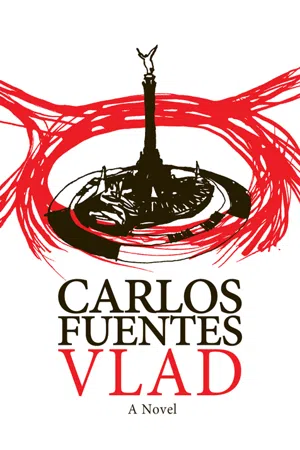
"Vlad" is Vlad the Impaler, of course, whose mythic cruelty was an inspiration for Bram Stoker's Dracula. In this sly sequel, Vlad really is undead: dispossessed after centuries of mayhem by Eastern European wars and rampant blood shortages. More than a postmodern riff on "the vampire craze, " Vlad is also an anatomy of the Mexican bourgeoisie, as well as our culture's ways of dealing with death. For—as in Dracula—Vlad has need of both a lawyer and a real-estate agent in order to establish his new kingdom, and Yves Navarro and his wife Asunción fit the bill nicely. Having recently lost a son, might they not welcome the chance to see their remaining child live forever? More importantly, are the pleasures of middle-class life enough to keep one from joining the legions of the damned?
- 112 pages
- English
- ePUB (mobile friendly)
- Available on iOS & Android
eBook - ePub
About this book
Information
Topic
LiteraturaSubtopic
Literatura generalChapter 1
“I wouldn’t trouble you, Navarro, if Dávila and Uriarte were available. I’m not going to call them your inferiors—subordinates sounds better—but neither will I forget that you are a senior partner, primus inter pares, and so are higher ranked in this firm. I am entrusting this task to you because, first and foremost, I consider this a matter of utmost urgency . . .”
Weeks later, when the awful adventure had ended, I recalled that, at its beginning, I had chalked up the absence of Dávila and Uriarte to luck. Dávila was off on his honeymoon in Europe, and Uriarte was tied up in a judicial embargo. As for me, I was neither going away on a wedding trip, nor would I have ordinarily accepted the work, appropriate for a lawyer just out of school, that our boss had delegated to our indefatigable Uriarte.
But I respected the decision of my elderly employer and appreciated the meaningful intimacy of his trust. He had always been an uncompromising man whose decisions were final. He was not in the habit of asking anyone for advice. Although he was tactful enough to listen attentively to his co-workers’ points of view, he replied with orders. And yet, in spite of what I just said, how could I ignore the peculiar circumstances by which he’d acquired his fortune? His status as a rich man was recent enough for him still to be considered “new money,” but even that new money, thanks to the gravitas of its owner, felt every bit as old as his eighty-nine years and tied to the history of an already buried century. His wealth was largely a result of the obsequiousness (or the moral flexibility) with which he had served (and risen in his service of) successive governmental administrations during his long years in Mexico. Suffice it to say he was an “influential man.”
I must confess that I never saw my boss behave submissively to anyone. I could only guess at the inevitable concessions that his haughty gaze and already curved spine had been forced to make—over the course of his career—to politicians who could hardly be said to exist at all beyond the six-year span of a president’s term. He knew perfectly well that political power was fleeting; the officials did not. They prided themselves on having been named ministers for six years, after which they would be forgotten for the rest of their lives; whereas the admirable thing about the distinguished Don Eloy Zurinaga, Esq., was that for sixty years he had known how to slither from one presidential administration to the next while always landing on his feet. His strategy was quite simple. Throughout his career, he never fell out with politicians because he never once let them glimpse the inevitability of their political greatness dwindling to a future of insignificance. Few saw past the superficial courtesy and empty praise of Eloy Zurinaga’s ironic smile.
As for his attitude toward me, I quickly accepted that if it did not behoove him to display any new loyalties, this was because he never demonstrated any lasting affection to anyone or to anything. That is, his official conduct was professional: honest and efficient. It can only remain a matter of conjecture whether that honesty was genuine and that efficiency just a type of tyranny, and whether both qualities combined into a mask necessary for survival in the swamp of political and judicial corruption. If Licenciado Zurinaga never quarreled with a government official, that was probably because he’d never much liked any of them. He didn’t need to say this. His life, his career, even his dignity confirmed it.
A year had passed since Mr. Zurinaga, my boss, had become housebound. In all that time, nobody at the firm ever dared imagine that the physical absence of the man in charge allowed for slack behavior, tardiness, or idle jokes. On the contrary, in his absence, Zurinaga felt all the more present. He seemed to have issued a warning: “Be careful. At any moment I might show up and surprise you. Watch out.”
More than once during the past year, Mr. Zurinaga had telephoned to announce his imminent arrival in the office. Although he never showed up, on each occasion a holy terror put the entire staff on high alert, leaving us all on our best behavior. And then, one morning, an individual who seemed identical to the boss came into, and a half hour later left, the office. The only reason we knew it wasn’t really him was that in the course of that half hour, Mr. Zurinaga telephoned a few times to issue instructions. On the phone that morning, he spoke in a decisive, almost dictatorial way, without entertaining a single question, remark, or response. Then, without allowing for so much as an acknowledgment, he hung up. Word spread that the individual in the office couldn’t be the boss after all, and yet, when he walked out, seen from behind, he was tall and stooped over, just like the absent lawyer. He was dressed in an old polo coat with its lapels lifted to his ears and a totally out-of-fashion black-and-brown felt hat from which two uncontrolled white tufts of hair burst like the wings of a bird.
The walk, the cough, and the clothing were all the boss’s, but this visitor, who entered the sancta sanctorum of the office with such nonchalance that nobody stopped him, was not Eloy Zurinaga. The joke—if it even was a joke—didn’t leave any of us laughing. Quite the opposite. The appearance of this double, specter, or look-alike—whatever he was—only made us feel unease and anxiety.
Because he no longer came into the office, my meetings with the lawyer Eloy Zurinaga, my boss, took place at his home. From the street, a skimpy and miserable garden led to an equally miserable, collapsing set of stairs to the great house. He lived in one of the last remaining Porfirian mansions, as they’re called, in reference to the dictatorship of General Porfirio Díaz, specifically the period from 1884 to 1910, our pretend belle époque. For some unknown reason, no one had torn down the mansion, unlike the rest of the Roma neighborhood of Mexico City, which has been razed to make way for office buildings, condominiums, and shops. One needed only enter the large, ramshackle two-storied house, crowned with a mansard roof and atop an inaccessible cellar, to understand that the lawyer’s entrenchment was not a matter of will so much as one of gravity. Zurinaga had accumulated so many papers, books, case files, pieces of furniture, bibelots, dishes, paintings, rugs, tapestries, folding screens, and especially memories in that residence that to change locations would have been for him like changing his life and accepting, even hastening, his death.
To demolish the house would be to demolish his entire existence.
Zurinaga’s obscure origins (or his cold reasoning, devoid of sentimental concessions) excluded from the gray stone mansion any reference to family. The interior lacked any pictures of women, parents, children, or friends. Instead, the house was crammed with an overabundance of old-fashioned decorative objects that gave the place the feeling of an antiques warehouse: Sèvres vases, Dresden figurines, bronze nudes and marble busts, flimsy chairs with gilded backrests, Biedermeier-style tables, heavy armchairs of burnished leather, along with the intrusion here and there of art-nouveau lamps . . . This was a house without the slightest hint of feminine grace.
Instead, hanging on the red velvet-lined walls were artistic treasures that, seen up-close and taken together, revealed a shared macabre quality: disturbing engravings by the Mexican Julio Ruelas of heads drilled by monstrous insects; phantasmagoric paintings by the Swiss Henry Füssli, whose specialty was the depiction of nightmares, of distortions, the marriage of sex and horror, females and fear . . .
“Just imagine,” the attorney Zurinaga smiled. “Füssli was a cleric who fell out with an ecclesiastical judge. The judge defrocked him, and that’s what pushed Füssli toward art . . .”
Zurinaga brought his fingers together beneath his chin.
“Sometimes, I would like to have been a judge who expelled himself from the judiciary and so is condemned to art . . . Too late,” he sighed. “For me, life has become a long parade of corpses . . . My only comfort is to count those who have not yet left, th...
Table of contents
- Cover
- Title Page
- Contents
- Other Works by Carlos Fuentes in English Translation
- Dedication
- Epigraph
- Chapter 1
- Chapter 2
- Chapter 3
- Chapter 4
- Chapter 5
- Chapter 6
- Chapter 7
- Chapter 8
- Chapter 9
- Chapter 10
- Chapter 11
- Chapter 12
- Chapter 13
- Chapter 14
- Copyright
Trusted by 375,005 students
Access to over 1.5 million titles for a fair monthly price.
Study more efficiently using our study tools.
Frequently asked questions
Yes, you can cancel anytime from the Subscription tab in your account settings on the Perlego website. Your subscription will stay active until the end of your current billing period. Learn how to cancel your subscription
No, books cannot be downloaded as external files, such as PDFs, for use outside of Perlego. However, you can download books within the Perlego app for offline reading on mobile or tablet. Learn how to download books offline
Perlego offers two plans: Essential and Complete
- Essential is ideal for learners and professionals who enjoy exploring a wide range of subjects. Access the Essential Library with 800,000+ trusted titles and best-sellers across business, personal growth, and the humanities. Includes unlimited reading time and Standard Read Aloud voice.
- Complete: Perfect for advanced learners and researchers needing full, unrestricted access. Unlock 1.5M+ books across hundreds of subjects, including academic and specialized titles. The Complete Plan also includes advanced features like Premium Read Aloud and Research Assistant.
We are an online textbook subscription service, where you can get access to an entire online library for less than the price of a single book per month. With over 1.5 million books across 990+ topics, we’ve got you covered! Learn about our mission
Look out for the read-aloud symbol on your next book to see if you can listen to it. The read-aloud tool reads text aloud for you, highlighting the text as it is being read. You can pause it, speed it up and slow it down. Learn more about Read Aloud
Yes! You can use the Perlego app on both iOS and Android devices to read anytime, anywhere — even offline. Perfect for commutes or when you’re on the go.
Please note we cannot support devices running on iOS 13 and Android 7 or earlier. Learn more about using the app
Please note we cannot support devices running on iOS 13 and Android 7 or earlier. Learn more about using the app
Yes, you can access Vlad by Carlos Fuentes, Alejandro Branger, Ethan Shaskan Bumas, Alejandro Branger,Ethan Shaskan Bumas in PDF and/or ePUB format, as well as other popular books in Literatura & Literatura general. We have over 1.5 million books available in our catalogue for you to explore.