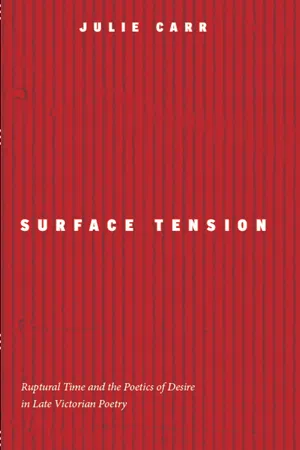
Taking Dante Gabriel Rossetti, William Morris, and Gerard Manley Hopkins as its primary subjects, Surface Tension reveals how these later Victorian poets repeatedly imagine the aesthetic moment—charged, variegated, intensely focused—as capable of birthing a new, and newly redemptive, culture. Turning to contemporary experimental poets and theorists of poetry, such as Andrew Joron, Lisa Robertson, Christopher Nealon, and Joan Retallack, it goes on to reveal how our own poetry's fascination with complex surfaces and imagined social transformation has deep and under-recognized ties to Victorian concepts. Surface Tension offers new insights into the debt we owe to the most radical of the Victorians while yielding new understandings of how late Victorian poetry, even when least explicitly political, engages, and often re-envisions, the period's pressing anxieties about social progress, decadence, and revolution.
- 350 pages
- English
- ePUB (mobile friendly)
- Available on iOS & Android
eBook - ePub
Surface Tension
About this book
Information
CHAPTER I
MATHEW ARNOLD’S PREGNANT POETRY
MATHEW ARNOLD’S PREGNANT POETRY
[T]he Kantian “without interest” must be shadowed by the wildest interest, and there is much to be said for the idea that the dignity of artworks depends on the intensity of the interest from which they are wrested. . . .Art does not come to rest in disinterestedness. For disinterestedness immanently reproduces—and transforms interest . . . For the sake of happiness, happiness is renounced. It is thus that desire survives in art.
Theodor Adorno xxviii
Wandering between two worlds, one dead,
The other powerless to be born.
Matthew Arnold
I. Introduction
Matthew Arnold makes a sustained case throughout his criticism for poetry’s active role in the history and development of the nation. Of the Victorian critics, Arnold is perhaps the most convinced of poetry’s social usefulness, calling on poetry, as the replacement of religion and philosophy, to carry the values of the democratic nation into the future. And yet, Arnold’s rejection of unresolved feeling and “fine writing” as the foci for poetry, his de-emphasizing of the linguistic surface of the poem and its ability to generate or represent affect, and his corresponding conception of the poem as a sealed container, ultimately limit his vision of poetry’s capacity to participate in social or political change. When he writes in “The Study of Poetry” (1880), “The future of poetry is immense, because in poetry, where it is worthy of its high destinies, our race, as time goes on, will find an ever surer and surer stay,” he is assigning to poetry the role of vehicle for “the best that has been known and thought in the world,” which, as we know, is criticism’s (or later, culture’s) object (Works, 9:161). Affect in poetry is in the service of “idea,” and ideas are for Arnold the key to social progress. And yet crucially, in Arnold’s poetics, the poem itself does not generate the “stream of fresh and free thought” so necessary for a healthy society. For while poetry may be “criticism of life,” it can only be so when the culture is suffused with ideas—when criticism has already done its work.xxix
The poet therefore serves the very specific and secondary function of carrying ideas within the “effective and attractive” forms of poetry, while the critic serves the primary function of inseminating the culture, and thus the poet, with ideas. Poetry, such as that of the Romantics, without great critical effort “behind it” is, for Arnold, “premature”—that is, like a failed or compromised birth. Thus while the critic plays an active role in shaping history, the poet passively receives, absorbs, and carries within his or her body that which has its true source elsewhere. Arnold’s formulation, rather than granting poetry a powerful role in the shaping of the world from which it emerges and into which it moves, finally empties poetry, and thus poets, of the capacity to effect transformation (“The Function of Criticism at the Present Time,” Works, 3: 261-2).
In Arnold’s formulation, the Romantic figure of the poet as creative agent is erased—replaced by “poetry” as an abstraction that only acts insofar as it interacts with critical production. Arnold praises poetry for its “pregnancy,” imagining the pregnant poem as a sphere sealed tight with “inviolate and inviolable” laws. Pregnancy is a useful metaphor not because it evokes the activity of (re)production, the catastrophe of birth, but rather because it evokes the security of containment. Arnold’s metaphor is thus best envisioned as a disembodied and perpetually pregnant womb, rather than a woman’s pregnant body. And further, this erasure of the woman’s body in Arnold’s metaphor is homologous to the erasure of the figure of the poet in the imagined marriage of poetry and criticism. This obscured and de-legitimated poet, while suggesting the degree to which Arnold disparages the subjective poetry of feeling, means that poems, as representatives of critical thought, must always take a secondary role in the generation of the future. As the pure bride of criticism, poems can only repeat, never create.
There are echoes here with Keats, for Keats, as we saw in “The Fall of Hyperion,” similarly wants poetry to aim toward social responsibility or healing. Negative capability, Keats’s theory of poetic agency, imagines a poet emptied of coherent identity who attempts to fill this emptiness with an acute sympathetic responsiveness. Yet, Arnold’s absented poet differs from Keats’s “chameleon” poet in one crucial way. Negative capability arises out of the poet’s heightened sensitivity, his ability to suspend selfhood in meeting the other; while the self is emptied of center, this emptiness is an effect of the quality of openness. Thus the concept of negativity allows for productivity, allows for the “uncertainties and doubts” that define any movement toward the new. In contrast, the sealed sphere of the poem/idea dyad we find in Arnold’s poetics is given the very specific function of reproducing the rationally apprehended products of criticism’s efforts. Poems themselves cannot ultimately produce the new—the “stranger” that each (actual and metaphoric) birth must produce.xxx Thus the poem, despite Arnold’s claim for its immense futurity, in fact has no future at all.
Arnold’s Aristotelian poetics reveals his distinctive discomfort with the multiple, fragmentary, unresolved, and contingent. He disparages poetry that foregrounds language’s materiality over content because such poetry is not unified: it leaks outward, its focus is dispersed, it seems to lack purpose.xxxi Similarly, Arnold worries throughout his career as a social critic and political theorist about the fragmenting of belief systems, the breaking or loss of cohesive ideals.xxxii This anxiety about fragmentation is tied directly to Arnold’s understanding of “modernity.” As he writes in “On the Modern Element in Literature” (1857), “the present age exhibits to the individual man who contemplates it the spectacle of a vast multitude of facts awaiting and inviting his comprehension” (Works, 1:20). Later in his career he will sound much less confident of this invitation, as when in 1880 he writes, “There is not a creed which is not shaken, not an accredited dogma which is not shown to be questionable, not a received tradition which does not threaten to dissolve” (“The Study of Poetry,” Works, 3:161).
As Isobel Armstrong reminds us, Arnold’s anxiety about modernity is not unique to him: “Victorian modernism, as it emerges in its poetics, describes itself as belonging to a condition of crisis which has emerged from economic and cultural change” (Victorian Poetry, 3). Yet, perhaps what is unique to Arnold is the degree to which his concerns about modernity are reflected simultaneously in his politics and his poetics. As we know from the 1861 essay, “Democracy,” as well as from Culture and Anarchy, a strong state is called upon for the administration and dissemination of aesthetic and cultural values, values that are borne forth by critical thought. And a poetry capable of bearing these ideals is crucial to the maintenance of a strongly unified national character. Later in this chapter we will see how despite Arnold’s attempt to harness poetry into serving as modernity’s antidote, poetic language erupts in his work, participating in, rather than healing, the fracturing force of the modern.
To some, concerned about the marginalization and perceived uselessness of poetry, Arnold’s assertion of the political centrality of poetry might sound like good news. Yet according to Arnold, for poetry to perform the function he has set out for it, it must adhere to stringent (classical) “rules.” At a time when other poets were experimenting broadly with prosody, form, emotional range, and subject-matter, Arnold was arguing for adherence to Aristotelian poetics, the disciplining of feeling and poetic material, and against linguistic play. 1848, a year of political fragmentation and revolution across Europe, also marks the formation of the PRB. And though the group was certainly not at that early date influential, their self-proclaimed alliance does indicate the degree to which artists and writers at mid-century were interested in exploring and experimenting with affect, subjectivity, and poetic form. 1850 marks the publication of Tennyson’s In Memoriam and Wordsworth’s The Prelude, works that are perhaps less about aesthetic unity than about the display and analysis of subjectivity. Robert Browning’s Men and Women is published just three years later, and Elizabeth Barrett Browning’s Aurora Leigh appears in 1857. Both works self-consciously push against conventions of content and form. The 1850’s are also the years of the “Spasmodic School,” the group of poets (including P.J. Bailey, Sydney Dobell, and Alexander Smith) whose work, in Armstrong’s words, “surges with Keatsian excess and Shakespearean fecundity,” exploring political and social issues directly (Victorian Poetry, 169).xxxiii This enormous wealth of poetic exploration indicates that Arnold’s classicism, his insistence on the “grand style,” on poetry’s “wholesome regulatory laws,” as well as on “great actions from a heroic time” as the truly fit subject-matter for poetry is, at this moment in British literary history, self-consciously reactionary, positioning itself against Romanticism and contemporary Victorian experimentation at once. As the negative reviews of his volumes from 1849 and 1852 make clear, “Arnold’s literary and aesthetic values—his ‘taste’—opposed those of many middle-class readers of poetry and fiction” (Harrison, Arnold, 57).xxxiv
Consistent with Arnold’s demand that poetry incarnate rather than generate ideas is a poetics that attempts to limit language to its referential function. Arnold’s resistance to “fine writing” is rooted in a desire for language to represent, rather than disrupt, the rational and ideational. And yet, while in the pivotal poem Empedocles on Etna, discussed at the end of this chapter, we find Arnold presenting, through the figure of Callicles, an oppositional aesthetics that celebrates sensation, and thus explores language’s ability to represent but also generate affect. Arnold’s rejection of the poem from the reissued Poems of 1853 provided the motivation for his famous Preface. In that essay, as in his later essays on poetics, Arnold’s aesthetic strictures against the exploration of linguistic materiality finally result in a disavowal of language’s ability to interrupt, rather than repeat, ideology. Ultimately Arnold’s poetics resists what defenders of poetry’s negatively critical force (from Shelley and Arthur Hallam to Althusser and Adorno, to Robert Kaufman, Joan Retallack, and Isobel Armstrong, to name a few such defenders relevant here) see as poetic language’s capacity to (in Adorno’s words), “let those things be heard which ideology conceals . . . [to] proclaim a dream of a world in which things would be different” (“Lyric Poetry,” 157).
One might protest here that Arnold’s concept of the “grand style” or “grand manner” betrays an interest in language’s “literariness,” in de Man’s sense, that Arnold’s insistence on the importance of style reveals that for him “content” was not all, that he was not purely interested in language’s discursive functionality. In “On Translating Homer: Last Words” (1861), where Arnold praises Homer for “nobleness, the grand manner,” we find him articulating a theory of poetic language that argues for the importance of style, and thus, we might think, of language’s material properties. And yet, Arnold insists that poetic vocabulary is a product of convention, and as such, an ideally invisible aspect of the poem. Again, this invisibility finally limits the possibility for the poem’s surface to complicate, rather than simply reflect or repeat, the poem’s ideational function.
Arguing for the “plainness of words and style,” in Homer’s poetry, Arnold writes:
Everyone at Athens who dabbled in epic poetry, not only understood Homer’s language,—he possessed it. He possessed it as everyone who dabbles in poetry with us, possesses what may be called the poetical vocabulary, as distinguished from the vocabulary of common speech and of modern prose: I mean, such expressions as perchance for perhaps, spake for spoke, aye for ever, don for put on, charmed for charm’d, and thousands of others. (Works, 1:180...
Table of contents
- Cover
- Title Page
- Epigraph
- Contents
- PREFACE
- INTRODUCTION
- CHAPTER I: Matthew Arnold’s Pregnant Poetry
- CHAPTER II: Dante Gabriel Rossetti and the Aesthetics of Emergency
- CHAPTER III: Murder in Utopia: William Morris and the Surface of Desire
- CHAPTER IV: Gerard Manley Hopkins and the Reck of the Moment
- CODA: Messianism Now, or, Other Victorians
- ENDNOTES
- WORKS CITED
- INDEX
- About the Author
- Copyright
- Other Works by Julie Carr
Trusted by 375,005 students
Access to over 1.5 million titles for a fair monthly price.
Study more efficiently using our study tools.
Frequently asked questions
Yes, you can cancel anytime from the Subscription tab in your account settings on the Perlego website. Your subscription will stay active until the end of your current billing period. Learn how to cancel your subscription
No, books cannot be downloaded as external files, such as PDFs, for use outside of Perlego. However, you can download books within the Perlego app for offline reading on mobile or tablet. Learn how to download books offline
Perlego offers two plans: Essential and Complete
- Essential is ideal for learners and professionals who enjoy exploring a wide range of subjects. Access the Essential Library with 800,000+ trusted titles and best-sellers across business, personal growth, and the humanities. Includes unlimited reading time and Standard Read Aloud voice.
- Complete: Perfect for advanced learners and researchers needing full, unrestricted access. Unlock 1.5M+ books across hundreds of subjects, including academic and specialized titles. The Complete Plan also includes advanced features like Premium Read Aloud and Research Assistant.
We are an online textbook subscription service, where you can get access to an entire online library for less than the price of a single book per month. With over 1.5 million books across 990+ topics, we’ve got you covered! Learn about our mission
Look out for the read-aloud symbol on your next book to see if you can listen to it. The read-aloud tool reads text aloud for you, highlighting the text as it is being read. You can pause it, speed it up and slow it down. Learn more about Read Aloud
Yes! You can use the Perlego app on both iOS and Android devices to read anytime, anywhere — even offline. Perfect for commutes or when you’re on the go.
Please note we cannot support devices running on iOS 13 and Android 7 or earlier. Learn more about using the app
Please note we cannot support devices running on iOS 13 and Android 7 or earlier. Learn more about using the app
Yes, you can access Surface Tension by Julie Carr in PDF and/or ePUB format, as well as other popular books in Literature & Literary Criticism. We have over 1.5 million books available in our catalogue for you to explore.