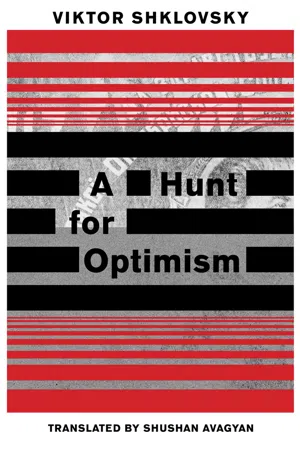
Begun in 1929 under the title "New Prose" and drastically revised after Vladimir Mayakovsky's sudden death, A Hunt for Optimism (1931) circles obsessively around a single scene of interrogation in which a writer is subjected to a show trial for his unorthodoxy. Using multiple perspectives, fragments, and aphorisms, and bearing the vulnerability of both the Russian Jewry and the anti-Bolshevik intelligentsia—who had unwittingly become the "enemies of the people" Hunt satirizes Soviet censorship and the ineptitude of Soviet leaders with acerbic panache. Despite criticism at the time that it lacked unity and was too "variegated" to be called a purely "Shklovskian book, " Hunt is stylistically unpredictable, experimentally bold, and unapologetically ironic—making it one of the finest books in Shklovsky's body of work.
- 160 pages
- English
- ePUB (mobile friendly)
- Available on iOS & Android
eBook - ePub
A Hunt for Optimism
About this book
Information
Topic
LetteraturaSubtopic
Critica letterariaPART ONE
Titled “Everything as it Should Be,” with an Epigraph
I haven’t thought of you for so long, my dear, that I don’t even miss you.
— From a personal letter
THE REGISTRY OFFICE
Are you here for a funeral?
To register your marriage? And he never showed up? Could he be late? Does he work?
It’s funny how marriages and funerals are registered at the same desk.
Look, even the signs are identical.
You aren’t very talkative.
I’m not here for a funeral either — I’m here for a divorce.
Life has become unbearable.
You are a complete stranger to me and you won’t even answer, but I will tell you.
Look, another couple is getting registered.
I had a husband, I called him Serenky. He was short, with gray hair on his temples. Such a gentle, caring man. See my lilac stockings? He’s the one who picked them for me to match the color of my shoes.
And these are aquamarines — they are my grandmother’s. They match the color of my eyes. Even my blouse matches. Isn’t it pretty?
Listen, your man might never show up. Aren’t the aquamarines pretty?
There, now you are smiling.
My Serenky is plain. We have a nice room in a large building. With a stone hallway that’s noisy. But the room is nice. We have a few neighbors whom we hardly ever see. And nobody knows who comes and who goes.
But I’m here to get a divorce.
Whom am I waiting for?
Not him, of course. I am just waiting.
We have a nice room, but there are no curtains on the window, so you wake up early in the morning. You can’t buy everything. See my stockings? I have only two pairs of these. The rest are Soviet-made.
And then he left. They are crying again at the desk. He left. To the Urals. On a business trip. It’s close to Siberia. I missed him very much. You sleep alone, the car lights flicker through the window at night. And you can’t get enough sleep in the morning — the sun, you know, rises like clockwork. I have a friend, Verochka. She has very thin eyebrows. They are very pretty.
She shaves them.
And her legs are pretty too, though a little fat. She is an attractive woman. We are always together.
She even gave me a ribbon — it’s so beautiful, you know, old and embroidered. It’s lilac, to match my color.
You shouldn’t worry. He might still show up. You probably came early anyway.
And who gets married on a lunch break!?
So he left. I missed him a lot. Though it’s worthwhile — the allowance is one twenty-eighth of his salary. Still, you can’t buy curtains with that money.
I missed him a lot. He is plain, but he’s so elegant, accurate, and caring.
Then I met a man from Latvia. It turned out that he was German. I don’t speak Latvian either. He wore a wooly coat. Not like the ones they wear around here. A long striped scarf. And a suede vest. Very handsome. He used to take me to the cinema. He didn’t care for theater, he didn’t understand.
We strolled through the streets. Window-shopped. His Russian was very bad.
Well, yes, we kissed. He would take me around in a cab. And all men kiss in cabs. I don’t know why. He was very attentive, generous, and he kissed differently, not like Serenky. And you know, it was rather unpleasant.
I had a coat like everyone else. It was yellow. Didn’t match at all. And I was cold in it.
He was very fond of me. Once, as we were strolling, we saw a moleskin manteau on the corner of Dmitrovka and Stoleshnikov. It was exquisite!
They didn’t spare anything — simply extravagant!
Made from carefully selected pelts.
Pale blue-gray.
If you wore it with the aquamarines . . . Don’t mind my crying.
It’s all right to cry here. They’ll think it’s a funeral.
I’m crying so much I’m even cold.
Look at those infants on the posters — they are horrifying!
Is that from syphilis?
No, no. He didn’t infect me. He was very careful. So we bought the manteau in the spring. It was so light. The fur didn’t make a sound. It was exceptional. And your posture completely changes with it.
He didn’t really want to buy it, you see. But I was kissing him so tenderly.
Then he left. He was in a hurry. Afraid of being late. We couldn’t find a cab. He left in two carriages and laughed that he had to ride sitting atop his suitcases.
Meanwhile my husband was sending telegrams from the Urals. I would always get overjoyed and cried. It’s easier when there is a telegram — you know that he’s there.
I didn’t see off the German. He was in a hurry and there was no room in the carriages: two carriages with suitcases and him on top — he looked so funny.
My husband sent a telegram: “I’m coming back. Kisses.” I was very happy and anxious at the same time. What about the manteau?
There are no curtains on my window. I got up so early in the morning that even the sun wasn’t up yet. I went to the pawnshop. The line was very long and everyone was pawning things because it was spring. I stood in line for hours. I was worn out.
They take everything so quickly at the cash register and give the same amount for every item, without a difference. Not more than twenty-five rubles. And they took it away.
I shouted: “Wrap it with something at least!”
They gave me a receipt instead and asked me to hurry up.
My husband came home. He was very affectionate. Didn’t bring back any butter with him. Said they didn’t let it through. He had saved very little money. Everything was expensive in the Urals.
I was afraid the whole night that I would kiss him the wrong way, that he would find out.
Then he fell asleep. I looked at his hair and thought, “Serenky, Serenky,” and I felt sorry for him. I still loved him very much.
Two days went by.
It was his payday. I came home and said: “Misha, I found a pawn receipt in the street, it’s for twenty-five rubles. You have money, buy it back and we’ll count it as your gift to me. But it’s hard to tell what’s written on it.”
I gave him the receipt. That day was full of happy events. Verochka called: “I’m back from my mother’s.”
How that woman cries!
What’s wrong with her? Oh, yes, somebody must have died. Probably her child.
Misha came home from work. I asked him: “Did you buy it back, Serenky?”
“No,” he said, “I forgot.”
I waited another day. He had a day off. Then he brought home a wrapped package. I opened it and saw a plain coat from the Moscow garment factory. It’s worth a hundred and forty-five rubles with the fur — I’m wearing it now.
Misha got excited: “How fortunate, look, it’s your size!” I didn’t know what to say. So I said: “My head is spinning, Misha.”
Then the doorbell rang. It was Verochka. She looked very happy — and on her was my moleskin manteau . . .
Is he here? Are you leaving?
Oh, that’s not him. I’m almost done with my story. I cried terribly. He was with her the whole time. Thought I wouldn’t find out. So I’m here for a divorce. I can’t. He’s worse. He didn’t think about me, he stole from me.
. . . No, I don’t know your future wife.
How she waited for you!
No, I’m not here for a funeral.
I’m going home now. I wish you happiness.
A SIMPLE LIFE
I
Life is simple but we like to make it complicated. I recall the following incident.
There was a woman sculptor who lived in an attic room in Berlin. Attic rooms in Berlin are cheap, but they are freezing cold. The windows face almost directly into the sky, while the glass isn’t properly fitted to its frame. The iron stove smells of intense heat, short-lived comfort. The clay cools in the vats.
It’s difficult to live in Berlin. The gray asphalt streets are clean. In the summer, they are filled with the scent of vanilla from flowers that bloom in clean flowerbeds. The house façades look like interior walls, and the sky — I’m starting to remember now — is uninviting and foreign, it’s very urban, organized, and it’s not even a sky, but a spotless blue lid over the gray walls of houses that extend toward it.
They asked civil engineers at a conference: Will the person who sweeps streets get the same salary as the chief engineer in a socialist state?
It’s easier now to imagine socialism in Russia than the idea that streets are going to be cleaned by machines.
A quiet battery-powered car with rubber brushes cleaned the street in front of Ksana’s house. The car cleaned and polished the street until it shined. At night the street froze in the reflection of illuminated buildings.
The attic room was lit by a gas lamp. The clay was cooling in the vat. And the stove occasionally hummed.
The woman was beautiful and she didn’t love anyone.
She sculpted and applied wet clay on the badly connected rusty armature.
Art is difficult.
The sculpture stood wrapped in heavy rags. The rags would dry slowly and turn gray. At first they would look like carved draperies, then they would turn completely gray. She had to wet them again. The metal frame was bending with great difficulty.
The woman was beautiful and she had many suitors. They...
Table of contents
- Cover
- Title Page
- CONTENTS
- TRANSLATOR’S PREFACE
- ON ARCHITECTURE
- PART ONE: Titled “Everything as it Should Be,” with an Epigraph
- PART TWO: Which Is of No Particular Importance
- PART THREE: The Middle of the Book or Thereabouts
- PART FOUR: Titled “The Trumpet of the Martians”
- PART FIVE: The End of A Hunt for Optimism
- JUST A FEW LAST WORDS — FROM MYSELF
- Copyright
- About the Author
- OTHER WORKS BY VIKTOR SHKLOVSKY IN ENGLISH TRANSLATION
Trusted by 375,005 students
Access to over 1.5 million titles for a fair monthly price.
Study more efficiently using our study tools.
Frequently asked questions
Yes, you can cancel anytime from the Subscription tab in your account settings on the Perlego website. Your subscription will stay active until the end of your current billing period. Learn how to cancel your subscription
No, books cannot be downloaded as external files, such as PDFs, for use outside of Perlego. However, you can download books within the Perlego app for offline reading on mobile or tablet. Learn how to download books offline
Perlego offers two plans: Essential and Complete
- Essential is ideal for learners and professionals who enjoy exploring a wide range of subjects. Access the Essential Library with 800,000+ trusted titles and best-sellers across business, personal growth, and the humanities. Includes unlimited reading time and Standard Read Aloud voice.
- Complete: Perfect for advanced learners and researchers needing full, unrestricted access. Unlock 1.5M+ books across hundreds of subjects, including academic and specialized titles. The Complete Plan also includes advanced features like Premium Read Aloud and Research Assistant.
We are an online textbook subscription service, where you can get access to an entire online library for less than the price of a single book per month. With over 1.5 million books across 990+ topics, we’ve got you covered! Learn about our mission
Look out for the read-aloud symbol on your next book to see if you can listen to it. The read-aloud tool reads text aloud for you, highlighting the text as it is being read. You can pause it, speed it up and slow it down. Learn more about Read Aloud
Yes! You can use the Perlego app on both iOS and Android devices to read anytime, anywhere — even offline. Perfect for commutes or when you’re on the go.
Please note we cannot support devices running on iOS 13 and Android 7 or earlier. Learn more about using the app
Please note we cannot support devices running on iOS 13 and Android 7 or earlier. Learn more about using the app
Yes, you can access A Hunt for Optimism by Viktor Shklovsky, Shushan Avagyan in PDF and/or ePUB format, as well as other popular books in Letteratura & Critica letteraria. We have over 1.5 million books available in our catalogue for you to explore.