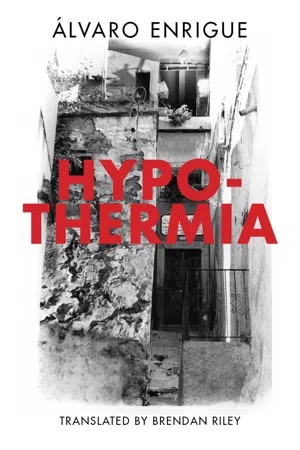
Shocking, erudite, and affecting, these twenty-odd short stories, "micro-novels, " and vignettes span a vast territory, from Mexico City to Washington, D.C. to the late nineteenth-century Adriatic to the blood-soaked foothills of California's gold-rush country, introducing an array of bewildering characters: a professor of Latin American literature who survives a tornado and, possibly, an orgy; an electrician confronting the hardest wiring job of his career; a hapless garbage man who dreams of life as a pirate; and a prodigiously talented Polish baritone waging musical war against his church. Hypothermia explores the perilous limits of love, language, and personality, the brutal gravity of cultural misunderstandings, and the coldly smirking will to self-destruction hiding within our irredeemably carnal lives.
- 183 pages
- English
- ePUB (mobile friendly)
- Available on iOS & Android
eBook - ePub
Hypothermia
About this book
Information
Two Waltzes Toward Civilization
After this we’ll know how to eat against death, to
devour only dead things, cooking to kill them again.
We’ll know that feeding means dealing with other
bodies, that desire makes us itch, and it only finds
relief in order to get worse, that to love is to devour.
devour only dead things, cooking to kill them again.
We’ll know that feeding means dealing with other
bodies, that desire makes us itch, and it only finds
relief in order to get worse, that to love is to devour.
ANTONIO JOSÉ PONTE
ESCAPE FROM SUICIDE CITY
I leave the Soul behind; bearing onward,
my pilgrim body, deserted and alone.
my pilgrim body, deserted and alone.
QUEVEDO
I
Mr. Hinojosa was waiting for me outside the Lima airport in the sinister black Mercedes Benz the Swiss television producer had rented to pick up the guests for Lard, the highly successful European TV cooking show that had been a minor cable hit in the United States and Canada.
Although I’d heard some of my colleagues express their admiration, and even reverence, for the program, I never watched it because I don’t own a TV. My own gastronomic principles require me to live in total retreat from the world; I don’t believe that one can recreate seventeenth-century Mexican conventual cooking unless one exists in harmony with the ways of life that gave rise to it.
This vision that I’ve nurtured my entire life was by no means easy to make a reality, especially because my restaurant is located in Washington, D.C., the world’s most shameless city, with its ten-foot-wide sidewalks, its streets the size of soccer fields, and its monuments standing as an architectural prelude to national obesity. Nevertheless, it was here that I found a financier to invest in my talents, and I do what I can to recreate those customs and conditions. Both my sesame honey glazed squid, and my chilpachole verde—a spicy green crab soup—have earned me some slight recognition in the pages of the local food section.
The concept behind Lard is that six young, promising chefs compete to eliminate each other by passing a series of trials putting to the test their charisma, manners, and hygiene, as well as their ability to improvise with unusual ingredients. The producers film the whole competition—in itself, quite boring—then jazz it up in editing. Each episode takes place in a different location and is judged by a different celebrity from the world of international gastronomy. The broadcast I was invited to was filmed in Lima because the theme was “Latin American Seafood Cuisine” and Max Terapia was the guest star.
Like all chefs of my generation, I admire and envy Terapia, although I realize that I’m never going to achieve his level of celebrity: when his star began to rise, in the ’60s, Latin American cuisine enjoyed no international cachet, while European cuisine was still trapped in the excessive experimentation that characterized that decade. So, thanks to his creations, as fine and transparent as a razor blade, he scooped up all the prizes and honors without any competition. They called him the master of gastronomy povera, an authentic revolutionary in an eminently bourgeois art. These days he’s based in Miami, where he owns a restaurant catering to an exclusive clientele and which is only open during the cooler months of the year. The place has neither a name nor a front door; you enter by car, through a rolling metal shutter at the rear of the building. Terapia spends the rest of his time as a guest chef at important, high-level culinary events, and at his nineteenth-century house in the center of Lima, which is said to have, and which I confirmed, its original kitchen intact, with a stove that burns charcoal and guano, a cool room, and a hand-powered water pump. A kitchen, it must be said, on account of which I’m almost dying with envy. All my silent partner would pay to have installed in my own place was a bread oven and a wood-fired grill; he told me to buckle down, get busy, and use them to make something wonderful, which I’ve never stopped trying to do since Teresa left me years ago, and I turned my back on the world.
The Swiss, it seems, are naturally mysterious. One day, an enormous glossy envelope arrived at my office. Inside it was a signed letter from some enigmatic Secretariat, informing me that I’d been nominated to compete in Lard. I answered them the very same day, that I was quite honored to receive their invitation but that I had no idea what Lard was—of course I knew, but I wanted to keep them on their toes—and could they do me the favor of explaining things to me. I said that I’d be grateful if they could tell me who’d nominated me so that I could thank them: as far as I know, the only people who eat at my restaurant are Adams Morgan residents and a few Mexican diplomats and professors who tend to be excessively nostalgic—as if the food that I make really has something in common with the country that we were all so happy to escape from.
The same, mysterious Secretariat answered with another extremely pompous letter, along with a promotional flyer for the program, informing me that under no circumstances could they reveal the identity of their advisory committee. In the coming weeks a new panel of connoisseurs would visit my restaurant—they would make the final decision about who would and who wouldn’t take part in Lard.
Again I requested more precise information, to be sure that we would treat the visiting committee well when it showed up. They replied by saying that the anonymity of the visit was sacrosanct. I felt humiliated, and in one of those crazy, headstrong moments that make us lose World Cup games we’ve already won by committing fouls, I demanded that they at least tell me who my competition would be. Another giant envelope from the Secretariat, another refusal.
I’ve lost too many contests—including one that was rigged in my favor—for the likelihood of my being judged to keep me awake at night. Even so, I was on the alert for several weeks, awaiting the arrival at my restaurant of a contingent of Swiss gentlemen—tall, balding, red-faced, and wearing thick eyeglasses. In the fantasies produced by my abominably boring and friendless life, in an apartment without a TV, that’s precisely how the Swiss appear.
Nobody who looked even remotely like that ever sat down at our tables, so I supposed that they’d forgotten about me, or that the Swiss might have snuck in in the guise of gringo students or Mexican office clerks. One of my waiters—a Colombian know-it-all—told me that the Swiss were Calvinists, and that’s how we’d be able to recognize them. I asked him what a Calvinist would look like. He told me that they’re very strict, practically vegetarians, and that they’ve got no lips. I took note.
At last a woman with a neutral French accent phoned to let me know that my masterful red snapper in fig vinaigrette had earned me the privilege of competing on Lard. She didn’t speak Spanish but she understood my English, and she was polite, friendly, and obviously very young. It had never occurred to me that there were also Swiss women, much less ones that were young. She was quite insistent that it was the fine quality of my cooking that had won me the honor of participating, that I should be proud and list it as such on my résumé, for which reason I supposed my restaurant to be lacking in hygiene and me in charisma. I asked her if she was from the Secretariat. She didn’t understand and again recommended that I include my status as a finalist on my résumé.
Once in Lima, Mr. Hinojosa was equally unable to set me straight. The moment I got in his Mercedes I asked him about the people who had hired him. He said that he had no information to give me. He worked for a security agency and all they told him was what to do—he’d spent the whole day delivering foreigners to a hotel in Miraflores. I spoke vaguely about how Mexican chauffeurs made more money from tips than from their nominal wages, then after a pause asked him if he wasn’t authorized to give me that information or if he really didn’t know. Although I’ve lived in the United States for several years, I know perfectly well how to overcome the resistance of my fellow Latin Americans. He told me that if he knew he would tell me because he liked me. Sure, I answered him. Are you attending a conference? he asked me after a while. I was riding along staring distractedly out the window—I’m from Mexico City but still managed to be astonished by the ugliness of Lima, which even surpassed its reputation. No, I told him, with my eyes fixed on the horrific casinos that lined the avenue down which we traveled, we’re here for a dinner, and then a kind of competition.
The program that they’d sent me once I became a finalist wasn’t very clear, at least not to me, and if there’s something I know nothing about, it’s how the media works: the first day was for individual p...
Table of contents
- Cover
- Title
- Contents
- Dumbo’s Feather
- Scenes from Family Life
- Saving Face
- Filth
- Grand Finales
- Two Waltzes Toward Civilization
- Copyright
Trusted by 375,005 students
Access to over 1.5 million titles for a fair monthly price.
Study more efficiently using our study tools.
Frequently asked questions
Yes, you can cancel anytime from the Subscription tab in your account settings on the Perlego website. Your subscription will stay active until the end of your current billing period. Learn how to cancel your subscription
No, books cannot be downloaded as external files, such as PDFs, for use outside of Perlego. However, you can download books within the Perlego app for offline reading on mobile or tablet. Learn how to download books offline
Perlego offers two plans: Essential and Complete
- Essential is ideal for learners and professionals who enjoy exploring a wide range of subjects. Access the Essential Library with 800,000+ trusted titles and best-sellers across business, personal growth, and the humanities. Includes unlimited reading time and Standard Read Aloud voice.
- Complete: Perfect for advanced learners and researchers needing full, unrestricted access. Unlock 1.5M+ books across hundreds of subjects, including academic and specialized titles. The Complete Plan also includes advanced features like Premium Read Aloud and Research Assistant.
We are an online textbook subscription service, where you can get access to an entire online library for less than the price of a single book per month. With over 1.5 million books across 990+ topics, we’ve got you covered! Learn about our mission
Look out for the read-aloud symbol on your next book to see if you can listen to it. The read-aloud tool reads text aloud for you, highlighting the text as it is being read. You can pause it, speed it up and slow it down. Learn more about Read Aloud
Yes! You can use the Perlego app on both iOS and Android devices to read anytime, anywhere — even offline. Perfect for commutes or when you’re on the go.
Please note we cannot support devices running on iOS 13 and Android 7 or earlier. Learn more about using the app
Please note we cannot support devices running on iOS 13 and Android 7 or earlier. Learn more about using the app
Yes, you can access Hypothermia by Alvaro Enrigue, Brendan Riley in PDF and/or ePUB format, as well as other popular books in Literature & Literature General. We have over 1.5 million books available in our catalogue for you to explore.