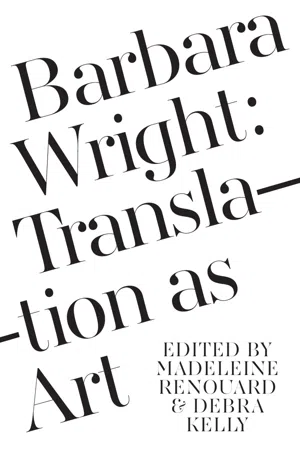
Legendary publisher and writer John Calder said of Barbara Wright that she was "the most brilliant, conscientious and original translator of 20th century French literature." Wright introduced to an English-speaking readership and audience some of the most innovative French literature of the last hundred years: a world without Alfred Jarry's Ubu, Raymond Queneau's Zazie, and Robert Pinget's Monsieur Songe scarcely bears thinking about. This wonderful collection of texts about and by Barbara Wright—including work by David Bellos, Breon Mitchell, and Nick Wadley, as well as a previously unpublished screenplay written and translated by Wright in collaboration with Robert Pinget—begins the work of properly commemorating a figure toward whom all of English letters owes an unpayable debt.
eBook - ePub
Barbara Wright
Translation as Art
- 400 pages
- English
- ePUB (mobile friendly)
- Available on iOS & Android
eBook - ePub
About this book
Information
Portraits
Barbara, a portrait sketch
Nick Wadley
As I write, I have in front of me two photographs of Barbara Wright. In the first (in the rarefied world of the Collège de ’Pataphysique) she sits between Arrabal and Baudrillard, on the occasion of her elevation to the rank of Satrape. In the second (in our house in Belsize Park) she is face-to-face with her lifelong friend, Stanley Chapman. In the first she smiles, almost shyly. In the second her expression is uncompromising, as if waiting—neither particularly patiently nor with much concern—for something that may or may not deserve her attention.
These extremes form an autograph pair of parentheses to contain the range of images and thoughts of Barbara, from the self-deprecating to the acerbic, that I carry around in my head. I nearly wrote “in my memory”, but they feel less like memories than resident traces of Barbara, parts of the mental fabric which from time to time appear centre-stage without having to be called. She still echoes around, either sharing some thoughts with me (not least about stupidities of the world and its words), or as a yardstick by which to measure others.
I have read again through all the surviving letters, cards and—latterly—e-mails that she wrote. Her range of signatures, from Barbara to B—via Babar, Bar, Barab, la barbe, and “la barbare (would-be)”—is touched by the light mockery with which she viewed the world and her place within it. One might gather from it, too, the lightness with which she wore successive literary prizes and exotic designations (from Commandeur to Satrape) by which her art of translation was celebrated. One convalescent letter of 2002 is signed “Rorschach blot”.
It’s easy to guess from this that she would identify readily with the gravity of aspiration and levity of means whose blend formed the signature of the Gaberbocchus Press, founded by Stefan and Franciszka Themerson in 1948. Barbara became a key player in the enterprise from the late 1940s into the early 60s. It was there that she learned to translate. Few of her trade can have cut their teeth on such works as Jarry’s Ubu Roi (1951) and Queneau’s Exercices de Style (1958). By the time of this latter book, she was already into the fluent breadth of her mature working style. Jarry hadn’t survived to enjoy her, but Queneau’s appreciation developed into friendship and the sort of close working relationship that she was to establish with many of her authors. It was a means of getting inside the work she was translating, and a formative source for her own hierarchy of values. Reviewing her translation of Queneau’s Pierrot Mon Ami (1987), Updike wrote that she “has waltzed around the floor with the Master so many times by now that she follows his quirky French as if the steps were in English”.
Barbara had a good line in quirky English—both in her oral delivery, broken as it was into a stream of breathless phrases and punctuated by percussive noises, and in the conversational dialect of her letters. Her affection for the colloquial—a key attribute in her armoury as translator—permeated it all. Her correspondence is littered with phrases from popular song lyrics, the Liverpool poets, puns and jingles from the radio; and she used an archaic childish slang that I had grown up with during the war, and which [natch] established common ground between us. She extemporized constantly—ekcetra, ridickerless, probly, hideosity, self-ecstasing. She looked things up in the diksh and posted them in an ombelope. We started openly to share such tastes and cultural flaws through her enthusiastic patronage of and the enjoyment she took in my silly drawings, mostly pictorial/verbal puns, that I started making into postcards in the 1990s. (Some that I made with Sylvia Libedinsky were published then, as weekly cartoons in the Daily Telegraph and later in the Financial Times) A cartoon-like language was familiar territory to Barbara, and it was second nature to her to celebrate the silly and the absurd. Her generous eulogies, full of percussive adjectives like époustoufflant, were almost without reservation. She ordered and re-ordered a dozen cards at a time of many images, and commissioned from me a letterhead and, every year, a personal Christmas card (usually 100 copies), complaining only about the inertia of my phynance department. She distributed the postcards to friends worldwide and designed her own letterhead for the office of Direcktor of the Number One NW Post-Card Consumer Research Consultancy, always finding bouquets to report or award, for lampoons that she endorsed or for qualities she valued in the pictures—from their authentic expressions to their moral attitude. The eye of this beholder was an open-handed, all-seeing phenomenon.
Only occasionally did she offer any criticism of the drawings. Once she asked if two polar bears couldn’t smile a bit (but later wrote to the bears personally, apologizing). One pun was just a little too owchish; one Ubu “looks too much like a hell’s angel”; and generally, there weren’t enough women being mocked. Another time she was “only too happy to join you in taking the piss out of intellectuals, but couldn’t you do the same to academics?” Once or twice she edited a caption (“do you welcome or despise pedants?”). And then, in 2005, there was a more serious moment when she confessed that “Nick cards don’t seem to be silly any more. Their wit had a silliness that got my wavelengths flowing. The recent batch seems to be more metaphysical, more serious, even sad. Which seems to me totally and utterly reasonable.”7
The immediate context was probably a long series of pictures I was drawing about doctors and hospitals. In fact, subjects related to that world—waiting rooms, consultants, aches, medication, side effects—had long since become another world shared between us. In another letter of the same month she signed off saying “yes, melancholy is around. All we have to do is kick it in the pants.” In 2002 she had commissioned me to make a drawing of her pace-maker (Percy), an image which she then distributed to all her doctors and surgeons, of course. And a few years later she asked for a picture of herself as a lame snail, which when received was welcomed as “the best portrait I’ve ever had. Could I have six of them please—no! call it ten.”
I think her very favourite drawing, one she often went back to over the years, was “status crow”, a typically painful pun, which she celebrated as a stand against the hypocrisy and inhumanity of hierarchies, a very Barbara-like cause to champion. From things she wrote, it was obvious that she plagued her correspondents with explanatory notes on its multi-nuanced expression (she told me how Sarraute would have loved it, and regretted she wasn’t around to see it).
Transitions from light relief into more serious matters weren’t uncommon in her letters, and conversations. Many of the serious matters were complaints—against medicines or ailments and against the technology of blankety-blank word-processors, in equal measure. She condemned snobbery of any sort, especially the intellectual variety. She railed against clichés, bossiness, verbosity, inaccuracies of language and Americanizations. I was her last literate English friend, she said, who used hallo not hello. She felt the same about “like” used for “as if”, and was delighted with an American equivalent of Fowler that agreed with her. She was a mentor for me, as for many of her friends and working associates, in the fields of language, its usage and its translation, always there to advise with a word or phrase, and enormously missed, for that too, since she isn’t on the end of a phone any more. By the end of her life her tastes were resolute. Shortly before she died, I remember how, reading Proust the second time around, she felt relief that awe had dissolved (“he does go on and on and ON”). Around the same time she commended Ivy Compton Burnett to me, unreservedly—rather shocked I hadn’t read any. Her colourful tastes in paperback fiction are common knowledge.
To return to my opening comparison, Barbara, for a star in so many private firmaments, could appear surprisingly self-deprecating. I recall, for instance, being surprised when she twice solicited company to a TLS event, which might otherwise daunt her into not going, and when she expressed self-doubt about holding her own in company elsewhere. I can see more clearly since she’s not here that these were less manifestations of self-doubt than a reluctance to spend time and energy dealing with some of the pretensions a...
Table of contents
- Cover
- Title
- Contents
- Acknowledgments
- Introduction
- Portraits
- Bibliography: Barbara Wright’s principal translations
- Index
- Copyright
Trusted by 375,005 students
Access to over 1.5 million titles for a fair monthly price.
Study more efficiently using our study tools.
Frequently asked questions
Yes, you can cancel anytime from the Subscription tab in your account settings on the Perlego website. Your subscription will stay active until the end of your current billing period. Learn how to cancel your subscription
No, books cannot be downloaded as external files, such as PDFs, for use outside of Perlego. However, you can download books within the Perlego app for offline reading on mobile or tablet. Learn how to download books offline
Perlego offers two plans: Essential and Complete
- Essential is ideal for learners and professionals who enjoy exploring a wide range of subjects. Access the Essential Library with 800,000+ trusted titles and best-sellers across business, personal growth, and the humanities. Includes unlimited reading time and Standard Read Aloud voice.
- Complete: Perfect for advanced learners and researchers needing full, unrestricted access. Unlock 1.5M+ books across hundreds of subjects, including academic and specialized titles. The Complete Plan also includes advanced features like Premium Read Aloud and Research Assistant.
We are an online textbook subscription service, where you can get access to an entire online library for less than the price of a single book per month. With over 1.5 million books across 990+ topics, we’ve got you covered! Learn about our mission
Look out for the read-aloud symbol on your next book to see if you can listen to it. The read-aloud tool reads text aloud for you, highlighting the text as it is being read. You can pause it, speed it up and slow it down. Learn more about Read Aloud
Yes! You can use the Perlego app on both iOS and Android devices to read anytime, anywhere — even offline. Perfect for commutes or when you’re on the go.
Please note we cannot support devices running on iOS 13 and Android 7 or earlier. Learn more about using the app
Please note we cannot support devices running on iOS 13 and Android 7 or earlier. Learn more about using the app
Yes, you can access Barbara Wright by Debra Kelly, Madeleine Renouard, Debra Kelly,Madeleine Renouard in PDF and/or ePUB format, as well as other popular books in Literature & Literary Criticism. We have over 1.5 million books available in our catalogue for you to explore.