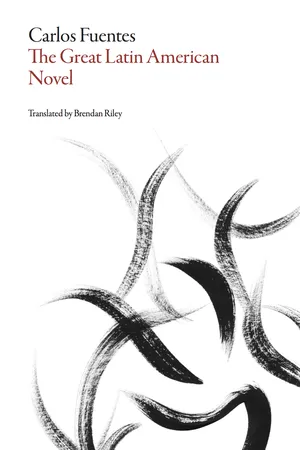
One of the late Carlos Fuentes's final projects, this compendium of his criticism traces the evolution of the Latin American novel from the discovery of America to the present day. Combining historical perspective with personal and often opinionated interpretation, Fuentes gives us a tour from Machado de Assis to Borges and beyond. A landmark analysis, as well as a scintillating and often wry commentary on a great author's peers and influences, this book is as much a contribution to Latin American literature as it is a chronicle of that literature's greatest achievements.
- English
- ePUB (mobile friendly)
- Available on iOS & Android
eBook - ePub
The Great Latin American Novel
About this book
Information
Topic
LiteraturaSubtopic
Colecciones literarias1. Pre-Iberian Foreword
One of the great thinkers of our time, the Mexican comedian Mario Moreno, better known as Cantinflas, once silenced a man with whom he was arguing with this rejoinder: “Alright, enough already; the problem here is obviously your lack of ignorance!”
Cantinflas was a master of the paradox, and his comical retort contains a profound truth. Our world conceals an unwritten culture, one expressed through memory, oral transmission, and the cultivation of tradition. In order to understand it—as Cantinflas rightly believed—one needs a touch of ignorance.
In the early twentieth century, upon concluding his study of Andalusian peasants, the Spanish philosopher José Ortega y Gasset exclaimed: “These illiterate folks are actually quite cultured!” The same sort of thing might be said today about many groups of peasants and indigenous peoples in Indo-Afro-Hispanic America: Despite their illiteracy, these people are incredibly cultured!
Cantinflas was praising an “ignorance” which is perhaps synonymous with traditional, ancestral, unwritten “wisdom.” What is “ignorant” for us is actually, in these oral, retentive, unrecorded cultures, “wise,” and we are the ones ignorant of it.
I say this in order to establish from the outset the idea that proximity and access to words and speech is neither exclusive nor restrictive. Language is, at times, like a great flowing river, at other times barely a stream, but always the master of its channel, which is orality: “Do you remember?,” “Good morning,” “I love you so much,” “What’s for dinner?,” “See you tomorrow.” This whole profuse current of orality runs between two shores: memory and imagination. He who remembers, imagines. He who imagines, remembers. Language, oral or written, forms the bridge between these two shores.
I would like to consider literature in the broadest possible terms: when not being hounded and banned by political tyrannies, it is all too frequently limited and impoverished by ideological restrictions.
The various literatures of the American continent begin (and are kept alive) in the epic, ancestral, and mythic memory of its indigenous peoples. America—the name that signifies the contiguous continental geography from Canada to Tierra del Fuego: North America, Central America, and South America all together—was once uninhabited. Then, descending from Asiatic or Polynesian origins, our indigenous population emerged and spoke the first words heard in this hemisphere. The Mayan Popol Vuh of the K’iche’ kingdom recalled the creation of the world, while the Chilam Balam foretold its destruction. In the ages between origin and apocalypse the indigenous world resounded with beautiful songs of love and instruction as well as bellicose tones of combat and bloodshed.
These words have been perpetuated through the centuries in oral tradition, from the Pueblo Indians of the North to the Mapuche of the South. Their rhythm, their memory, and perhaps their melancholy, underlie the Spanish-language literature of America, a written literature which stands in contrast to the orality prevalent in these societies before Columbus and Vespucci.
José Luis Martínez explored the multiplicity of American cultures and languages, as well as the themes that were central to them prior to the arrival of the Europeans. He began with Alaska: Eskimos and their deep lore about the creation of the Earth and the stars, and their early, urgent questions about life and death. The Kutenai of Canada with their songs to the Sun and the Moon. The Nez Percé of Oregon and the Pawnee of Nebraska and Kansas, religions of ghostly marriages and prodigal sons. The Natchez of Louisiana and the creation of the world. The Navajo of Arizona and the tension between nomadic rootlessness and domestic rootedness. And the Cora people of Nayarit, in the place we now call Mexico, who reconfigured the rituals of Holy Week and the figure of Christ brought by the Spanish, according to their own understanding and imagination, into celebrations about the creation of the world and the Creator who existed even before the world itself. The Tarascan of Michoacán and the death of the different indigenous peoples. The Mixtec of Oaxaca and the origin of the world, a constant preoccupation of these peoples who lived so much closer to the origin of things: the Cuna of Panama remembering how man learned to cry; and in South America, the Chocó of Colombia and their memory of the universal flood; the Chachi and their legends of the dream; the Sápara people of Brazil and how they spoke with the animals of the jungle. Also in Brazil, the love and dancing of the Ñangatú. The Chilean Mapuche and the rebellion of the children of God. The Guarani of Paraguay and their memory of the first father. All of these peoples alongside the great leading cultures: the Toltecs and the Nahuatl in Central Mexico. The Olmecs, the original peoples of the Gulf Coast, who were, for a time, misclassified in the Veracruz Museum of Anthropology. The Maya in the Yucatan, and the Quechua in both Peru and the Central Altiplano of South America.
Orality and corporality, architecture and music: Enrique Florescano tells us that these ancient peoples employed these arts as a way to express their culture, preserve it, and hand it down through the ages. And if these artifacts and remnants have survived to reach us today, it is because these peoples intuited the hereditary and survivalist power of language, body, and perception.
In Mexico, out of a total population of more than one hundred twenty million inhabitants, some sixteen million are indigenous. While they are increasingly educated within the general mestizo current, the majority of them retain their original languages, which number over forty, as different from one another as Swedish is from Italian.
To travel to the lands of the Huichol people in Jalisco, or the Tarahumara in Chihuahua, the Nahuatl in Central Mexico, the Zapotecs in Oaxaca, or the Maya in the Yucatan is to discover that, even when they are illiterate, indigenous people are far from ignorant, and even when they are poor, they are not culturally impoverished. They possess an extraordinary talent for remembering or imagining dreams and nightmares, cosmic catastrophes and dazzling rebirths, as well as the minute details of daily life, a child’s first words, the stupid jokes of the village idiot, the faithful family dog, favorite foods, the passing of their grandparents.
Fernando Benítez, the great chronicler of Mexico’s indigenous peoples, once said that, when one person from a traditional culture dies, a whole library dies with him. And it is a fact that for a defeated people who had to become invisible in order to remain unnoticed, orality is safer than literality. To move from centuries of invisibility and orality to modern visibility and literality is a gigantic step, and a difficult one, for the indigenous cultures of the Americas. The sporadic rebellions its peoples have mounted from time to time must someday give way to a dignified, permanent, and mutually enriching relationship for all the people of the Americas, old and new.
From the first Chiapas rebellion in 1712, sparked by the miraculous vision of the young María Candelaria, to the most recent uprising in Chiapas in 1994, sparked by the equally miraculous vision that Mexico was now a first world nation, it seems interesting to note the presence—as well as the vision—of creole or mestizo leaders, Sebastián Gómez de la Gracia in 1712, and Subcomandate Marcos in 1994. Whether or not they declared themselves to be leaders of the rebellions, they are the ones who gave them a public voice, and that voice, whether we like it or not, speaks Spanish.
Today, a movement to reclaim the great oral tradition of the indigenous peoples—the Nahuatl, Aymara, Guarani, and Mapuche—extends through the ancient aboriginal lands of the Americas. The universal voice of that movement, however, the voice that links its highly respectable demands to the greater social and political community of each country, is the Castilian voice. The Guarani of Paraguay and the Maya of the Yucatan might not understand each other in their aboriginal languages but I wager that they will both recognize each other in the common language: la castilla, Castilian, Spanish—the Esperanto of the Americas.
Even as the indigenous peoples of Latin America strive for individual recognition and cultural autonomy, modern Spanish is the language that the vast majority of them use to speak to one another, and to the non-hispanic world beyond their borders. Spanish is the lingua franca of the Indian world in the Americas. Through Maya or Quechua translated into Spanish, the natives of America let us, the inhabitants of the continent’s white and mestizo cities, understand what they desire, what they remember, what they reject. And what is our role but to listen, to pay attention, and to respect that part of our Indo-Euro-American community? It is our role to be invested in sharing the cultural wealth of the indigenous community, its ritual purity, its proximity to the sacred, its memory of what has been forgotten by urban amnesia. It is our role to respect the natives’ values, without condemning them to abandonment, and to protect them from injustice.
The indigenous people of America are a part of our polycultural and multiracial community. To forget them is to condemn ourselves to being forgotten. Justice for them should be inseparable from justice for ourselves. They are the common denominator of our shared future, and we will never truly be satisfied until we share the world equally with them.
But they, in the end a part of us, not all of us, must also accept the rules of a democratic coexistence, must not use tradition as a shield to perpetuate authoritarian abuses, offenses against women, ethnic rivalries, or the parallel response to white racism, which is racism against the white or mestizo. As a Mixtec Indian said to Benítez: “They want to kill me because I speak Spanish.”
¡Colón al paredón! “Columbus up against the wall!” This was the cry raised by a group of indigenous Mexicans gathered around the statue of the Genoese native in 1992. Fine, condemn Columbus to the firing squad—but even as the supporters of indigenous rights moved towards anti-imperialist extremism, they had to shout their demands in Spanish.
While I am certainly also concerned with the black population of America, theirs is a different history. Brought from Africa in slave ships, they surrendered their original languages and were obliged to learn those of the colonizer. My central theme in this study is fiction written in the Spanish—and sometimes Portuguese—language of the New World.
2. Discovery and Conquest
Between August 27 and September 2, 1520, at the Royal Palace in Brussels, Albrecht Dürer was the first European painter to view the works of Aztec art which the conquistador Hernán Cortés had sent to the Emperor Charles V. “I have seen the things which they have brought to the King out of the new lands of gold,” wrote Dürer, “and all the days of my life, I have seen nothing that reaches my heart so much as these, for among them I have seen wonderfully artistic things and have admired the subtle ingenuity of men in foreign lands.” If only the spirit of this great artist had been present in those who destroyed a large part of the pre-Columbian heritage of the Americas which they saw as the work of heathen devils.
America is both a fantasy and a nightmare, and it occupied the same dualistic role in the culture of Renaissance Europe. Which is to say: in America, Europe found lands in which to expend the excess energies of its Renaissance, a place that also allowed it to enact its vision of cleansing history and regenerating man.
THE INVENTION OF AMERICA
The Mexican historian Edmundo O’Gorman suggests that America was not discovered: it was invented. And it was invented, surely, because it was needed. In his book The Invention of America, O’Gorman speaks of a European man who was a prisoner of his own world. The medieval prison was built with the stones of geocentrism and scholasticism, two hierarchical visions of an archetypal universe, perfect, unchangeable although finite, because by the Middle Ages, the epicenter of European society was the ideology of the Fall of Man.
The vast natural environment of the New World confirms the Old World’s hunger for new space. Having lost the stable structures of the medieval order, European man feels diminished and displaced from his age-old central position. The Earth shrinks in size within the Copernican universe. Man’s passion—above all, his desires and ambitions—expand to compensate for this diminishment. Both upheavals are resolved by his desire to extend his dominion over the earth and other men: the New World is desired, the New World is invented, the New World is discovered; thus is it named.
In this way, all the dramas of Renaissance Europe come to be represented in the European colonization of America: the Machiavellian drama of power, the Erasmian drama of humanism, the utopian drama of Thomas More, as well as the drama of the new perception of the natural world. If Renaissance logic held that the natural world had finally been dominated and that man was truly the measure of all things, including nature, the New World was immediately shown to comprise a nature that is excessive, disproportionate, hyperbolic, and immeasurable. This would become a constant theme in Ibero-American culture, born from the first explorers’ sense of astonishment, and persisting in the explorations of a seemingly endless natural world in books such as Rebellion in the Backlands by Euclides da Cunha, Canaima by Rómulo Gallegos, The Lost Steps by Alejo Carpentier, The Devil to Pay in the Backlands by João Guimarães Rosa, and One Hundred Years of Solitude by Gabriel García Márquez. Significantly, this very same amazement and fear in the face of a natural world that exceeds the limits of human control, roars above King Lear and his “cold night” on the heath, when The Fool cries out, “It will turn us all to fools and madmen.”
The New World is discovered (pardon me: invented, imagined, desired, needed) in a moment of European crisis which is both confirmed by and reflected in the discovery. In Christianity, nature is proof of divine power. But it is also a temptation: it seduces us and pushes us away from our otherworldly destiny; nature tempts us to repeat the sin and pleasure of the Fall.
By contrast, the rebellious spirit of the Renaissance perceives nature as the reason for human existence. Nature is the living world celebrated by the inventors of Renaissance Humanism: the poet Petrarch, the philosopher Ficino, the painter Leonardo. The Renaissance is born, so to speak, when Petrarch casts in verse his memory of the precise day, the hour, the sublime season when, for the first time, he saw Laura—a woman of flesh and blood, not an allegory—cross the bridge over the Arno:
Blessed be the day and the month
and the year and the time and the season,
the time, the spot, the beautiful country and the place where I was reunited
with two lovely eyes, which have ensnared me …
(Sonnet XXIX)
In 1535, Gonzalo Fernández de Oviedo, the Spanish conquistador and governor of the fortress of Santo Domingo, wrote his Natural History of the Indies and rapidly confronted the problem that lies at the heart of the relations between the Old World and the New World. As told to us by his Italian biographer, Antonello Gerbi, Oviedo’s attitude toward the recently discovered lands belongs as much to the Christian world as to the Renaissance. It belongs to Christianity because Oviedo shows himself to be pessimistic about history. It belongs to the Renaissance because he shows himself to be optimistic about nature. In this way, if the world of men is absurd and sinful, nature is, itself, living evidence of God’s reason. Oviedo can sing the dithyramb to the new lands because they are lands without history, lands without time. They are atemporal utopias.
America becomes Europe’s Utopia. As Edmundo O’Gorman writes, it is a utopia invented by Europe but also a utopia desired by Europe and so, for that reason, a necessary utopia. But was it truly necessary?
The American utopia is a utopia projected in space, because, in the transition between the Middle Ages and the Renaissance, space is the vehicle for European imagination, desire, and necessity. The rupture in medieval unity is first manifested in space as the outer defenses of the walled cities crack, their drawbridges fall forever, and stumbling into the new, open cities—the cities of Don Juan and Faust, the city of La Celestina—come the epidemics of skepticism, individual pride, empirical science, and the crime against the Holy Spirit: usury. In come love and inspiration separate from God, embodied in Shakespeare’s Cleopatra and Cervantes’s Don Quixote.
More than time, modern history was defined by space because nothing distinguishes the old from the new with such crystal clarity as space. Columbus and Copernicus reveal a hunger for space which, in its appropriately Latin American version, ironically culminates in “The Aleph,” the famous modern story by Jorge Luis Borges. The Aleph is the space which contains all others but the story’s success does not depend on a minute and detailed description of all the places in space; it simply suggests a simultaneous vision of the infinite: all the spaces of the Aleph occupy the same point in a gigantic instant, “without overlap and without transparency: … each thing was infinite things … because I saw it clearly from every point in the universe. I saw the swarming sea, saw the dawn and dusk, saw the multitudes of America, saw a silver spider web in the very center of a black pyramid, I saw a cracked and broken labyrinth (it was London) … I saw all the mirrors on the planet and none of them reflected me …”
The image of the Aleph contains a double irony. On one hand, Borges is forced to enumerate his vision wi...
Table of contents
- Cover
- Title Page
- Copyright
- Contents
- Dedication
- 1. Pre-Iberian Foreword
- 2. Discovery and Conquest
- 3. Colonial Culture
- 4. From Colony to Independence: Machado de Assis
- 5. Rómulo Gallegos: Impersonal Nature
- 6. The Mexican Revolution
- 7. Borges: Silver from the River Plate
- 8. Upriver: Alejo Carpentier
- 9. Onetti
- 10. Julio Cortázar and the Smile of Erasmus
- 11. José Lezama Lima: Body and Word of the Baroque
- 12. García Márquez: Second Reading
- 13. A Time Without Heroes: Vargas Llosa
- 14. José Donoso: From Boom to Boomerang
- 15. The Boomerang
- 16. The Post-Boom (1)
- 17. The Crack
- 18. The Post-Boom (2)
- 19. Nélida Piñon in the Republic of Dreams
- 20. Juan Goytisolo: Persona Grata
- 21. First Mexican Finale: Queens Quintile
- 22. Second Mexican Finale: Three Jacks
- A Final Word
Trusted by 375,005 students
Access to over 1.5 million titles for a fair monthly price.
Study more efficiently using our study tools.
Frequently asked questions
Yes, you can cancel anytime from the Subscription tab in your account settings on the Perlego website. Your subscription will stay active until the end of your current billing period. Learn how to cancel your subscription
No, books cannot be downloaded as external files, such as PDFs, for use outside of Perlego. However, you can download books within the Perlego app for offline reading on mobile or tablet. Learn how to download books offline
Perlego offers two plans: Essential and Complete
- Essential is ideal for learners and professionals who enjoy exploring a wide range of subjects. Access the Essential Library with 800,000+ trusted titles and best-sellers across business, personal growth, and the humanities. Includes unlimited reading time and Standard Read Aloud voice.
- Complete: Perfect for advanced learners and researchers needing full, unrestricted access. Unlock 1.5M+ books across hundreds of subjects, including academic and specialized titles. The Complete Plan also includes advanced features like Premium Read Aloud and Research Assistant.
We are an online textbook subscription service, where you can get access to an entire online library for less than the price of a single book per month. With over 1.5 million books across 990+ topics, we’ve got you covered! Learn about our mission
Look out for the read-aloud symbol on your next book to see if you can listen to it. The read-aloud tool reads text aloud for you, highlighting the text as it is being read. You can pause it, speed it up and slow it down. Learn more about Read Aloud
Yes! You can use the Perlego app on both iOS and Android devices to read anytime, anywhere — even offline. Perfect for commutes or when you’re on the go.
Please note we cannot support devices running on iOS 13 and Android 7 or earlier. Learn more about using the app
Please note we cannot support devices running on iOS 13 and Android 7 or earlier. Learn more about using the app
Yes, you can access The Great Latin American Novel by Carlos Fuentes in PDF and/or ePUB format, as well as other popular books in Literatura & Colecciones literarias. We have over 1.5 million books available in our catalogue for you to explore.