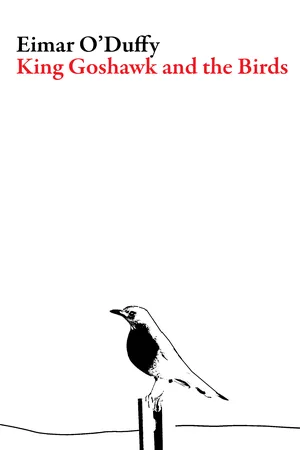
Originally published in 1926, King Goshawk and the Birds is the first installment of O'Duffy's Cuanduine trilogy, which also included The Spacious Adventures of the Man in the Street (1928) and Asses in Clover (1933). Set in a future world devastated by the development of capitalism, King Goshawk concerns the eponymous tyrant's attempt to buy all of the wildflowers and songbirds in Ireland, and the attempt by a Dublin philosopher as well as a number of mythical heroes of Irish tradition to stop him.
- English
- ePUB (mobile friendly)
- Available on iOS & Android
eBook - ePub
King Goshawk and the Birds
About this book
Information
BOOK III
THE TRAVELS OF CUANDUINE
CHAPTER I
The Lord Mammoth and the Lord Cumbersome
THESE EVENTS IN IRELAND were recorded in one half of the English newspapers as follows:
Renewed political and sectarian strife appears to be breaking out in Ireland as a result of the speeches of a man named Cooney, evidently a Bolshevik, who claims descent from some legendary hero. Our readers will recollect that the island passed out of British control some twenty or thirty years ago. England is fortunate in having rid herself of these turbulent subjects.
The other half of the newspapers reported the matter in these terms:
Claiming descent from the old Celtic divinities, a Bolshevik agitator named Considine has been creating fresh religious and political discord in the Emerald Isle. British intervention appears to be called for.
One half of the Press of England was in those days owned by Lord Mammoth, and the other half by Lord Cumbersome. These two potentates had bought up all their smaller rivals, and would have bought up one another if they could: for though both were staunch upholders of the principles of competitive civilisation, they knew better than to allow any competition against themselves if they could help it. Being unable to buy each other up, they hated each other with notable intensity, and directed their newspapers to take opposite standpoints on all topics. Thus a Government which happened to be supported by Lord Mammoth’s papers was certain to be denounced collectively and individually by Lord Cumbersome’s as the most incompetent cabal that had ever guided the Empire to destruction; if Lord Cumbersome were to advocate a policy of peace and retrenchment, Lord Mammoth’s organs would brand as a traitor anybody who might suggest that England’s safety could be secured without the immediate conquest of the whole world; and if Lord Mammoth proposed the remission of a penny from the milk tax, Lord Cumbersome would insist that without the imposition of another two pence the Budget could not be balanced. A very bitter controversy raged one time between one of Lord Cumbersome’s pet scientists who wrote that vegetables should be very lightly cooked in order to preserve their vitamines, and one of Lord Mammoth’s special hygienic experts who argued that they should be given a prolonged boiling in acid to destroy the germs that infest them. Nay more, Lord Mammoth’s humourists could not make a harmless jest about mothers-in-law, without the Cumbersome satirists denouncing the bad taste and pointlessness of such allusions, and maintaining that in jokes about bad cheese alone could the good old Anglo-Saxon type of humour be preserved as the precious heritage of their imperial race.
The question of greatest moment in England at this time was whether London should be rebuilt or whether a new city should be erected upon a fresh site. For London, like most of the world’s cities, had been largely laid in ruins in the great wars. The problem was a thorny one; and as the organs of Lord Cumbersome and of Lord Mammoth had thrown themselves into the fray on opposite sides, and were bandying arguments with even more than their wonted ferocity, they had little space to spare for the doings of a prophet across the water. Hence the meagre space allotted to the matter.
It happened, however, that Lord Mammoth, who had a drop or two of Irish blood in his arteries, reading the report in his most important organ, the Daily Record, felt some slight stir of interest; which was quickened when he turned to the account given by Lord Cumbersome’s Morning Journal. The noble newsmonger was taking breakfast at the time in a sunny parlour of his castle in Epping Forest (which, like the region of Tallaght and Bohernabreena near Dublin, was enclosed as a ghetto for millionaires). The breakfast was a fine one and a récherché, calculated to put anybody in good fettle and adventurous mood: under which influence Lord Mammoth ordered that an airplane should be at once dispatched to London to fetch for his inspection the original wire from Dublin which had been compressed into the paragraph aforesaid.
It was brought to him half an hour later as he sat in his garden smoking a cigar. It ran to about a thousand words, and he read it through carefully twice, chewing his cigar as the cinema had taught all strong characters to do. This impressed the valets, secretaries, runners, and others who were standing about, but he did not like the taste, so presently he threw the cigar away with a gesture of decision, and desired to be carried indoors. He had really come to no decision at all, but later on in the day he did; and the result was that next morning he flew to Dublin with but a single attendant, a junior valet who had been deaf and dumb from birth.
So perfect, however, was the intelligence department of his rival, so resourceful and daring were his spies, that within half an hour his flight, and within two hours the reason of it, were known at Castle Cumbersome. The Lord Cumbersome was not so energetic a person as his fellow prestidigitator, his eliminating organs being somewhat overcharged with the by-products of rotten goose-liver, which was his staple diet; neither had he any Irish blood or interests; nevertheless, he knew the laws of competitive economics better than to leave the field to the enemy. Summoning therefore an airplane and two eunuchs he set off in hot pursuit.
CHAPTER II
How the Two Lords made Propositions to Cuanduine
IT WAS THREE DAYS before the Lord Mammoth was able to find out where Cuanduine dwelt. When the information was brought to him, discarding his gorgeous raiment—for the making of which a hundred furry creatures had writhed in the cold steel jaws of traps—he donned a simple suit of plain grey tweed, and, accompanied by his faithful valet, took tram to Stoneybatter. He found the Philosopher alone in his room; for Cuanduine was out, walking gloomily on Merrion Strand by its sluggish waters.
“Good day, sir,” said the Lord Mammoth.
“Good day,” said the Philosopher.
“I had better introduce myself,” said the newsmonger. “I am Lord Mammoth.”
“And the other gentleman?” inquired the Philosopher, indicating the deaf and dumb valet who stood modestly behind.
“My attendant,” said Lord Mammoth. “I—”
“I meant his name,” said the Philosopher. “His name? Ha, ha, ha,” laughed Lord
Mammoth. “Don’t think I know it, now that I come to think of it. However, that’s not what I came about. You’re Mr. Cooney, I suppose?”
Before the Philosopher could answer, the door opened, and the prosperous figure of Lord Cumbersome came breezing in, almost upsetting the deaf and dumb valet, and completely ignoring Lord Mammoth, swept up to the Philosopher, clasped him warmly by both hands, and with radiant smile and treacly voice said: “My dear Mr. Considine, how do you do? I hardly expected to find you in. Pray excuse my enthusiasm”—shaking his hand with a fervour which the Philosopher found as embarrassing as it was uncomfortable—“but having read of your interesting discourses in the newspapers, I have been unable to rest until I should see you in the flesh.”
Here he was interrupted by the cold stern voice of Lord Mammoth: “I don’t know where you learnt your manners, Cumbersome, but I was engaged in conversation with Mr. Cooney when you came butting in.”
“My dear Mammoth, a thousand pardons,” said Lord Cumbersome, as with a start of surprise. “I entirely overlooked you. I apologise sincerely, and can only excuse myself on the ground that in the presence of such a man as Mr. Considine—”
“Gentlemen,” interrupted the Philosopher, “this is some strange mistake. My name is not Considine.”
“Cooney,” suggested Lord Mammoth.
“No,” said the Philosopher. “Murphy.”
“Then I owe you a most hearty apology,” said Lord Cumbersome winningly. “But is there not a man called Considine or some such name—a street preacher or something, with a mission of sorts—living somewhere near here?”
“The name is Cooney,” said Lord Mammoth sourly.
“If you mean Cuanduine,” said the Philosopher, “he lives here. But he is out at present, walking on Merrion Strand, with the weight of the world’s sorrow upon his shoulders.”
“I shall await his return,” said Lord Cumbersome, appropriating the only comfortable chair in the room.
“So shall I,” said Lord Mammoth, planting himself firmly on his own two legs.
“You’ve no objection, I hope,” said Lord Cumbersome pleasantly to the Philosopher; but the Philosopher did not hear him, being already reabsorbed in contemplation.
“Funny old bird,” observed Lord Cumbersome, but Lord Mammoth made no answer. Tired of standing, he directed his deaf and dumb valet to go down on hands and knees on the floor, and then sat on him. Lord Cumbersome’s eunuch presently made obeisance to his master, and began fanning him with a handbuzzer of platinum and ivory; for the air of the Stoneybatter back street was oppressive.
Thus Cuanduine found them on his return. At his entry the Philosopher came out of his meditation; Lord Mammoth eagerly arose from the small of his underling’s back; and Lord Cumbersome followed suit from his chair. The Philosopher introduced them: “Lord Mammoth and Lord Cumbersome, news-purveyors Cuanduine.”
“Delighted to meet you, sir,” said Lords Mammoth and Cumbersome in a breath.
“Why?” asked Cuanduine.
Lord Mammoth was taken aback, but Lord Cumbersome spoke suavely: “O come, sir. Can you ask such a question?”
“I have asked it,” said Cuanduine.
Here the Philosopher lau...
Table of contents
- Cover
- Title Page
- Copyright
- Contents
- Book I: A Corner in Melody
- Book II: The Coming of Cuanduine
- Book III: The Travels of Cuanduine
Trusted by 375,005 students
Access to over 1.5 million titles for a fair monthly price.
Study more efficiently using our study tools.
Frequently asked questions
Yes, you can cancel anytime from the Subscription tab in your account settings on the Perlego website. Your subscription will stay active until the end of your current billing period. Learn how to cancel your subscription
No, books cannot be downloaded as external files, such as PDFs, for use outside of Perlego. However, you can download books within the Perlego app for offline reading on mobile or tablet. Learn how to download books offline
Perlego offers two plans: Essential and Complete
- Essential is ideal for learners and professionals who enjoy exploring a wide range of subjects. Access the Essential Library with 800,000+ trusted titles and best-sellers across business, personal growth, and the humanities. Includes unlimited reading time and Standard Read Aloud voice.
- Complete: Perfect for advanced learners and researchers needing full, unrestricted access. Unlock 1.5M+ books across hundreds of subjects, including academic and specialized titles. The Complete Plan also includes advanced features like Premium Read Aloud and Research Assistant.
We are an online textbook subscription service, where you can get access to an entire online library for less than the price of a single book per month. With over 1.5 million books across 990+ topics, we’ve got you covered! Learn about our mission
Look out for the read-aloud symbol on your next book to see if you can listen to it. The read-aloud tool reads text aloud for you, highlighting the text as it is being read. You can pause it, speed it up and slow it down. Learn more about Read Aloud
Yes! You can use the Perlego app on both iOS and Android devices to read anytime, anywhere — even offline. Perfect for commutes or when you’re on the go.
Please note we cannot support devices running on iOS 13 and Android 7 or earlier. Learn more about using the app
Please note we cannot support devices running on iOS 13 and Android 7 or earlier. Learn more about using the app
Yes, you can access King Goshawk and the Birds by Eimar O'Duffy in PDF and/or ePUB format, as well as other popular books in Literature & Literature General. We have over 1.5 million books available in our catalogue for you to explore.