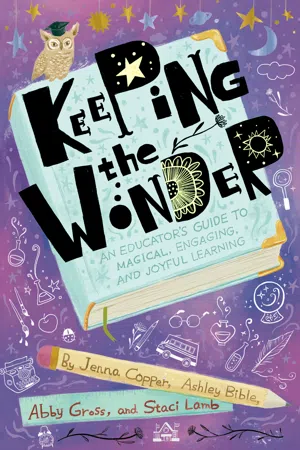
Structured around four key elements that fuel engagement—surprise, curiosity, freedom, and inspiration—Keeping the Wonder offers practical strategies and abundant inspiration for K-12 educators to create lessons that are fun and compelling. Combining enchanting anecdotes, real-world experience, and a wealth of research, the authors share their collective expertise as educators and founders of the innovative Keeping the Wonder workshop. In this dynamic handbook, Jenna, Ashley, Abby, and Staci offer a fresh approach to learning through the lens of wonder. By providing creative ideas for switching up standard lesson plans in ways both subtle and profound, they show us how to recapture our fascination with the world by employing all of our senses, and enhance engagement and critical thinking for students and teachers alike.
eBook - ePub
Keeping the Wonder
An Educator's Guide to Magical, Engaging, and Joyful Learning
- 264 pages
- English
- ePUB (mobile friendly)
- Available on iOS & Android
eBook - ePub
About this book
Information
Topic
EducationSubtopic
Professional DevelopmentElement 1
Surprise


The moment I stepped over the threshold, I was transported into a wild jungle.
The cement walls became towering green trees, the suspension ceiling became a tangle of low-hanging vines, and the blue area rug became a rushing river ready to take me on a journey to magical learning.
Like Lucy stepping through the magical wardrobe to discover Narnia, I stepped through the door to Mrs. Bakuhn’s second-grade classroom.
All of these years later, I can recall the surprise of seeing her classroom jungle for the first time. I was in awe. There was a thick withered tree trunk in the middle of the room complete with sprawling branches and bright green leaves and a howler monkey hanging from one of the vines. Never mind they were made of paper and stuffing. To me, it was magic.
The surprise of that day marked only the first of many surprisingly wonderful experiences in my second-grade classroom: the day I sat in our special reading tent for our independent reading time, the day we were explorers at the Pittsburgh Zoo, the day we traveled deep under the sea during our 20,000 Leagues Under the Sea read aloud, and the day we sang “Baby Beluga” while we learned about beluga whales.
It’s no mystery why, despite being only eight at the time, I can still remember so much about that school year. Mrs. Bakuhn knew something magical about learning. She had discovered the first element of wonder: surprise.

There aren’t too many situations in which we can imagine grown adults ready and willing to crouch under tables or slide behind bookshelves with hushed tones and dimmed lights. But we’re guessing you’ve experienced or at least observed the classic birthday surprise at least once in your life.
We love bursting out of our hiding spots with a hearty “SURPRISE!” to unsuspecting friends on their birthdays, and we love even more the exhilarated “you got me!” surrender when the surprise has played out for them.
We’ve all had experience with the excitement that comes from a big surprise. When was the last time you were surprised? It’s probably not hard to remember a truly exciting surprise because, quite frankly, surprises are memorable.
Surprises create wonder.
Psychologists call this phenomenon “flashbulb memory.” Coined in 1977 by researchers Roger Brown and James Kulik, a flashbulb memory is a distinct memory created by an emotional disruption in someone’s normal routine. Brown and Kulik studied national and global events that impacted people on a large scale, and the results explain why we can remember seemingly trivial details of a big surprise party that occurred three years ago, but can’t remember what we ate for lunch two days ago.
Care to give it a try? Think of a special day in your life. Here are some examples:
- The day you found out you got your first teaching job
- The day you graduated from college
- The day you met your partner
- The day your child was born
Chances are you can recall surprising details about that day. Can you remember what you were wearing, who you called on the phone, what you ate? It’s pretty surprising, isn’t it? Especially considering how easy it is to forget what you did two days ago, let alone two weeks. Need further evidence? Here’s a sweet example from Abby’s childhood.

Sometimes surprise is as sweet as the first taste of sprinkle-topped ice cream on a crisp summer night. Sometimes, surprise is ice cream—or at least that’s how the story of one of my most delightful flashbulb memories from my childhood goes:
It’s a sweet summer evening, and just as the fireflies begin to light up the sky, my Very Unreasonable Mother calls us inside from our barefoot game of hide-and-seek. Right on cue, we protest this early bedtime, pleading with our mom: “But it’s SUM-MER!” After much protest, we reluctantly pull on our pajamas, brush our teeth, and stomp our way into our bedrooms. “You’re not even going to read us a book?” we ask incredulously, as our mother betrays us by shaking her head no. Denied our beloved books, my sister and I furiously whisper from our bunk beds after the traitors we call our parents tuck us in. Fifteen minutes later, just as we’re about to give up the fight and attempt to actually sleep, we are alarmed by a ridiculous clatter of banging pots and pans.
First, we hear the racket, then the familiar creaks that signal someone is walking up the stairs. Then comes the unexpected singsong voice of my mom: “Get out of your beds and get into the van! We’re getting ice cream!”
We shoot up from our beds in utter delight and astonishment. “Wait, really?” we ask in surprise, as we realize our parents aren’t joking. We’re really getting ice cream! Soon enough, my mom and dad are loading all five of us kids into our minivan, and we’re on our way to get a good, old-fashioned ice cream cone. As we try to race the heat melting our cones, we can’t stop laughing and replaying that joyful moment when our bedtime sentence turned into a sweet treat.
I’ll never forget that night. To this day, my siblings and I still love to spontaneously swerve into McDonald’s drive-throughs just for a little taste of that childhood nostalgia. My parents paid less than five dollars for fifty-cent cones for our entire family that night, but the sheer surprise was priceless.
As you can see, it makes sense that formal definitions of surprise reveal words like “amazement,” “marvel,” and, of course, “wonder,” which pop up in partnership with words like “unexpected” and “sudden.” In their book Surprise: Embrace the Unpredictable and Engineer the Unexpected, Tania Luna and LeeAnn Renninger provide a fascinating look at how the element of surprise can help us harness these words to grow and learn. They argue that we need to abandon the negative feelings associated with the unknown and unexpected to thrive in a life filled with wonder.
The good news is that teachers were embracing this principle long before Luna and Renninger wrote their book, and for good reason. Learning by surprise is a concept that psychologists and educators alike have studied for years. In fact, researchers often use the word “novelty” to describe this learning mechanism. When something novel or unexpected happens within the familiar context of your classroom, your students are more likely to remember those events—just as we’re more likely to remember that surprise birthday party.
Let’s take David Johnson, a math teacher from Wisconsin, as an example. Some forty years before Luna and Renninger’s book, Johnson was one of the first educators to specifically identify the element of surprise as an effective classroom technique.
“Is the element of surprise present in your classroom NOW? I believe the element of surprise belongs there!” Johnson declared.
Aimee E. Stahl and Lisa Feigenson, researchers from Johns Hopkins University’s Department of Psychological and Brain Sciences, conducted an interesting study that supports Johnson’s assertion. They looked at how eleven-month-old babies react to the element of surprise. By revealing a ball in an unexpected way, like rolling it off a table without dropping or moving it through a wall, they tested the babies’ reactions. Babies could be seen rolling, pounding, and squishing the “surprise” ball, which resulted in more engagement, discovery, and most importantly, effective learning.
Dr. Judy Willis, a neurologist and middle school teacher, closes the gap between the laboratory and the classroom. In her book, Research-Based Strategies to Ignite Student Learning, she encourages teachers to utilize surprise:
Use surprise to bring students’ brains to attention. Consider employing the technique of surprise to light up students’ brains and illuminate the pathways to memory storage. Starting a lesson with an unanticipated demonstration or having something new or unusual in a classroom will spark student attention a...
Table of contents
- Cover
- Praise for Keeping the Wonder
- Title Page
- Copyright
- Dedication
- Contents
- Introduction
- I. Element 1
- II. Element 2
- III. Element 3
- IV. Element 4
- Conclusion
- Wonder Kit
- References
- Acknowledgments
- About Keeping the Wonder
- About the Authors
- More from Dave Burgess Consulting, Inc.
Trusted by 375,005 students
Access to over 1.5 million titles for a fair monthly price.
Study more efficiently using our study tools.
Frequently asked questions
Yes, you can cancel anytime from the Subscription tab in your account settings on the Perlego website. Your subscription will stay active until the end of your current billing period. Learn how to cancel your subscription
No, books cannot be downloaded as external files, such as PDFs, for use outside of Perlego. However, you can download books within the Perlego app for offline reading on mobile or tablet. Learn how to download books offline
Perlego offers two plans: Essential and Complete
- Essential is ideal for learners and professionals who enjoy exploring a wide range of subjects. Access the Essential Library with 800,000+ trusted titles and best-sellers across business, personal growth, and the humanities. Includes unlimited reading time and Standard Read Aloud voice.
- Complete: Perfect for advanced learners and researchers needing full, unrestricted access. Unlock 1.5M+ books across hundreds of subjects, including academic and specialized titles. The Complete Plan also includes advanced features like Premium Read Aloud and Research Assistant.
We are an online textbook subscription service, where you can get access to an entire online library for less than the price of a single book per month. With over 1.5 million books across 990+ topics, we’ve got you covered! Learn about our mission
Look out for the read-aloud symbol on your next book to see if you can listen to it. The read-aloud tool reads text aloud for you, highlighting the text as it is being read. You can pause it, speed it up and slow it down. Learn more about Read Aloud
Yes! You can use the Perlego app on both iOS and Android devices to read anytime, anywhere — even offline. Perfect for commutes or when you’re on the go.
Please note we cannot support devices running on iOS 13 and Android 7 or earlier. Learn more about using the app
Please note we cannot support devices running on iOS 13 and Android 7 or earlier. Learn more about using the app
Yes, you can access Keeping the Wonder by Jenna Copper in PDF and/or ePUB format, as well as other popular books in Education & Professional Development. We have over 1.5 million books available in our catalogue for you to explore.