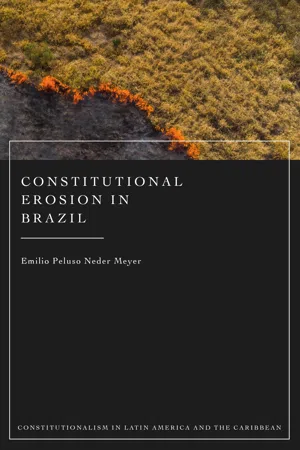
This book provides a fascinating analysis of a single jurisdiction, Brazil, and accounts for both the successes and the failures of its most recent constitutional project, inaugurated by the Constitution of 1988.
It sets out the following aspects of the constitutional development and erosion:
- the different phases of the promised transition from military rule to a 'social-democratic constitutionalism';
- the obstacles to democratisation derived from the absence of true institutional reforms in the judicial branch and in the civil-military relationship;
- the legal and social practices which maintained a structure that obstructed the emergence of an effective social-democracy, such as the neoliberal pattern, the acceptance in the political field of unlawful organisations, such as the milícias, and the way the digital revolution has been harming the formation of democratic sovereignty.
Situating Brazil in the global context of the revival of authoritarianism, it details the factors which are common to the third wave of democratisation reflux. Accounting for those aspects, particular to the Brazilian jurisdiction, it shows that there is a tension in the Brazilian constitution.
On the one hand, such constitutionalism was renewed by democratic pressure on governments to undertake social politics since 1988. On the other hand, it retained authoritarian practices through the hands of diverse institutions and political actors.
By exploring the ideas of constitutional erosion and collapse, as well as democratic, social and digital constitutionalism, the book presents a comparative analysis of Brazil and other jurisdictions, including the United States, South Africa, and Peru.
- 320 pages
- English
- ePUB (mobile friendly)
- Available on iOS & Android
eBook - ePub
Constitutional Erosion in Brazil
About this book
Information
1
Transitional Constitutionalism
Judicial and Military Attempts at Controlling a Transition
On 28 April 2010, the Brazilian Federal Supreme Court was in the midst of a trial that would have a long-lasting effect on the relationship between the military,1 the courts and politicians in Brazil. That was the Claim of Breach of Fundamental Precept (Arguição de Descumprimento de Preceito Fundamental, ADPF) 153. It was a form of abstract constitutional review by which one of the authorities indicated in the 1988 Constitution files a claim against either a normative act or law supposedly in breach of a fundamental constitutional command. This time, the Federal Bar Association (Conselho Federal da Ordem dos Advogados do Brasil) was questioning if the generally accepted interpretation of the Amnesty Law of 1979 (Law 6.683 of 1979) was in accordance with the 1988 Constitution. This granted an amnesty to public agents who, on behalf of the dictatorship of 1964–1985, had committed torture, murder, sexual offences and other crimes against political opponents and other civilians.
On the same day, President Luís Inácio Lula da Silva hosted a dinner at the Palace of Planalto. Among others, the Federal Supreme Court justices, the speaker of the Chamber of Deputies (Câmara dos Deputados, the lower house), Michel Temer (who would become President of the Republic between 2016 and 2018) and the speaker of the Federal Senate (Senado Federal, the upper house), José Sarney (who had been President of the Republic between 1985 and 1990) were in attendance.2 There were rumours at the time that the subject of amnesty would have been raised and that President Lula adopted a neutral position. Whereas the chief of staff, Dilma Rousseff (who became president from 2010 until 2016 and who was a former political opponent of the dictatorship), and the minister of social communication, Franklin Martins (also a former political opponent of the dictatorship), opposed amnesty for the supporters of the dictatorship, the Minister of Defence Nelson Jobim advocated so-called ‘bilateral’ amnesty (for both supporters and opponents of the dictatorship).3
Nelson Jobim was a former lower house representative and a deputy in the Constituent Assembly of 1987–1988, which produced the 1988 Constitution. Minister of Justice during Fernando Henrique Cardoso (FHC)’s term (1995–2002), Jobim was appointed to the Federal Supreme Court in 1997 and remained in office until 2006. He then became Minister of Defence between 2007 and 2011, and served Presidents Lula and Dilma. From time to time, Jobim publicly tried to clarify controversial juridical and political matters. On the fifteenth anniversary of the 1998 Constitution, Jobim gave an interview to the O Globo newspaper, in which he stated that a few constitutional provisions would not have been finally voted on after they had been inserted by an editorial committee of the 1987–1988 Constituent Assembly, including that which established a separation of powers.4 He then retracted the declaration.5 Right from the start, it is vital to highlight the dynamic, historical and discursive characters of a constituent assembly ignored by those findings.
In 2014, Jobim also gave testimony on the unending debate on the range of the 1979 amnesty, especially when considered in light of the 1988 Constitution. Jobim had already avoided an institutional reinterpretation of the Amnesty Law of 1979 three times, which could have held military and other officers criminally liable. During FHC’s term, Jobim would have acted to limit the range of the investigations of the Special Commission for People who Were Forcibly Disappeared or Killed for Political Reasons (Comissão Especial sobre Mortos e Desaparecidos Políticos, CEMDP). He also tried to restrict civil liability for the murder of former military captain Carlos Lamarca, a political opponent of the dictatorship. During Lula’s term, Jobim had meetings with his former colleagues from the Federal Supreme Court to present opinions related to the judgment of the ADPF 153. Finally, when, in 2009, debates started for the creation of the National Truth Commission (Comissão Nacional da Verdade, CNV) he would have also pointed out that there was a difference between responsibility and truth-finding.6
The Federal Supreme Court’s ruling of 2010 in the ADPF 153 raises several issues that have consequences for the past, the present and the future of Brazilian constitutionalism. Additionally, they point to juridical and political elements that, comparatively, have resonance in constitutional theory. Consider, for instance, the case of Chile, a country which had experienced a period of dictatorship similar to that of Brazil (the Pinochet dictatorship, which lasted from 1973 until 1990) and transitioned to democracy whilst preserving the 1980 Constitution. Brazil and Chile also worked together in the so-called ‘Operation Condor’.7 The Chilean judiciary initially adopted a conservative approach to crimes committed by the military during the dictatorship. The Chilean Amnesty Law, Decree Law 2.191 of 1978, was invoked continuously, as were other statutes of limitations. Cases that treated the crimes of the dictatorship era as punishable were rare, but their adjudication started at the onset of the democratic period. For instance, the cases of the enforced disappearances of José Julio Llaulén and Juan Eleuterio Cheuquepán were considered by a first-level court to be ‘ongoing crimes’ in 1993. Therefore, they could not be favoured by a statute of limitations. The ruling was confirmed by the Chilean Supreme Court afterwards.8
Chilean courts snaked through different answers to the problem, but they started to apply the Geneva Convention and to treat the Pinochet era’s crimes as crimes against humanity.9 The ruling of the IACtHR in Almocinad Arellano played an essential role in re-shaping the case law.10 Although the courts continued to rely on a provision of the Chilean Criminal Code which benefited the defendants through a ‘half prescription’, the judiciary seemed to abide by human rights norms and a new reading of the 1980 Constitution. However, politics also influenced the scenario. In the middle of an insurgency sparked by the pension’s reform in 2019, when the country was heading towards a constituent process, Justice María Brahm, the Constitutional Tribunal’s Chief Justice, leaked to the press that Justice Iván Aróstica, the former Chief Justice of the Court, had postponed the presentation of cases concerned with human rights violations. According to her, the deferral was due to lawyers who were charging their clients with reference to the length of the delay they could obtain from the Court for issuing a final ruling.11 In fact, since 2015, a series of cases were controversially appealed to the Constitutional Tribunal with the specific aim of either impugning final Supreme Court verdicts or delaying their effectiveness.12 Such an intricate web illustrates the connections between politics, military and courts.
Nonetheless, the Chilean scenario seems more promising if one considers the liability for gross violations of human rights a good indicator for constitutionalism and the rule of law enforcement. The two condemnations of the Army’s previous commander, General Juan Emilio Cheyre (2002–2006) – one for the torture sessions that happened in Arica right after the 1973 Pinochet coup and the other for covering up the so-called Death Caravan (Caravana de la Muerte)13 – show that, even with a constitution that traces back to the dictatorship, it is possible to calibrate the relationship between civilian and military authorities through the courts.14 With 600 criminal convictions for violations occurred under Pinochet’s regime, it is hard to state that the civil–military relationship in Chile is equivalent to that in Brazil. There is much to do in terms of institutional reforms, of course, and the next constituent process could be a suitable venue for that.
This book aims to highlight how courts have had a role in the slow deterioration of Brazilian constitutionalism, especially during the post-1988 period. One of the critical points relies on the fact that courts have been partially unsuccessful in strengthening the rule of law and the democratic backbone of the 1988 constitutionalism. Even with crucial contributions to 1988 Brazilian constitutionalism, some contradictions must be observed. The restricted role of courts for strengthening constitutionalism in Brazil goes back to the dictatorship and the transition it entailed. It is vital to understand how this has happened.
Chapter one will recollect some of the main points of the juridical configuration of the 1964–1985 dictatorship. The issue of amnesty acted as a catalyst to the transitional process, as this chapter will consider. And, of course, the Federal Supreme Court ruling on the ADPF 153 demands reflection, as does the contrasting decisions of the IACtHR. From the perspective of Brazilian prosecutors, there was a breach to the 1988 Constitution in the dominant judicial view on amnesty for crimes against humanity. Chapter one will end at the military’s return to politics, a matter to be resumed in chapter five.
I.THE BRAZILIAN DICTATORSHIP OF 1964–1985 JURIDICAL APPARATUS
It is not the aim of this chapter to take the place of historians who have been examining the different aspects of the Brazilian dictatorship of 1964–1985. Our main starting point, however, is the traditional coup or authoritarian collapse which happened in the early hours of 1 April 1964 (a date some military preferred to remember as 31 March 1964, as 1 April is also April Fool’s Day in Brazil).15
Consider how current key political actors in Brazil consider the events of this day. Before Jair Bolsonaro’s inauguration, the Federal Supreme Court’s Chief Justice Dias Toffoli publicly declared that ‘today, I do not refer either to a coup or a revolution. I refer to the movement of 1964’.16 He criticised those both on the left and the right who, before 1964, had refused to assume their responsibilities, which led to the ‘movement’ that would charge the military. Toffoli’s statement was widely criticised. However, this discourse pleased Bolsonaro’s most radical voters and fuelled the debate which resulted in President Bolsonaro’s victory.
Each year, the Military Club, a private association of former members of the armed forces, founded in 1887, holds lunch parties to celebrate 1964. On 31 March 2020, they invited people to participate in a commemoration of ‘56 years of the democratic revolution’. Throughout the 1970s, the date was publicly celebrated as being the anniversary of the so-called revolution. In the 1980s, the commemorations started to happen inside the barracks. They became more restricted during the 1990s and especially during the 2000s. The pressure from the families of the disappeared and political opponents of the dictatorship seems to have been a fundamental reason for limiting these celebrations. In 2011, the date was deleted from a list on the Army’s website and a lecture by General Augusto Heleno (who would become Bolsonaro’s Institutional Security Cabinet Minister) about the alleged ‘revolution’ was suspended by Minister of Defence Nelson Jobim.17 On 31 March 2020, by order of President Bolsonaro, it was announced that the date should be celebrated. There was an order establishing a daily schedule set by the Ministry of Defence which stated that the 31 March 1964 was a ‘landmark for democracy’. The order was signed by Minister of Defence, Fernando Azevedo e Silva and the commanders of the armed forces.
A lawsuit was filed against the Ministry of Defence’s order. A first-degree federal judge and the 5th Regional Appellate Court (Tribunal Regional Federal da 5ª Região) suspended the order on the basis that it was against the democratic values of the 1988 Constitution. The office of the Solicitor General of the Union (Advocacia-Geral da União, AGU) then filed another lawsuit in the Federal Supreme Court and Chief Justice Dias Toffoli ruled on it. The Court was criticised by Bolsonaro, who accused it of repeatedly acting against him, especially in a case that suspended the nomination of the Director of the Federal Police after the resignation of his Minister of Justice and Public Security (hereafter Minister of Justice), Sérgio Moro.18 During the COVID-19 crisis, Chief Justice Toffoli reviewed the judicial rulings on the military manifestations, alleging that they made an analysis of internal affairs of the Ministry of Defence. According to Justice Dias Toffoli, the rulings were an act of censorship against the Minister of Defence and the commanders of the armed forces, and represented an invasion by the judiciary into matters of ...
Table of contents
- Cover
- Dedication
- Title Page
- Acknowledgements
- Table of Contents
- Introduction: Defining Brazil’s Constitutional Erosion
- 1. Transitional Constitutionalism: Judicial and Military Attempts at Controlling a Transition
- 2. Social-Democratic Constitutionalism: Neoliberal Unconstitutional Politics and Socio-Economic Rights
- 3. Institutional and Personal Judicial Guarantees: Judges, Inequality and Politics
- 4. Judges and Courts Destabilising Constitutionalism
- 5. Subverting the Rule of Law: The Military vs the Milícias – Eroding Brazilian Constitutionalism
- 6. Moderating Powers? Military and Judges in Brazilian Constitutionalism
- 7. Digital Constitutionalism: WhatsApp Elections and Fake News
- 8. Constitutional Resilience against Erosion: Responses Provided for by the 1988 Constitution
- Epilogue
- Index
- Copyright Page
Trusted by 375,005 students
Access to over 1.5 million titles for a fair monthly price.
Study more efficiently using our study tools.
Frequently asked questions
Yes, you can cancel anytime from the Subscription tab in your account settings on the Perlego website. Your subscription will stay active until the end of your current billing period. Learn how to cancel your subscription
No, books cannot be downloaded as external files, such as PDFs, for use outside of Perlego. However, you can download books within the Perlego app for offline reading on mobile or tablet. Learn how to download books offline
Perlego offers two plans: Essential and Complete
- Essential is ideal for learners and professionals who enjoy exploring a wide range of subjects. Access the Essential Library with 800,000+ trusted titles and best-sellers across business, personal growth, and the humanities. Includes unlimited reading time and Standard Read Aloud voice.
- Complete: Perfect for advanced learners and researchers needing full, unrestricted access. Unlock 1.5M+ books across hundreds of subjects, including academic and specialized titles. The Complete Plan also includes advanced features like Premium Read Aloud and Research Assistant.
We are an online textbook subscription service, where you can get access to an entire online library for less than the price of a single book per month. With over 1.5 million books across 990+ topics, we’ve got you covered! Learn about our mission
Look out for the read-aloud symbol on your next book to see if you can listen to it. The read-aloud tool reads text aloud for you, highlighting the text as it is being read. You can pause it, speed it up and slow it down. Learn more about Read Aloud
Yes! You can use the Perlego app on both iOS and Android devices to read anytime, anywhere — even offline. Perfect for commutes or when you’re on the go.
Please note we cannot support devices running on iOS 13 and Android 7 or earlier. Learn more about using the app
Please note we cannot support devices running on iOS 13 and Android 7 or earlier. Learn more about using the app
Yes, you can access Constitutional Erosion in Brazil by Emilio Peluso Neder Meyer in PDF and/or ePUB format, as well as other popular books in Law & Comparative Law. We have over 1.5 million books available in our catalogue for you to explore.