Produced in the aftermath of the Second World War, Michael Powell and Emeric Pressburger's A Matter of Life and Death (1946) stars David Niven as an RAF pilot poised between life and death, his love for the American radio operator June (Kim Hunter) threatened by medical, political and ultimately celestial forces. The film is a magical, profound fantasy and a moving evocation of English history and the wartime experience, with virtuoso Technicolor special effects. In the United States it was released under the title Stairway to Heaven, referencing one of its most famous images, a moving stairway between earth and the afterlife.
Ian Christie's study of the film shows how its creators drew upon many sources and traditions to create a unique form of modern masque, treating contemporary issues with witty allegory and enormous visual imagination. He stresses the teamwork of Powell and Pressburger's gifted collaborators, among them Director of Photography Jack Cardiff, production designer Alfred Junge, and costume designer Hein Heckroth, and explores the history of both British and international responses to the film. Christie argues that the film deserves to be thought of as one of the greatest achievements of British cinema, but of all cinema.
- 96 pages
- English
- ePUB (mobile friendly)
- Available on iOS & Android
eBook - ePub
A Matter of Life and Death
About this book
Information
1 Beginnings
Where I come in …
Having loved A Matter of Life and Death (1946) for over a quarter of a century, I finally had to decide how highly I rated it several years ago. A newspaper asked me to write about ‘my favourite film’. I considered the options – rescuing something obscure; new light on a classic; a childhood enthusiasm revisited; Hollywood or not – before concluding that the subject of this book really had to be it.6 What surprised me was realising how much resistance even I had to selecting a British film, putting my critical judgment where my advocate’s mouth had long been. Writing the book has become an attempt to explore this unease. The result is not a close reading of the film’s text, which would occupy another book, nor even a full account of its making (yet another book), but a contextual reading, aiming to place it in its own time and ours.
A Matter of Life and Death (hereafter AMOLAD) has for too long been a prisoner of its founding premise. Originally conceived as wartime propaganda, it couldn’t be made until after the war’s end, when its message risked seeming out of date. But even if it started as a contribution to improving Anglo-American relations, there is ample evidence that its makers also had much larger and less circumstantial ambitions. And over the years, despite critical disdain and frequent regret over its propaganda aims, audiences have discovered for themselves that it is a poetic and provocative fantasy. It now ranks number twenty in the BFI’s poll of the British Top 100 (and number two in the BFI Library users’ poll, indicating higher status among students and scholars?). But even if it’s a confirmed favourite, is it more than this? And who cares if it isn’t?
Well, I care, because what’s at stake echoes the film’s ostensible theme – defending Britain’s ‘cause’ (or ‘case’) in the post-war world. Its uncertain critical reputation invites us to consider how to defend a British film against the claims of cinema’s accredited classics – Eisenstein, Ford, Renoir, Welles, or Hollywood’s great collaborative fantasies of the 1930s and 40s.
In at least one respect, it must be a contender. The opening of AMOLAD remains one of the most remarkable of any film, even by the standards of two illustrious precursors which probably influenced it – The Wizard of Oz (Victor Fleming, 1939) with its tornado transition from Kansas to Munchkin-land; and Citizen Kane (Orson Welles, 1941), which starts with an atmospheric death scene, before crashing into its brash pseudo-newsreel. AMOLAD begins with nothing less than a guided tour of the universe, moving us past nebulae and novae, with an authoritative, slightly amused, voice making the cosmic seem cosy: ‘And here’s the earth, our earth, part of the grand design. Reassuring isn’t it?’ But if we have been reassured, this equilibrium is abruptly shattered as we find ourselves in the wrecked cockpit of a bomber, blazing in full Technicolor, listening to its pilot’s last radio exchange. Powell and Pressburger had already rehearsed this shock-beginning in their earlier ‘… one of our aircraft is missing’ (1942), which starts with a mysteriously empty bomber, an aerial Marie Celeste, that crashes before we travel back in time to discover what happened to its missing crew.
But here there’s no doubling back, no flashback reassurance. This pilot really is going to die, unless a miracle saves him – which it does in a distinctively modern way, resulting from a bureaucratic mistake of the kind only too familiar to those who had lived through the war with uncertain news of loved ones’ fate. Also a ruefully patriotic one, since the pilot misses his rendezvous with death thanks to ‘a real English fog’. But even before we discover his plight, we’re treated to a condensed self-presentation that is more rhetorical than anything in Kane. The voice we hear for a full seventy seconds before we see its owner answers an imaginary questionnaire – age, education, religion, politics – as well as quoting Raleigh and Marvell to a bewildered radio operator. By the end of their passionate exchange, they have all but pledged their love in the face of the pilot’s imminent death – a twist on (or merely an example of?) that other cliché of wartime romance, the kiss before dying.
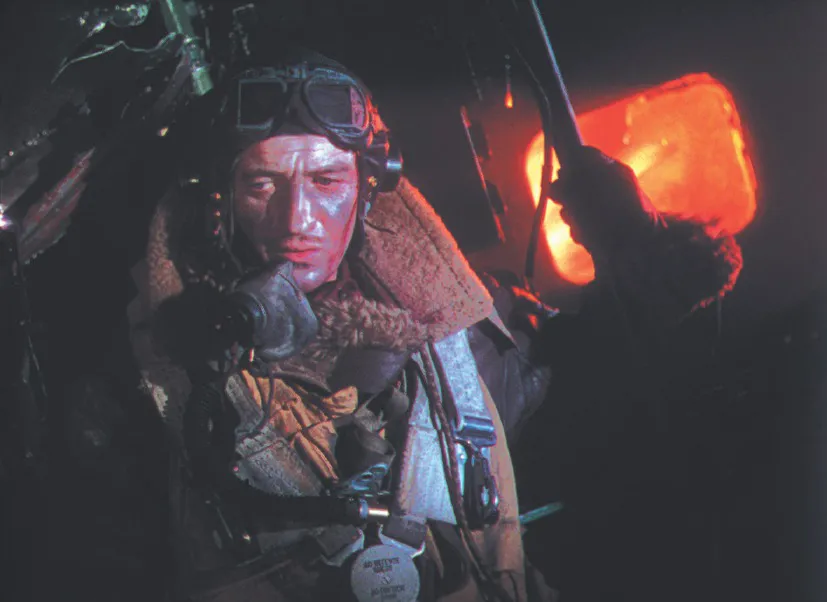
An airman’s love letter to England: Peter in the blazing cockpit
Today, the effect is ultra-melodramatic, teetering on the edge of absurdity. At various public cinema screenings over the years, I have felt that familiar rising embarrassment, just held in check by the headlong bravado and humour of the writing, and by David Niven’s compelling delivery. Yet the association of pilots and poetry wasn’t new. A poem had provided the emotional pivot of Rattigan’s and Asquith’s elegiac 1945 flying drama The Way to the Stars.7 And just four years later Jean Cocteau would have his modern Orpheus take dictation by car radio from beyond the grave in Orphée. Poetry was indeed in the air.
Then comes the film’s biggest, boldest stroke, its bid for immortality. Suddenly we’re in a cool modernist heaven in black and white, staffed by efficient angels wearing Women’s Auxilliary Air Force (WAAF) uniforms and reached by escalator. Contemporary audiences may well have thought of The Wizard of Oz, perhaps realising this neatly reversed that film’s reality/fantasy colour scheme. They might also have been reminded of the futuristic décor of Things to Come (William Cameron Menzies, 1936), which had been reissued early in the war, and recalled Raymond Massey’s similar roles in both films. Critics of the time recalled other ‘two worlds’ fantasies, such as The Ghost Goes West (René Clair, 1936), Here Comes Mr. Jordan (Alexander Hall, 1941) or Heaven Can Wait (Ernst Lubitsch, 1943), although few thought that AMOLAD measured up to these.8 Ambitious, technically accomplished, imaginative – but ultimately shallow or silly, according to the more intellectual critics who might have been expected to appreciate it. Humphrey Swingler delivered the most scathing of the ‘yes, but’ verdicts:
in this fantasy of two worlds the authors’ continual concessions to the romantic (box-office) conception of entertainment flatten the idea behind their story. In the very first reel the effect of an exceptionally ingenious entrée to the supernatural nature of the film, via a slow panning shot across the stratosphere, is completely spoiled by an extremely tedious dialogue between doomed-bomber-pilot David Niven and an anguished WAC Kim Hunter in the conventional war-film idiom.
[I]t is time that the Powell–Pressburger combination achieved something more than mere oddity; time for them perhaps to stop reaching for the moon and, if they can, plant their four feet on the earth with their contemporary technicians. For they would be in no mean company. Asquith, Carol Reed, Launder and Gilliat, the Boultings, Thorold Dickinson and David Lean among others, are establishing a tradition of solid native skill to which the latest production of this better-known combination contributes almost nothing.9
I quote this, not to mock its shortsightedness, but because it goes to the heart of the matter: how to mount a case for a film so out of step with other British film-making during what was felt to be a renaissance of national cinema? My defence will involve exploring the roots of the film in myth, in Shakespeare, in the tradition of masque and allegory, in English ‘time culture’ and 1940s Neo-Romanticism, in contemporary medicine; as well as in production research being carried on within Rank, and the development of Technicolor itself. What this will reveal is not a poor, provincial imitation of Clair, Lubitsch, Capra et al., but a pioneering work both of and beyond its time. One patronised – as was Shakespeare in his own day – but now clearly able to bear an exceptional range of interpretation and analysis.10
Origins
Like all Powell and Pressburger’s previous joint films (although only one after, The Red Shoes (1948)), AMOLAD was an original script; and like at least four of their wartime productions, it was in some sense ‘commissioned’ for propaganda, or public relations purposes. Powell told the story on several occasions of how Jack Beddington, head of the film department at the Ministry of Information, had suggested over ‘a very good lunch’ that The Archers might tackle the theme of worsening Anglo-American relations.11 Many in Britain had formed a negative impression of the American service personnel whose presence had grown during 1944; and during the last phase of the war, there was increasing resentment over American claims of leadership and Britain’s growing economic and material dependence on its ally. The Archers were no strangers to this delicate subject, after 49th Parallel (1941) and, more idiosyncratically, A Canterbury Tale (1944).12
According to Powell’s later account, Beddington wanted ‘a big film’ which would, in Archers’ style, ‘put things the way that people understand without understanding’.13 Pressburger duly conceived ‘a real fantasy with supernatural beings’, in ‘a kind of surrealism’ that, crucially, ‘would need Technicolor’. When this proved unavailable, he quickly devised another forward-looking film that could be made in monochrome, I Know Where I’m Going!, although this was not finished until September 1945 – by which time The Archers had already committed to AMOLAD (probably in January) and the end of the war was clearly in sight. Why did they revert to a propaganda piece, when conventional wisdom would have suggested that audiences needed anything but another war film?
Part of the answer is obviously that AMOLAD, like IKWIG, makes a deliberate bridge from war into peace, debating the values that will be needed in the post-war world. The opening sequence is full of topical references to the events of 1945. Although apparently set on the night of 2 May, three days before the German surrender, the commentary and dialogue refer to ‘thousand bomber’ attacks on German cities, which had reached a climax in February 1945; and, by implication, to the general election of July that gave Labour a mandate for sweeping reform (Peter describes his politics as ‘Conservative by instinct, Labour by experience’) and to the atomic bombs that were dropped on Japan in August (‘someone’s been messing around with the uranium atom’). Thereafter, the war recedes rapidly as the film develops its metaphysical and broad historical themes.
AMOLAD also leaves behind the realism that had framed their strictly wartime films to engage with the modernist mystique of the aviator. The 1920s and 30s had seen a succession of pilots such as Charles Lindbergh and Amy Johnson become world celebrities, and artists were quick to develop a new mythology of aviation. Yeats, Brecht, Auden and Saint-Exupéry, himself a flyer, were among the writers who developed this new technological chivalry.14 Among 30s film-makers, Pudovkin celebrated aviators as the new explorers in Victory (1938); while Hawks and Renoir both portrayed the new self-deprecating style of heroism associated with flyers in Only Angels Have Wings and La Régle du jeu (both 1939).15
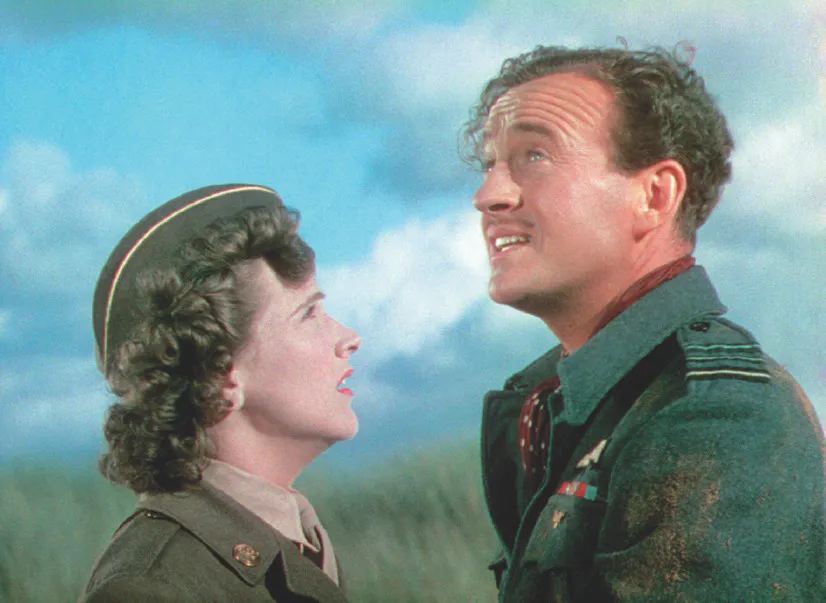
Prede...
Table of contents
- Cover
- BFI Film Classics
- Dedication
- Title Page
- Contents
- Foreword to the 2021 Edition
- Acknowledgments
- 1 Beginnings
- 2 Production
- 3 Responses
- Epilogue
- Notes
- Credits
- eCopyright Page
Trusted by 375,005 students
Access to over 1.5 million titles for a fair monthly price.
Study more efficiently using our study tools.
Frequently asked questions
Yes, you can cancel anytime from the Subscription tab in your account settings on the Perlego website. Your subscription will stay active until the end of your current billing period. Learn how to cancel your subscription
No, books cannot be downloaded as external files, such as PDFs, for use outside of Perlego. However, you can download books within the Perlego app for offline reading on mobile or tablet. Learn how to download books offline
Perlego offers two plans: Essential and Complete
- Essential is ideal for learners and professionals who enjoy exploring a wide range of subjects. Access the Essential Library with 800,000+ trusted titles and best-sellers across business, personal growth, and the humanities. Includes unlimited reading time and Standard Read Aloud voice.
- Complete: Perfect for advanced learners and researchers needing full, unrestricted access. Unlock 1.5M+ books across hundreds of subjects, including academic and specialized titles. The Complete Plan also includes advanced features like Premium Read Aloud and Research Assistant.
We are an online textbook subscription service, where you can get access to an entire online library for less than the price of a single book per month. With over 1.5 million books across 990+ topics, we’ve got you covered! Learn about our mission
Look out for the read-aloud symbol on your next book to see if you can listen to it. The read-aloud tool reads text aloud for you, highlighting the text as it is being read. You can pause it, speed it up and slow it down. Learn more about Read Aloud
Yes! You can use the Perlego app on both iOS and Android devices to read anytime, anywhere — even offline. Perfect for commutes or when you’re on the go.
Please note we cannot support devices running on iOS 13 and Android 7 or earlier. Learn more about using the app
Please note we cannot support devices running on iOS 13 and Android 7 or earlier. Learn more about using the app
Yes, you can access A Matter of Life and Death by Ian Christie in PDF and/or ePUB format, as well as other popular books in Medios de comunicación y artes escénicas & Películas y vídeos. We have over 1.5 million books available in our catalogue for you to explore.