Cigarette smoking is estimated to lead to 4.9 million premature deaths per year worldwide. This is predicted to rise to 10 million by 2020. In western countries it kills half of all smokers who fail to stop.
The prevailing model for tobacco addiction is that nicotine from cigarettes rewards smoking and punishes abstinence, tapping into a motivational system of operant conditioning that requires no conscious awareness. However, there are also accounts which involve cognitive biases and the effect of nicotine on impulse control. The brain pathways involved have been studied extensively, but the role of different nicotine receptor subtypes and other neurotransmitter systems is still subject to debate.
In western countries, cigarette smoking as an adult has a heritability of 30-50% and candidate genes have been identified that may contribute in part to addiction susceptibility. Many socio-cultural correlates of cigarette smoking have been established, but a comprehensive model that accounts for these and links them with the psychobiological aspects of nicotine addiction has not been forthcoming. Structured behavioural support programmes aid cessation attempts, as do a number of pharmacotherapies, most notably nicotine replacement treatments and bupropion, but the underlying mechanisms are unclear.
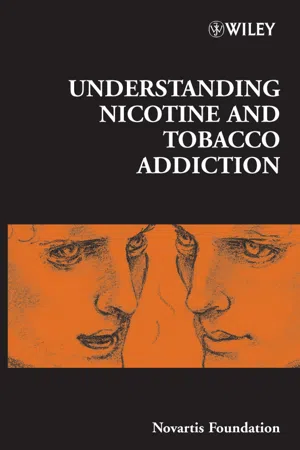
This book deals with the problems involved in understanding and treating nicotine and tobacco addiction. Topics covered include the nature of the worldwide health problem posed by cigarette smoking, the psychodynamics of cigarette addiction, and the basic pharmacology and biochemistry of nicotine and its effect on the brain. Further chapters analyse the genetic basis of susceptibility to nicotine addiction. Finally, the contributors address approaches to therapy. A continuing theme in the discussions throughout the book is how best to treat nicotine addiction, given that many smokers would like to stop smoking but are unable to do so because of their addiction.
This book will be of great value to all psychologists and psychiatrists working on addiction, specifically to nicotine but also to other compounds and behaviours. It will also be of interest to neuroscientists and pharmacologists working on nicotine receptors and the brain pathways involved in dependence, as well as to biochemists, molecular biologist and to public health officials.
eBook - PDF
Understanding Nicotine and Tobacco Addiction
- 285 pages
- English
- PDF
- Available on iOS & Android
eBook - PDF
Understanding Nicotine and Tobacco Addiction
About this book
Information
Table of contents
- Cover
- Contents
- Chair’s introduction
- The hazards of smoking and the benefits of stopping
- Animal models for nicotine dependence
- Defining and assessing nicotine dependence in humans
- General discussion I
- Nicotinic acetylcholine receptor functions in the CNS investigated with a novel method of stereotaxic gene re-expression in knockout mice
- Nicotine-mediated activation of signal transduction pathways
- Complementary roles for the accumbal shell and core in nicotine dependence
- The dopamine D3 system: new opportunities for dopamine-based reward
- Pathways and systems involved in nicotine dependence
- Localizing tobacco dependence pathways with functional brain imaging
- Pharmacogenetic approaches to nicotine dependence treatment
- Pharmacogenomics and smoking cessation
- General discussion II
- What limits the efficacy of current nicotine replacement therapies?
- Exploring behavioural mechanisms of nicotine replacement therapy for smoking cessation
- Modifying the metabolism of nicotine as a therapeutic strategy
- Challenges in discovery and development of pharmacotherapies for tobacco addiction
- Final discussion
- Contributor Index
- Subject Index
Trusted by 375,005 students
Access to over 1.5 million titles for a fair monthly price.
Study more efficiently using our study tools.
Frequently asked questions
Yes, you can cancel anytime from the Subscription tab in your account settings on the Perlego website. Your subscription will stay active until the end of your current billing period. Learn how to cancel your subscription
No, books cannot be downloaded as external files, such as PDFs, for use outside of Perlego. However, you can download books within the Perlego app for offline reading on mobile or tablet. Learn how to download books offline
Perlego offers two plans: Essential and Complete
- Essential is ideal for learners and professionals who enjoy exploring a wide range of subjects. Access the Essential Library with 800,000+ trusted titles and best-sellers across business, personal growth, and the humanities. Includes unlimited reading time and Standard Read Aloud voice.
- Complete: Perfect for advanced learners and researchers needing full, unrestricted access. Unlock 1.5M+ books across hundreds of subjects, including academic and specialized titles. The Complete Plan also includes advanced features like Premium Read Aloud and Research Assistant.
We are an online textbook subscription service, where you can get access to an entire online library for less than the price of a single book per month. With over 1.5 million books across 990+ topics, we’ve got you covered! Learn about our mission
Look out for the read-aloud symbol on your next book to see if you can listen to it. The read-aloud tool reads text aloud for you, highlighting the text as it is being read. You can pause it, speed it up and slow it down. Learn more about Read Aloud
Yes! You can use the Perlego app on both iOS and Android devices to read anytime, anywhere — even offline. Perfect for commutes or when you’re on the go.
Please note we cannot support devices running on iOS 13 and Android 7 or earlier. Learn more about using the app
Please note we cannot support devices running on iOS 13 and Android 7 or earlier. Learn more about using the app
Yes, you can access Understanding Nicotine and Tobacco Addiction by Gregory R. Bock, Jamie A. Goode, Gregory R. Bock,Jamie A. Goode in PDF and/or ePUB format, as well as other popular books in Medicine & Psychiatry & Mental Health. We have over 1.5 million books available in our catalogue for you to explore.