Anticipation
eBook - ePub

Anticipation

A Novel

  1. 480 pages
  2. English
  3. ePUB (mobile friendly)
  4. Available on iOS & Android
eBook - ePub

Anticipation

A Novel

About this book

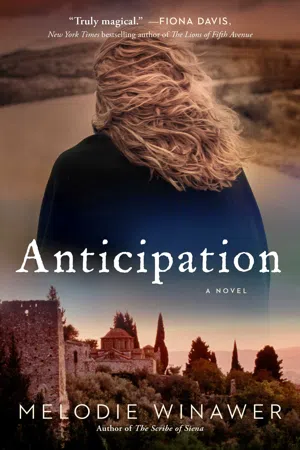
From the author of the "engrossing historical epic" ( Booklist ) The Scribe of Siena comes a thrilling tale set in the crumbling city of Mystras, Greece, in which a scientist's vacation with her young son quickly turns into a fight for their lives after they cross paths with a man out of time. After the death of her beloved husband and becoming a single parent to her nine-year-old son Alexander, overworked scientist Helen desperately needs an escape. So when Alexander proposes a trip to Greece—somewhere he's always dreamed of visiting—Helen quickly agrees. After spending several days exploring the tourist-filled streets, they stumble upon the ancient city of Mystras and are instantly drawn to it. Its only resident is Elias, a mysterious tour guide living on the city's edges…both physically and temporally. In 1237, Elias's mother promised his eternal service to the Profitis Ilias in Mystras in exchange for surviving a terrible illness. But during his 800 years of labor, he's had one common enemy: the noble Lusignan family. The Lusignan line is cursed by a deadly disease that worsens with each generation, and a prophecy hints that Elias's blood is their only hope for a cure. He has managed to survive throughout the centuries, but the line has dwindled down to the last Lusignan and he is desperate to avert his family's destiny. When Elias runs into Helen, he meets his match for the first time—but he unwittingly puts both her and her young son in danger as a result. With time running out and an enemy after them, Elias and Helen are forced to choose between the city they love, and each other. Blending the historical romance of Diana Gabaldon, the rich detail of Philippa Gregory's novels, and Dan Brown's fast-paced suspense, Anticipation is a thrilling and satisfying read like no other.
Frequently asked questions

Yes, you can cancel anytime from the Subscription tab in your account settings on the Perlego website. Your subscription will stay active until the end of your current billing period. Learn how to cancel your subscription.
No, books cannot be downloaded as external files, such as PDFs, for use outside of Perlego. However, you can download books within the Perlego app for offline reading on mobile or tablet. Learn more here.
Perlego offers two plans: Essential and Complete
  • Essential is ideal for learners and professionals who enjoy exploring a wide range of subjects. Access the Essential Library with 800,000+ trusted titles and best-sellers across business, personal growth, and the humanities. Includes unlimited reading time and Standard Read Aloud voice.
  • Complete: Perfect for advanced learners and researchers needing full, unrestricted access. Unlock 1.4M+ books across hundreds of subjects, including academic and specialized titles. The Complete Plan also includes advanced features like Premium Read Aloud and Research Assistant.
Both plans are available with monthly, semester, or annual billing cycles.
We are an online textbook subscription service, where you can get access to an entire online library for less than the price of a single book per month. With over 1 million books across 1000+ topics, we’ve got you covered! Learn more here.
Look out for the read-aloud symbol on your next book to see if you can listen to it. The read-aloud tool reads text aloud for you, highlighting the text as it is being read. You can pause it, speed it up and slow it down. Learn more here.
Yes! You can use the Perlego app on both iOS or Android devices to read anytime, anywhere — even offline. Perfect for commutes or when you’re on the go.
Please note we cannot support devices running on iOS 13 and Android 7 or earlier. Learn more about using the app.
Yes, you can access Anticipation by Melodie Winawer in PDF and/or ePUB format, as well as other popular books in Literature & Women in Fiction. We have over one million books available in our catalogue for you to explore.

Information

part one FIRST LIFE

What if some day or night a demon were to steal after you into your loneliest loneliness and say to you: ā€œThis life as you now live it and have lived it, you will have to live once more and innumerable times more; and there will be nothing new in it, but every pain and every joy and every thought and sigh and everything unutterably small or great in your life will have to return to you….ā€
—Nietzsche, The Gay Science, sec. 341, Walter Kaufmann, trans.

chapter one

The moment one shared life explodes into two, both lives hang in the balance. Chryse had already lost two children and despaired that a living being would ever enter the world from her perilous body. She feared every kick beneath her ribs would be the last, and that she would look again into the dull eyes of a life snuffed out before its time.
She awoke in the night with a gush that drenched her bedclothes, then a searing pain that made her feel as if she might tear in two. She had no time to send for the midwife, but she was a midwife herself, and she knew this child was coming early. Her husband, JƩhan, had marched with his regiment the day before and was encamped far from home. Tonight she was alone, crouching on the dirt floor while a rainstorm raged and wind wailed through the gaps in the wooden shutters.
After a minute’s pause, the pain began again. Had there been a messenger to send, she could have found help in one of the other houses surrounding the residence of the Frankish prince Villehardouin, who ruled the valley and the land beyond. But there was no messenger.
In the end, it was not her experience that guided her when the time came; the knowledge came from the labyrinth of childbirth. At dawn, the pains came hard and fast with no time to breathe between, and then he was there, first head, then body, all four limbs—blessed Theotokos, mother of God. A boy with the sea-gray eyes of a newborn. As she lifted the slippery child into her arms, he took his labored first breath. His lips were dusky blue; he fought the air like an enemy.
Not this one, too, please no.
Chryse cut the baby’s cord with the scissors she had used for others’ births. Did she imagine the resistance in that twist of vessels, the reluctance to sever the last physical connection between herself and this delicate life? Around her neck the mother’s amulet of protection swung forward, etched with the she-demon Abyzou being stabbed by a holy rider’s sword.
You will not have him, Abyzou. This one is mine.
She rubbed her son roughly with a cloth until he squirmed and wailed. She had not had time to draw water from the well or to warm it on the fire to mix with salt. Chryse swaddled her son and put him to her breast. He struggled between sucks, pulling away while his little chest heaved with effort. Chryse had seen tragedy come to lives that started just like this one. She closed her eyes.
Profitis Ilias, who looks upon new mothers and babes with compassion, hear this prayer. Breathe air into his lungs…
The wind gusted, clattering the bare branches of the olive tree outside.
Profitis Ilias, answer me, and I will promise you whatever you ask.
The wind stopped as suddenly as it had come, and into the silence a voice spoke in Chryse’s head.
Bring him to me now.

Chryse wrapped her son in a wool blanket and bound him against her chest; his heart beat fast against her own. She pulled her cloak around them both and closed the door behind her. At first the road was flat, winding through the valley’s bare-limbed orange trees, but soon it began to climb. Myzithras, it was called, this solitary peak rising starkly out of the valley, silhouetted against the snowcapped Taygetos mountains behind. It was just daylight, and goats’ bells echoed in the morning air.
Mud made the way treacherous, and the boulders were slippery with moss. Once, Chryse lost her footing, and she wrapped her arms around the bundle on her chest, rather than putting her hands out to break her fall. With that instinct, she realized she had become a mother. Chryse’s knee hit rock, and the pain made her eyes tear, but then she was up again, her robe muddy and her knee burning.
Farther up, the trees thinned and the wind blew fiercely with nothing to block it but scrub and scattered gray-brown rocks. As Chryse neared the peak, the sun cleared the ring of mountains surrounding the valley. Finally she reached the tiny shrine of Profitis Ilias, its white stone bright in the sun. Chryse ducked inside the low doorway.
It was quiet in the shrine, the wind blocked by the thick walls, but the silence was receptive, an ear into which prayers might be spoken and heard. She unwrapped her son from her chest. His eyes were closed, and for a moment her heart stopped. But there it was, a lift of his shoulders, his next breath. She straightened her arms to raise the baby above her head.
ā€œI have brought him to you,ā€ Chryse said. She waited until her arms ached. When the answer came, she could not tell whether the voice was in her head or in the air.
In the years that come, a city will grow upon this hill, where my shrine now stands. The city will flourish as the heart and soul of this land and its people. You shall name your son after me, and he shall be mine. He will serve the city that grows upon the hill for all its days, and in return I shall breathe air into his lungs. But heed me: for when I call him he must come, and his lives will be in my service.
ā€œI heed you, Profitis Ilias, and my son heeds you also,ā€ Chryse said. A wind rose again: first a hum, then a rush, and finally a keening wail, and at the sound’s peak her son took the first strong breath of his life. His face flushed and his eyes opened to fix upon her face.
As Chryse made her way down the steep path back to the house, she heard an echo: For when I call him he must come, and his lives will be in my service.
Chryse’s son felt suddenly heavy with the weight of that word: lives.
It’s a weighty name, Helen. I’m not Greek, or Spartan for that matter, which would be more accurate. No one is really Spartan anymore, not since Menelaus had the bad luck of marrying the most beautiful woman in the world. My mother, who was a New York Jewish girl, was reading the Iliad when she was pregnant with me and got inspired. My face is fine, but no wars have resulted from it. I consider this a good thing.
Names are the least of what we load on our kids’ little backs, inadvertently or otherwise. ā€œParenting is not for sissies,ā€ my mom used to say. I would like to tell her, now that I am a parent, too, how right she was.
I was reading Mary Renault’s Fire from Heaven when I found out I was pregnant, which partially explains my son’s ending up with the name Alexander. I say partially because I’d always loved the name, but having Alexander the Great on the brain when a baby was beginning life in my belly hammered the decision home. Alexander seems to be handling his name fine so far, but there is an opacity about kids. You never quite know what they’re thinking, even when they tell you, which they usually don’t.
Alexander is particularly opaque, especially about what’s bothering him. Until he blows. But, fortunately, that doesn’t happen very often. He reminds me of his dad, Oliver—the way he thinks before talking, as if he is gravely considering the consequences. Oliver almost never got mad either, and I don’t like to remember the few times he did—especially now. I am always looking for things that remind me of the best of Oliver, now that memories are all that’s left. Alexander is a natural place to find them. I try not to look too hard. My kid is himself, he’s not a window into someone else.
Almost a year later, I wonder whether my memories of Oliver are accurate. Was he actually perfect or do I just remember him as perfect? I suppose there is an advantage to dying suddenly. No one has time to think of you as sick, or failing, or needy. No one gets tired of your whining, no one has to watch you fade in the months before the end. Butterflies, I read once, die by just drifting to the ground, beautiful to the last second. Poetic, but it doesn’t help me much at the moment.
I am not at the point of appreciating anything positive about Oliver’s death, though some well-meaning acquaintances say at least he didn’t suffer long. I don’t know how long it takes to drown, nor whether drowning for a minute is worse than dying slowly, like my dad from Parkinson’s disease. So I can’t console myself with that, either. It is not a coincidence that I have devoted my life to studying the science of neurodegenerative diseases, while I watch my father gradually slow down to a nearly motionless state, except on those terrible moments when he falls and can’t stop himself from hitting the ground. He went from playing tennis to playing checkers, from living alone to living with help, and finally, reluctantly, from his apartment to a nursing home. Our paths were linked: nursing home for him, neurodegenerative disease lab for me.
My last few months with Oliver were ordinary. Oliver and I ignored one another healthily, the way normal parents do once the child eclipse hits. I was writing a proposal for a National Institutes of Health grant, while trying to imagine how we’d host Thanksgiving dinner for my extended family in our six-hundred-square-foot Manhattan apartment. Oliver was preparing for a foster child’s adoption case that kept him talking long after we’d turned the lights out.
In the meantime, we were preoccupied with ordinary things: complaints from the downstairs neighbor about my walking barefoot to the bathroom in the night, and Alexander’s troubles with writing in second grade. Oliver coaxed Alexander through p’s and q’s and b’s and d’s, more patient than I ever could be.
At night, we had moments together, if not necessarily at leisure. ā€œHow’s my sweet cellular biologist?ā€ he’d say. Oliver was the only person I’ve ever met who used the words sweet and cellular biologist in the same sentence. The week before he died, Oliver came home after Alexander’s bedtime to find me staring at a screen filled with incorrectly formatted tables.
ā€œBad at Excel,ā€ I said grimly. He kissed the back of my neck. ā€œHow about some help?ā€ he said. Oliver’s competence with Excel was legendary. He sat down next to me. I watched, letting relief wash over me.
A few months later I was on my own—with Alexander and Excel.

The first Monday in February blossomed into an epic childcare fail. The afterschool program I’d relied on to amuse Alexander until I could exit work—as usual, running, leaving multiple unfinished tasks in piles on my desk—had been shut down by a stomach bug. This meant Alexander, now a restless fourth grader who would have already spent seven hours that day sitting as still as possible in an overheated public school classroom, had to join me for a critically important, endless afternoon meeting with potential donors, a meeting that my lab’s survival hinged upon.
My research is, for want of a better word, basic. This means that I study things that nonscientific people would find incomprehensible or downright dull. Most of the time, I work with cells growing in a dish. The implications of what I do are big, but the cells are tiny, and my job is tough to explain.
ā€œSo, how does it help people exactly, this, er, science you are doing?ā€ my aunt Delia asked while filling her mouth with a roast beef canapĆ© at our wedding. That was neither the first time I’d heard that exact sentence, nor the last.
Despite all that, the actual experience of growing nerve cells is mesmerizingly beautiful: the elegant pattern of their delicate projections silhouetted like tree branches in winter, the gray-white grainy electron microscope images of mitochondria, the cells’ powerhouses, with their curious internal folds, hinting at mystery.
On the way to Alexander’s school, I plotted the best approach to avoid a work/life disaster. I could give him a device with a screen and headphones, then put him in a corner. There was also bribery—the $49 PokĆ©mon box he’d been begging for. I was still scheming when I picked him up at Door ā€œC,ā€ the eloquently named exit to the asphalt play yard behind his public school.
Alexander looked poignantly alone, his head turning while he searched for me. His backpack seemed impossibly big on his hunched shoulders. In that moment he looked, fleetingly, like Oliver on our first deliberate date, a boat tour of the Hudson River. I’d seen Oliver first that day too, searching the crowds for me. That was the moment I’d fallen in love, when his face was filled with anti...

Table of contents

  1. Cover
  2. Title Page
  3. Dedication
  4. Prologue
  5. Part One: First Life
  6. Part Two: Sicily
  7. Part Three: Philosophy
  8. Part Four: Independence
  9. Part Five: A Life in Ruins
  10. Author’s Note
  11. Acknowledgments
  12. About the Author
  13. Copyright