Elevate your Ruby skills to an advanced level by deepening your understanding of the design principles, best practices, and trade-offs involved in implementation approaches to future-proof your Ruby applications Key Features• Learn Ruby web application design principles and strategies for databases, security, and testing from a Ruby committer • Understand the design principles behind polished Ruby code and trade-offs between implementation approaches• Use metaprogramming and DSLs to reduce the amount of code needed without decreasing maintainabilityBook DescriptionAnyone striving to become an expert Ruby programmer needs to be able to write maintainable applications.Polished Ruby Programming will help you get better at designing scalable and robust Ruby programs, so that no matter how big the codebase grows, maintaining it will be a breeze.This book takes you on a journey through implementation approaches for many common programming situations, the trade-offs inherent in each approach, and why you may choose to use different approaches in different situations.You'll start by refreshing Ruby fundamentals, such as correctly using core classes, class and method design, variable usage, error handling, and code formatting. Then you'll move on to higher-level programming principles, such as library design, use of metaprogramming and domain-specific languages, and refactoring. Finally, you'll learn principles specific to web application development, such as how to choose a database and web framework, and how to use advanced security features.By the end of this Ruby programming book, you'll be a well rounded web developer with a deep understanding of Ruby.While most code examples and principles discussed in the book apply to all Ruby versions, some examples and principles are specific to Ruby 3.0, the latest release at the time of publication.What you will learn• Use Ruby's core classes and design custom classes effectively• Explore the principles behind variable usage and method argument choice• Implement advanced error handling approaches such as exponential backoff• Design extensible libraries and plugin systems in Ruby• Use metaprogramming and DSLs to avoid code redundancy• Implement different approaches to testing and understand their trade-offs• Discover design patterns, refactoring, and optimization with Ruby• Explore database design principles and advanced web app securityWho this book is forThis book is for Ruby programmers who are comfortable in coding with Ruby but want to advance their skills by mastering the deeper principles and best practices behind writing maintainable, scalable, optimized, and well-structured Ruby code. This book won't teach you the basics of Ruby – you'll need intermediate knowledge and practical experience before you can dive in.
- English
- ePUB (mobile friendly)
- Available on iOS & Android
eBook - ePub
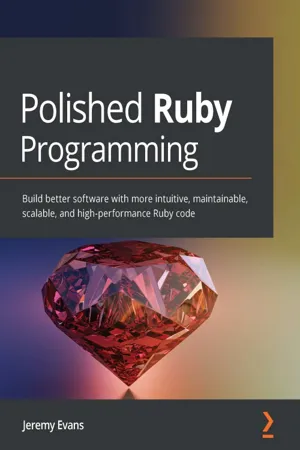
Polished Ruby Programming
About this book
Information
Table of contents
- Polished Ruby Programming
- Contributors
- Preface
- Section 1: Fundamental Ruby Programming Principles
- Chapter 1: Getting the Most out of Core Classes
- Chapter 2: Designing Useful Custom Classes
- Chapter 3: Proper Variable Usage
- Chapter 4: Methods and Their Arguments
- Chapter 5: Handling Errors
- Chapter 6: Formatting Code for Easy Reading
- Section 2: Ruby Library Programming Principles
- Chapter 7: Designing Your Library
- Chapter 8: Designing for Extensibility
- Chapter 9: Metaprogramming and When to Use It
- Chapter 10: Designing Useful Domain-Specific Languages
- Chapter 11: Testing to Ensure Your Code Works
- Chapter 12: Handling Change
- Chapter 13: Using Common Design Patterns
- Chapter 14: Optimizing Your Library
- Section 3: Ruby Web Programming Principles
- Chapter 15: The Database Is Key
- Chapter 16: Web Application Design Principles
- Chapter 17: Robust Web Application Security
- Assessments
- Other Books You May Enjoy
Trusted by 375,005 students
Access to over 1.5 million titles for a fair monthly price.
Study more efficiently using our study tools.
Frequently asked questions
Yes, you can cancel anytime from the Subscription tab in your account settings on the Perlego website. Your subscription will stay active until the end of your current billing period. Learn how to cancel your subscription
No, books cannot be downloaded as external files, such as PDFs, for use outside of Perlego. However, you can download books within the Perlego app for offline reading on mobile or tablet. Learn how to download books offline
Perlego offers two plans: Essential and Complete
- Essential is ideal for learners and professionals who enjoy exploring a wide range of subjects. Access the Essential Library with 800,000+ trusted titles and best-sellers across business, personal growth, and the humanities. Includes unlimited reading time and Standard Read Aloud voice.
- Complete: Perfect for advanced learners and researchers needing full, unrestricted access. Unlock 1.5M+ books across hundreds of subjects, including academic and specialized titles. The Complete Plan also includes advanced features like Premium Read Aloud and Research Assistant.
We are an online textbook subscription service, where you can get access to an entire online library for less than the price of a single book per month. With over 1.5 million books across 990+ topics, we’ve got you covered! Learn about our mission
Look out for the read-aloud symbol on your next book to see if you can listen to it. The read-aloud tool reads text aloud for you, highlighting the text as it is being read. You can pause it, speed it up and slow it down. Learn more about Read Aloud
Yes! You can use the Perlego app on both iOS and Android devices to read anytime, anywhere — even offline. Perfect for commutes or when you’re on the go.
Please note we cannot support devices running on iOS 13 and Android 7 or earlier. Learn more about using the app
Please note we cannot support devices running on iOS 13 and Android 7 or earlier. Learn more about using the app
Yes, you can access Polished Ruby Programming by Jeremy Evans in PDF and/or ePUB format, as well as other popular books in Computer Science & Computer Science General. We have over 1.5 million books available in our catalogue for you to explore.