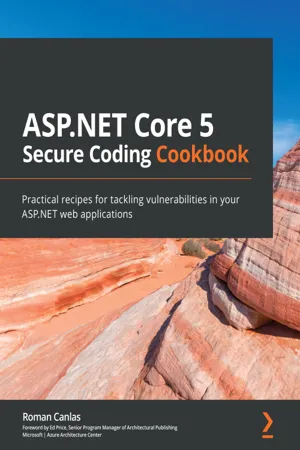
Learn how to secure your ASP.NET Core web app through robust and secure codeKey Features• Discover the different types of security weaknesses in ASP.NET Core web applications and learn how to fix them• Understand what code makes an ASP.NET Core web app unsafe• Build your secure coding knowledge by following straightforward recipesBook DescriptionASP.NET Core developers are often presented with security test results showing the vulnerabilities found in their web apps. While the report may provide some high-level fix suggestions, it does not specify the exact steps that you need to take to resolve or fix weaknesses discovered by these tests. In ASP.NET Secure Coding Cookbook, you'll start by learning the fundamental concepts of secure coding and then gradually progress to identifying common web app vulnerabilities in code. As you progress, you'll cover recipes for fixing security misconfigurations in ASP.NET Core web apps. The book further demonstrates how you can resolve different types of Cross-Site Scripting. A dedicated section also takes you through fixing miscellaneous vulnerabilities that are no longer in the OWASP Top 10 list. This book features a recipe-style format, with each recipe containing sample unsecure code that presents the problem and corresponding solutions to eliminate the security bug. You'll be able to follow along with each step of the exercise and use the accompanying sample ASP.NET Core solution to practice writing secure code. By the end of this book, you'll be able to identify unsecure code causing different security flaws in ASP.NET Core web apps and you'll have gained hands-on experience in removing vulnerabilities and security defects from your code.What you will learn• Understand techniques for squashing an ASP.NET Core web app security bug• Discover different types of injection attacks and understand how you can prevent this vulnerability from being exploited• Fix security issues in code relating to broken authentication and authorization• Eliminate the risks of sensitive data exposure by getting up to speed with numerous protection techniques• Prevent security misconfiguration by enabling ASP.NET Core web application security features• Explore other ASP.NET web application vulnerabilities and secure coding best practicesWho this book is forThis ASP.NET Core book is for intermediate-level ASP.NET Core web developers and software engineers who use the framework to develop web applications and are looking to focus on their security using coding best practices. The book is also for application security engineers, analysts, and specialists who want to know more about securing ASP.NET Core using code and understand how to resolve issues identified by the security tests they perform daily.
- English
- ePUB (mobile friendly)
- Available on iOS & Android
eBook - ePub
ASP.NET Core 5 Secure Coding Cookbook
About this book
Information
Table of contents
- ASP.NET Core 5 Secure Coding Cookbook
- Foreword
- Preface
- Chapter 1: Secure Coding Fundamentals
- Chapter 2: Injection Flaws
- Chapter 3: Broken Authentication
- Chapter 4: Sensitive Data Exposure
- Chapter 5: XML External Entities
- Chapter 6: Broken Access Control
- Chapter 7: Security Misconfiguration
- Chapter 8: Cross-Site Scripting
- Chapter 9: Insecure Deserialization
- Chapter 10: Using Components with Known Vulnerabilities
- Chapter 11: Insufficient Logging and Monitoring
- Chapter 12: Miscellaneous Vulnerabilities
- Chapter 13: Best Practices
- Other Books You May Enjoy
Trusted by 375,005 students
Access to over 1.5 million titles for a fair monthly price.
Study more efficiently using our study tools.
Frequently asked questions
Yes, you can cancel anytime from the Subscription tab in your account settings on the Perlego website. Your subscription will stay active until the end of your current billing period. Learn how to cancel your subscription
No, books cannot be downloaded as external files, such as PDFs, for use outside of Perlego. However, you can download books within the Perlego app for offline reading on mobile or tablet. Learn how to download books offline
Perlego offers two plans: Essential and Complete
- Essential is ideal for learners and professionals who enjoy exploring a wide range of subjects. Access the Essential Library with 800,000+ trusted titles and best-sellers across business, personal growth, and the humanities. Includes unlimited reading time and Standard Read Aloud voice.
- Complete: Perfect for advanced learners and researchers needing full, unrestricted access. Unlock 1.5M+ books across hundreds of subjects, including academic and specialized titles. The Complete Plan also includes advanced features like Premium Read Aloud and Research Assistant.
We are an online textbook subscription service, where you can get access to an entire online library for less than the price of a single book per month. With over 1.5 million books across 990+ topics, we’ve got you covered! Learn about our mission
Look out for the read-aloud symbol on your next book to see if you can listen to it. The read-aloud tool reads text aloud for you, highlighting the text as it is being read. You can pause it, speed it up and slow it down. Learn more about Read Aloud
Yes! You can use the Perlego app on both iOS and Android devices to read anytime, anywhere — even offline. Perfect for commutes or when you’re on the go.
Please note we cannot support devices running on iOS 13 and Android 7 or earlier. Learn more about using the app
Please note we cannot support devices running on iOS 13 and Android 7 or earlier. Learn more about using the app
Yes, you can access ASP.NET Core 5 Secure Coding Cookbook by Roman Canlas, Ed Price in PDF and/or ePUB format, as well as other popular books in Computer Science & Programming Languages. We have over 1.5 million books available in our catalogue for you to explore.