In Asia and the Pacific, 1.8 billion people still rely on traditional cooking methods using fires and solid fuels. The wider uptake of cleaner cooking solutions is vital for achieving the Sustainable Development Goal 7 objective of universal access to modern, affordable, reliable, and sustainable modern energy. It is also important for the environment and human health. This publication presents the results of a study on household cooking practices in the Philippines and provides insights and recommendations to encourage clean cooking in the country. The findings identify policy, information, technology, and financing gaps that must be addressed to boost the development and market expansion of clean cooking technologies.
- 70 pages
- English
- ePUB (mobile friendly)
- Available on iOS & Android
eBook - ePub
About this book
Information
1. Introduction
According to the World Health Organization (WHO), household air pollution (HAP) is the “single most important environmental health risk factor worldwide.” HAP is often caused by the still pervasive use of polluting fuels such as charcoal, cokes, fuelwood, or agricultural wastes for cooking, lighting and heating. These inefficient cooking practices produce high levels of air pollutants such as particulate matter (PM2.5), Carbon monoxide (CO), sulfur dioxide (SO2), and nitrogen dioxide (NO2)—exposure to which have been associated with various health concerns.1
It is estimated that 4.3 million of the 7 million premature deaths due to air pollution each year are from illnesses attributable to HAP, which include noncommunicable diseases (NCDs) such as stroke, ischemic heart disease, lung cancer, and chronic obstructive pulmonary disease (COPD). Furthermore, HAP disproportionately affects the world’s most vulnerable—putting women, children, the elderly, the displaced and the extremely impoverished population at a higher risk of disease from exposure (footnote 1). In 2020, ESMAP and the World Bank estimated that the costs to the global economy of meeting the 2030 targets of universal access to clean cooking amounts to $2.4 trillion annually, with the health impact alone accounting for $1.4 trillion or 58.3% of this cost. Also included in this cost estimate are the costs to climate ($0.2 trillion) and gender ($0.8 trillion).2
The ultimate goal of the United Nations (UN) is to end all forms of poverty and hunger, protect the planet from degradation, ensure prosperous and fulfilling lives for human beings, and foster peaceful, just, and inclusive societies.3 One of the 17 Sustainable Development Goals (SDGs), i.e., SDG 7, is to “ensure access to affordable, reliable, sustainable and modern energy for all.” This goal has five major targets, namely: (i) universal access to modern technology; (ii) increase global percentage of renewable energy; (iii) double the improvement in energy efficiency; (iv) promote access, technology and investments in clean energy; and (v) expand and upgrade energy services for developing countries (footnote 3).
Universal access to clean cooking, along with universal access to electricity, is an integral element of the SDG7 target of universal access to modern technology to be achieved by 2030. ESMAP, in 2020, identified these clean cooking solutions from the health perspective; among these are liquefied petroleum gas (LPG), electricity, improved cookstoves (ICS) such as best-in-class gasifiers, biogas digesters, and solar cookers (footnote 2).
The importance of universal access to clean cooking cannot be overemphasized. HAP, brought about by the use of inefficient cooking, not only impacts health but also affects other factors of development such as poverty, gender inequality, environmental degradation, air pollution, and climate change. Increasing access to clean fuels and technologies can therefore greatly contribute to the achievement of 10 out of the 17 SDG Goals.
In the latest Tracking SDG 7: Energy Progress Report, 2020, global access to clean cooking is reported to have increased from 56% in 2010 to 63% in 2018 leaving an estimated 2.8 billion people worldwide without access to cooking systems.4 Of these, 1.8 billion or 64% live in Asia and the Pacific.5 While there has been some progress, the pace is not sufficient to achieve the universal access target by 2030. It is also apparent that this reported increase in access to clean cooking has not cascaded evenly across all countries worldwide. As reported, the top 20 countries with the largest populations lacking access to clean cooking fuel and technologies accounted for 82% of the global population without access between 2014 and 2018. The Philippines is listed among these 20 countries.
Access to clean cooking in the Philippines is at 46% of its population in 2018 with rural areas lagging at 27% (Table 1). This leaves some 54% or around 57.6 million people relying on traditional cement cookstoves and utilizing charcoal or fuelwood as cooking fuel. Compared with other countries in Southeast Asia such as Indonesia and Viet Nam, the pace of increase in clean cooking access in the Philippines has been much slower. The lack of information on the extent of HAP and its impact on health and environment of communities in the Philippines could be a reason for the apparent inattention given to the ensuing health and environmental issues from traditional cooking practices, resulting to this relatively lackluster performance.
Table 1: Comparison of Clean Cooking Access of Southeast Asian Countries, 2018
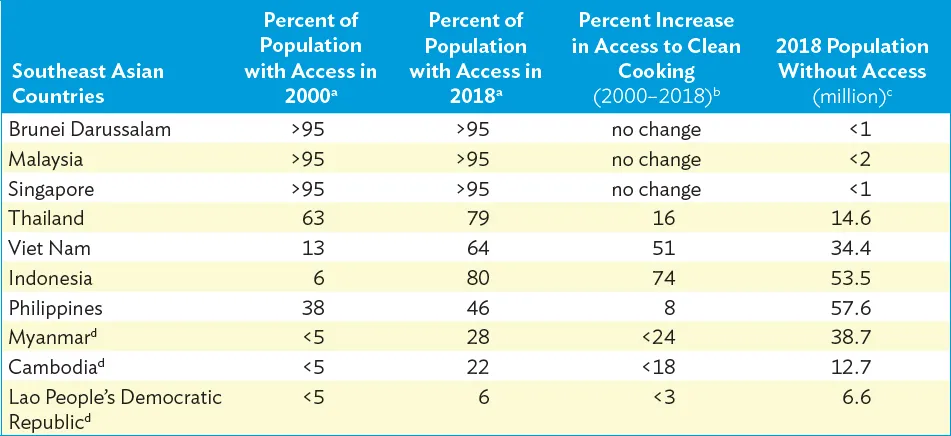
a International Energy Agency, International Renewable Energy Agency, United Nations Statistics Division, World Bank, World Health Organization. 2020. Tracking SDG 7: The Energy Progress Report. Washington DC.
b Values are computed from % of population with access in 2000 and 2008.
c Computed from percent of population without access in 2018 against World Bank 2018 population data from World Bank. 2020. World Development Indicators (Population, total). Last updated 1 July 2020. Accessed 6 August 2020.
d Percent of population with access in 2000 were approximate values so percent increase was also approximated.
A policy brief released by UN in 2018 identified three major barriers or challenges to efforts of transitioning toward universal access to clean cooking. These include: (i) supply issues or the lack of clean, affordable, and available supply of clean fuel and energy sources; (ii) demand issues which include cost of clean fuel and/or device, consumer preference and practices, and overall awareness; and, (iii) enabling environment or the existing monetary and fiscal policies that restrict or inhibit sector growth and sustainability whether due to lack of funding, poor implementation, or poor cross-sectoral coordination.6
With energy policymakers, clean cooking technology investors, and other stakeholders as the intended audience; this report aims to provide, through the Philippines’ context, a perspective on
(I)current fuel–technology combinations that households employ, their efficiency and the effect on indoor air quality;
(II)the costs involved in the utilization of current fuel–technology combinations and the impact of switching to clean cooking on these costs; and,
(III)the barriers and possible solutions to switching from traditional, inefficient stoves and fuel to clean cooking.
The study will also augment available information and foster understanding of the extent of HAP and the prevailing barriers and issues that hinder deployment of clean cooking technologies and serve as invaluable inputs to finding viable solution to increasing access to clean cooking. From the output of the study, the Asian Development Bank (ADB) can assess where it could contribute knowledge and resources in support of clean cooking access efforts not only in the Philippines but also in its other developing member countries (DMCs) across the Asia and Pacific region.
The first three chapters provide the Philippine context on cooking practices and preferences that define prevailing fuel–technology combinations and how these affect indoor air quality and household health. It investigates the degree of pollution that household members are exposed to. This information is vital in order to generate more appreciation of the issue of indoor air pollution by local governments and their constituents. The next chapters focus on the barriers, including the costs, and the prospects in switching to clean cooking. The report proceeds as follows:
Chapter 2 situates the reader to the Philippines’ context. A broader context on fuel use and cookstove preferences are initially presented. This is followed by the results of household surveys that shows current and site-specific cooking practices and local preferences that influence prevailing fuel–technology combinations.
Chapter 3 discusses the results of field emission tests, done in conjunction with the household surveys. The water boiling test (WBT) method was adopted for field emission testing to provide actual field measurements of the amount of air pollutants (PM2.5, CO, NO2, SO2) emitted by the various fuel–technology combinations employed by households in the study sites. These emission rate measurements for PM2.5 and CO were compared with the WHO Guidelines for indoor air quality: household fuel combustion, which set standards for clean burning in the homes. Emission concentration of PM2.5, CO, NO2, SO2 were also compared with the United States Environmental Protection Agency (US EPA) Air Quality Index (AQI), which provided comparisons between ranges of emission and its possible consequences to health.
Chapter 4 presents the results of laboratory tests conducted and its implications to the efficiency of various fuel–technology combinations. Laboratory tests conducted also employed the WBT method, with the controlled environment allowing for comparison among results not only of the emissions but also in terms of the thermal efficiency of the different fuel–technology combinations. The thermal efficiency tests provided controlled estimates of time and fuel needed to heat a specific quantity of water. This also allowed for the estimation of costs involved using household survey results of cooking practice duration.
Chapter 5 discusses the perceived barriers to shifting to clean cooking technologies and assesses the prospect of such a shift. This chapter further estimates the costs and emission reduction effect of switching from exclusive use of traditional and inefficient cooking practices to cleaner solutions. Due to the practice of fuel stacking, the impact on those employing a combination of cooking modalities was not determined, although, it may be deduced that some emission reduction can be achieved, if households switch to the use of improved cookstoves.
Chapter 6 concludes with the major findings, key takeaways, and recommendations formulated from the Philippines cooking study experience.
2. Typical Filipino Cooking Practices and Access to Clean Cooking
The Philippines, composed of 7,641 islands, is an archipelagic country with a population estimated at 108.1 million as of 2019, 51.2% of whom reside in urban areas.7 Culturally diverse, the various colonial influences, faith-based customs and limitations, and indigenous traditions are evident in its food. Traditional Filipino dishes are generally simple, local cuisines may differ based on regional location and dominant agricultural produce in each area. Viands for meals are usually a combination of fish or meat and vegetables cooked with broth. Dried and fresh fish are pan-fried in oil or grilled over firewood or charcoal. Most if not all meals revolve around the staple steamed rice. As with any typical Filipino household, women are still more often relegated with the task of preparing these meals.
The local market offers a variety of cookstoves for households from traditional cooking technologies such as the traditional cement stoves that can be used together with either firewood or charcoal, or modern cookstoves utilizing clean fuels such as LPG or butane, or electricity. Improved cookstoves (ICS) that allow for continued use of biomass as fuel but offer a more efficient cooking experience are also available, though not as extensively as the traditional and modern stoves (Box 1).
Box 1: Traditional, Improved, and Modern Cook Stoves available in the Philippines
Traditional cookstoves pertain...
Table of contents
- Front Cover
- Title Page
- Copyright Page
- Contents
- Tables, Figures, and Boxes
- Foreword
- Acknowledgments
- Abbreviations
- Weights and Measures
- Executive Summary
- 1. Introduction
- 2. Typical Filipino Cooking Practices and Access to Clean Cooking
- 3. Field Emissions Tests on Household Cooking Fuel
- 4. Controlling External Factors in Laboratory Tests
- 5. The Outlook on Shifting to Modern Technology
- 6. Conclusion
- Appendixes
- References
- Footnotes
- Back Cover
Trusted by 375,005 students
Access to over 1.5 million titles for a fair monthly price.
Study more efficiently using our study tools.
Frequently asked questions
Yes, you can cancel anytime from the Subscription tab in your account settings on the Perlego website. Your subscription will stay active until the end of your current billing period. Learn how to cancel your subscription
No, books cannot be downloaded as external files, such as PDFs, for use outside of Perlego. However, you can download books within the Perlego app for offline reading on mobile or tablet. Learn how to download books offline
Perlego offers two plans: Essential and Complete
- Essential is ideal for learners and professionals who enjoy exploring a wide range of subjects. Access the Essential Library with 800,000+ trusted titles and best-sellers across business, personal growth, and the humanities. Includes unlimited reading time and Standard Read Aloud voice.
- Complete: Perfect for advanced learners and researchers needing full, unrestricted access. Unlock 1.5M+ books across hundreds of subjects, including academic and specialized titles. The Complete Plan also includes advanced features like Premium Read Aloud and Research Assistant.
We are an online textbook subscription service, where you can get access to an entire online library for less than the price of a single book per month. With over 1.5 million books across 990+ topics, we’ve got you covered! Learn about our mission
Look out for the read-aloud symbol on your next book to see if you can listen to it. The read-aloud tool reads text aloud for you, highlighting the text as it is being read. You can pause it, speed it up and slow it down. Learn more about Read Aloud
Yes! You can use the Perlego app on both iOS and Android devices to read anytime, anywhere — even offline. Perfect for commutes or when you’re on the go.
Please note we cannot support devices running on iOS 13 and Android 7 or earlier. Learn more about using the app
Please note we cannot support devices running on iOS 13 and Android 7 or earlier. Learn more about using the app
Yes, you can access Increasing Access to Clean Cooking in the Philippines by in PDF and/or ePUB format, as well as other popular books in Technology & Engineering & Environment & Energy Policy. We have over 1.5 million books available in our catalogue for you to explore.