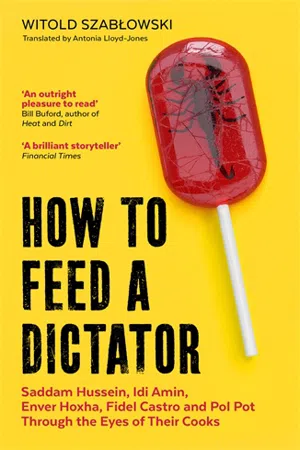
A devastatingly original look at the world's worst dictators, through the eyes of their personal chefs, by award-winning Polish author Witold Szablowski.
What is it like to cook for the most dangerous men in the world?
In this darkly funny and fascinating book, Witold Szablowski travels across four continents in search of the personal chefs of five dictators. From the savannahs of Kenya to the faded glamour of Havana, and the bombed-out streets of Baghdad, Szablowski finds the men and women who cooked fish soup for Saddam Hussein, roasted goat for Idi Amin and chopped papaya salad for Pol Pot. He reveals the strangeness of a job where a single culinary mistake could be fatal, but a well-seasoned dish could change your life. And in doing so, he lifts the veil on what life is like at the very heart of power.
As Brother Pouk’s cook, I was given my own home, almost at the centre of K5, our base. At first I lived there on my own, with everything I needed for cooking: pots, spoons, knives, chopping boards. Only later, when the camp had grown, did another cook share the cabin with me.
Near our cabin stood another one, quite empty. I didn’t know who or what it was for. Nobody talked about it, and I didn’t ask. I’d learned by then that in the Organisation if they didn’t tell you something themselves, it was better not to ask.
Every day I got up just after five to have breakfast ready for Pol Pot. From my cabin I could see his, so I often worked outside; I wanted to hear him getting up, bathing, and getting dressed.
It gave me pleasure.
At first, as I cooked, the bodyguards used to come up, one or two of them, and watch my hands. Maybe they were afraid I would try to poison him? But then Pol Pot would say, “Leave our Moeun alone.”
He trusted me entirely.
So the bodyguards left me in peace, though they went on watching me. But now they did it from a distance, discreetly. 116And not out of fear for Pol Pot’s life, but because I was young and very pretty, and they were young too.
At seven I took breakfast to Brother Pouk and the other leaders. Sister Khieu Thirith, who was Pol Pot’s secretary, taught me how to bake the kind of bread they make in Europe. We had yeast and a special tin. I’d leaven the dough, leave it overnight, and put it in the oven in its tin the next morning. Everyone said it came out very well.
At the camp we had large gardens where we grew all the fruits and vegetables we needed. Brother Pouk stressed at every step that we must be self-sufficient. Every soldier had the right to come to the garden with his mess tin and pick whatever he felt like eating, then light a fire and cook it up for himself.
They’d already been living in the jungle for several years, so by the time I got there, the gardens covered several hundred square yards and produced a large variety of fruits and vegetables. Our boys hunted wild pigs, caught fish in the lake, and bought hens from the peasants. We had our own hens too, running loose among the huts, but there were never many of them, because they caused too much confusion. So we usually bought chickens, and the same went for rice. Most of the peasants loved us and never refused to help us.
People from the villages that were under our control worked in the gardens. They planted everything imaginable there, so every day I could think up something new to cook. The sisters from the villages taught me how to cook other things and how to use the plants we had in the gardens. There was water spinach growing there, a leguminous plant that can be eaten on its own; you just have to add a little garlic and 117fish sauce. There were pumpkins, tomatoes, aubergines, and bitter gourds—that’s a kind of squash, but with a warty skin—as well as cabbages, wax gourds, broccoli, and onions.
I used to add bamboo shoots or banana flowers to the soups and salads. Bananas grew everywhere. I also used to make a banana flower salad that Brother Pouk liked very much. We had tamarind, taro, luffas, and winged beans—the pods have jagged edges, and you can eat the flowers, the leaves, the pods, and even the roots, which taste a bit like potato. As appetisers we also used to serve bamboo shoots and fruit.
The common soldiers learned how to eat turtle eggs from the Khmer Loeu, the highland Khmer. I learned to make soup out of turtle meat, though Pol Pot wasn’t fond of it. He preferred snake-meat soup.
Once in a while the Khmer Loeu would slaughter an elephant. This was always a great event, and they had special songs for the occasion. We’d dry some of the meat and store it for leaner times; it never went off, not even in the hottest weather. But our leaders refused to eat elephant meat.
Brother Pouk wisely taught his soldiers that wherever they went, first they should go and see the local gardeners, who would give them seedlings, and then the soldiers should plant them out in the jungle. In our country the earth bears fruit easily, so whenever the soldiers went to a new site to pitch camp, set an ambush, or scout out the terrain, they took water spinach seedlings and squash, aubergine, or bitter melon seeds with them in special bags. Or hot chilli peppers, which they loved, and thanks to which they had healthy stomachs. The commanders also taught them that the seeds of some of 118the plants they ate could be spat out and covered with earth, and then there was a chance of new plants growing from them. Brother Pouk used to say we should grow food at as many sites in the jungle as possible. Then the enemy would never be able to destroy us.
And it was true. Whenever we moved to a new location, we usually found some edible plants. Even in places where we stopped only for a short time, we’d find wild crops of chilli peppers or squash; evidently, someone had spat out a seed and made sure it sprouted, in accordance with Brother Pouk’s instructions.
Brother Pouk was always pleased to see these wild crops in the jungle. He knew Cambodia was under threat from the Vietnamese, the Thais, the Americans, and the French. And that the entire nation had to learn to be self-sufficient. If we wanted to survive as the Khmer, as the descendants of the people who built the ancient temples at Angkor Wat, we had to be capable of coping for ourselves in every way, from food to clothing and medical aid.
There were just two things we didn’t have: salt, and medication for malaria.
The Khmer Loeu weren’t familiar with salt, so in Ratanakiri there was nowhere to buy it. But it was possible to live without it. It was worse that there were no malaria drugs. Lots of people died of it, and most of them could have been saved if only we’d had the simplest medications. There was nothing we could do to stop fine warriors committed to the revolution from dying. Even Pol Pot fell sick with malaria, though he did have some medication. 119
Do you mean to say, brother, that if we were all equal, we should have been equal when it came to malaria too? Brother, in those days we were fighting against Lon Nol’s troops, and there were American bombs falling on us. Pol Pot was the head of our movement. His survival was more important than any of our lives.
57
1.
First of all, brother, tell me, do you believe in God? Do you believe in Jesus Christ, who gave his life for our salvation?
Brother, if it is as you say, let us shake hands and pray together. Let us pray, as in the days of the apostles.
Dear Lord, by whose will and grace we are all alive, who saved me from being attacked by the hyenas and the hippopotamus, who snatched me from the hands of Idi Amin’s assassins just as they were dragging me away to their dungeons to meet my death; O God, who is looking down on us at this very moment, who is watching us when we laugh and when we cry, and who places the food on our table—bread and fish, as in the time of our Lord Jesus Christ, as well as rice, chicken Kiev, and carrots—let us thank you for all your gifts. Let us thank you for the guests who have come to hear the story of my extraordinary life.
O God, who has given so much to me—a boy from the village of Rambugu on the shore of the Great Lake, a poor Luo, though he never finished a single class at school, who was 58never even enrolled at any school, whose mother earned a living by doing laundry for her richer neighbours and never thought that one day she would sleep in an expensive hotel, that she would travel to foreign countries, who could never have imagined that her son would cook for presidents, that he would fly abroad in an aeroplane, that he would shake the hands of the first black leaders of all the African countries, and that they would shake his hand and call him “brother”—although You gave me all this, including cars and good clothing, later, from one day to the next, You took everything away from me, to show me that nothing in this world is certain apart from Your love, dear Lord, king of kings, we praise You and worship You.
2.
At first light we set off from Kisumu, the third-largest city in Kenya, where shoelace sellers and packs of stray dogs wander the streets, and where the drivers of the motorcycle taxis that are known here as boda bodas wait for customers. We drive along the shore of Lake Victoria, as vast as the sea and as unsettling as death, its waves capable of turning a fishing boat belly up. With me are Julia Prus, the Africa correspondent for Polish Radio, and Carl Odera, a local journalist who comes from the same tribe as the cook whom we are on our way to see (they even have the same last name, but they’re not related).
We’re going to meet the man who cooked for Idi Amin, the Ugandan dictator who had his enemies thrown to the crocodiles.
We pass boats painted yellow, green, blue, and black, decorated 59with images of popular politicians, TV stars, or Jesus Christ the Saviour. Finally, we reach a village where the earth is red brown, the colour of clotted blood. Here we turn off and drive for some time along a blood-red road, before making another turn, then a third one, and a fourth. The birds are singing madly as the thorny branches of trees scrape the side of the car. We drive down a steep hill and park under a tall tree, under which a man who looks like a biblical patriarch is sitting on an old orange box, surrounded by his family. He’s tall and thin, like the grass growing on the savannah; he has prominent cheekbones, and as we come closer, I see that he also has long, thin fingers with large fingernails. As I approach the tree, he gets up and embraces me, and instantly I feel as if I’ve found a long-lost friend.
The man who looks like a patriarch is Otonde Odera. Those great long fingers of his have diced meat and vegetables and ground rice for two Ugandan presidents in succession, including Idi Amin, the bloody dictator said by some to have eaten human flesh.
Did Otonde ever cook it for Amin? How did he prepare it? What did he serve with it?
And how do you go on living after something like that?
I want to ask him those questions. But how?
I don’t know. Not yet. And I haven’t time to stop to think about it, because at once Odera leads me to the house, where on a wall, under a one-string fiddle, hangs a black-and-white photograph of a woman.
It’s his mother.
It was from her that it all began, so if our conversation is to go according to the will of God, we must start from her too. And from an incident that marked this man for his entire life. 60
3.
My mother’s name was Teresa Anaza, and my father’s was Odera Ojode. My mother had thirteen children before me, but they all died in turn. Smallpox, malaria, whooping cough. My parents were very poor; they couldn’t afford a doctor.
Nobody expected me to survive either. My mother already had a very large belly when she went to visit her sister. My aunt’s husband, Nyangoma Obiero, was a fisherman, and they lived right on the shore of the lake, in the village of Liunda. Sometimes my uncle gave my parents fish. Every few weeks my mother went to see them.
From our house it takes a good few hours to walk to the lake, but Mama didn’t want to stay the night there, so although dusk was falling, she set off on the return journey. “Don’t go,” they told her. “There are lots of hyenas along the road.” Just a few days earlier they had bitten a man very badly.
But my mother was adamant. And when she insisted, it was impossible to persuade her to change her mind. She said goodbye, hugged my aunt, picke...
Table of contents
Title Page
Menu
Epigraph
Map
Starter
Snack
Breakfast Thieves’ Fish Soup: The Story of Abu Ali, Saddam Hussein’s Chef
Lunch Roasted Goat: The Story of Otonde Odera, Idi Amin’s Chef
Dinner Sheqerpare: The Story of Mr. K., Enver Hoxha’s Chef
Supper Fish in Mango Sauce: The Story of Erasmo and Flores, Fidel Castro’s Chefs
Dessert Papaya Salad: The Story of Yong Moeun, Pol Pot’s Chef
Seasonings
After-Dinner Mints
About the Author
Copyright
Trusted by 375,005 students
Access to over 1.5 million titles for a fair monthly price.
Study more efficiently using our study tools.
Frequently asked questions
Yes, you can cancel anytime from the Subscription tab in your account settings on the Perlego website. Your subscription will stay active until the end of your current billing period. Learn how to cancel your subscription
No, books cannot be downloaded as external files, such as PDFs, for use outside of Perlego. However, you can download books within the Perlego app for offline reading on mobile or tablet. Learn how to download books offline
Perlego offers two plans: Essential and Complete
Essential is ideal for learners and professionals who enjoy exploring a wide range of subjects. Access the Essential Library with 800,000+ trusted titles and best-sellers across business, personal growth, and the humanities. Includes unlimited reading time and Standard Read Aloud voice.
Complete: Perfect for advanced learners and researchers needing full, unrestricted access. Unlock 1.5M+ books across hundreds of subjects, including academic and specialized titles. The Complete Plan also includes advanced features like Premium Read Aloud and Research Assistant.
Both plans are available with monthly, semester, or annual billing cycles.
We are an online textbook subscription service, where you can get access to an entire online library for less than the price of a single book per month. With over 1.5 million books across 990+ topics, we’ve got you covered! Learn about our mission
Look out for the read-aloud symbol on your next book to see if you can listen to it. The read-aloud tool reads text aloud for you, highlighting the text as it is being read. You can pause it, speed it up and slow it down. Learn more about Read Aloud
Yes! You can use the Perlego app on both iOS and Android devices to read anytime, anywhere — even offline. Perfect for commutes or when you’re on the go. Please note we cannot support devices running on iOS 13 and Android 7 or earlier. Learn more about using the app
Yes, you can access How to Feed a Dictator by Witold Szabłowski, Antonia Lloyd-Jones in PDF and/or ePUB format, as well as other popular books in Historia & Historia social. We have over 1.5 million books available in our catalogue for you to explore.