eBook - PDF
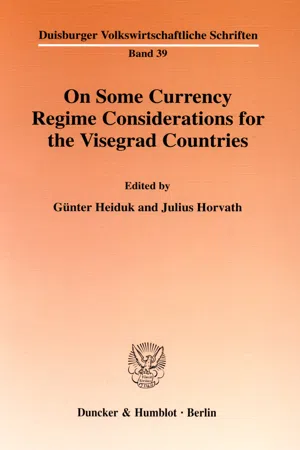
On Some Currency Regime Considerations for the Visegrad Countries.
- 212 pages
- English
- PDF
- Available on iOS & Android
eBook - PDF
On Some Currency Regime Considerations for the Visegrad Countries.
About this book
This volume contains, for the most part, the papers and their formal discussions presented at an International Symposium "EUFORIKZ" (EURO, FORINT, KRONE, ZLOTY), held at Gerhard-Mercator-University Duisburg, Germany, on October 26-28, 2001. The focus of the volume lies on the following two questions:
Firstly, which lessons can the Visegrad countries draw from exchange rate theory to choose the best strategy for monetary integration into the European Union? Secondly, which specific problems do the Visegrad countries face in their exchange rate policies?
The first group of papers includes discussions of the policies of the European Central Bank, a general discussion of possible alternative options for the monetary integration of the accession countries, a discussion of the optimum currency area criteria with an emphasis on the endogeneity hypothesis, a discussion of inflation targeting and the proposal for euroization. The second group of papers analyzes specific problems of Poland, Hungary, the Czech Republic and the Slovak Republic on their way towards the accession to the European Union as well as towards the fulfillment of the Maastricht convergence criteria.
Der Tagungsband enthält die Ergebnisse eines Internationalen Symposiums "EUFORIKZ", das vom 26.-28. Oktober 2001 an der Gerhard-Mercator-Universität Duisburg stattfand. Dabei standen folgende Fragen im Vordergrund des Interesses:
Erstens, was können die Visegrad Länder von der Wechselkurstheorie für ihre eigene wechselkurspolitische Strategie lernen? Zweitens, mit welchen spezifischen Problemen haben diese Länder in ihrer Wechselkurspolitik zu kämpfen?
In der ersten Gruppe der Beiträge werden Themen wie die Politik der Europäischen Zentralbank, die möglichen Alternativen für die monetäre Integration der Beitrittsländer, die Anwendung der Kriterien eines optimalen Währungsraumes unter Betonung der Endogenitätshypothese, inflation targeting sowie der Vorschlag der euroization behandelt. Die zweite Gruppe der Beiträge beschäftigt sich mit spezifischen Problemen Polens, Ungarns, der Tschechischen Republik und der Slovakischen Republik auf ihrem Weg in die Europäische Union wie auch auf dem Weg zur Erfüllung der Maastrichter Konvergenzkriterien.
Information
Table of contents
- Acknowledgement
- Contents
- Editors Introduction
- Jürgen Jerger: The Monetary Policy of the ECB: Observations and Issues
- Peter Backé / Cezary Wójcik: Alternative Options for the Monetary Integration of Central and Eastern European EU Accession Countries
- Jarko Fidrmuc: The Endogeneity of the Optimum Currency Area Criteria, Intraindustry Trade and EMU Enlargement
- Christopher Klisz: Are the Inflation and Exchange Rate Targets for Joining the European Single Currency Inconsistent?
- Julius Horvath: Comments on Unilateral Euroization
- Adam Budnikowski / Rafal Wielqdek: Polish Economy of 1990s in Perspective of the Convergence Criteria
- Kàlman Dezséri: Exchange Rate Regime of Hungary and Approaching EMU Membership
- Josef Pöschl: Implications of the Introduction of Euro. The Case of the Czech Republic
- Julius Horvath: On Currency and Exchange Rate Regime. Example of Slovakia
- Contributors and Discussants
Trusted by 375,005 students
Access to over 1.5 million titles for a fair monthly price.
Study more efficiently using our study tools.
Frequently asked questions
Yes, you can cancel anytime from the Subscription tab in your account settings on the Perlego website. Your subscription will stay active until the end of your current billing period. Learn how to cancel your subscription
No, books cannot be downloaded as external files, such as PDFs, for use outside of Perlego. However, you can download books within the Perlego app for offline reading on mobile or tablet. Learn how to download books offline
Perlego offers two plans: Essential and Complete
- Essential is ideal for learners and professionals who enjoy exploring a wide range of subjects. Access the Essential Library with 800,000+ trusted titles and best-sellers across business, personal growth, and the humanities. Includes unlimited reading time and Standard Read Aloud voice.
- Complete: Perfect for advanced learners and researchers needing full, unrestricted access. Unlock 1.5M+ books across hundreds of subjects, including academic and specialized titles. The Complete Plan also includes advanced features like Premium Read Aloud and Research Assistant.
We are an online textbook subscription service, where you can get access to an entire online library for less than the price of a single book per month. With over 1.5 million books across 990+ topics, we’ve got you covered! Learn about our mission
Look out for the read-aloud symbol on your next book to see if you can listen to it. The read-aloud tool reads text aloud for you, highlighting the text as it is being read. You can pause it, speed it up and slow it down. Learn more about Read Aloud
Yes! You can use the Perlego app on both iOS and Android devices to read anytime, anywhere — even offline. Perfect for commutes or when you’re on the go.
Please note we cannot support devices running on iOS 13 and Android 7 or earlier. Learn more about using the app
Please note we cannot support devices running on iOS 13 and Android 7 or earlier. Learn more about using the app
Yes, you can access On Some Currency Regime Considerations for the Visegrad Countries. by Günter Heiduk,Julius Horvath, Günter Heiduk, Julius Horvath in PDF and/or ePUB format, as well as other popular books in Business & International Business. We have over 1.5 million books available in our catalogue for you to explore.