eBook - PDF
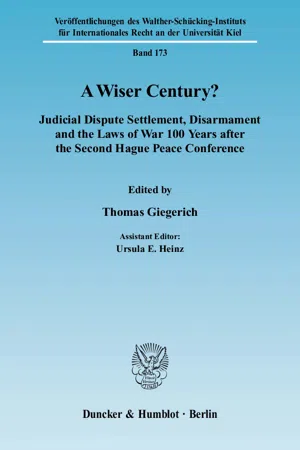
A Wiser Century?
Judicial Dispute Settlement, Disarmament and the Laws of War 100 Years after the Second Hague Peace Conference.
- 523 pages
- English
- PDF
- Available on iOS & Android
eBook - PDF
A Wiser Century?
Judicial Dispute Settlement, Disarmament and the Laws of War 100 Years after the Second Hague Peace Conference.
About this book
The Hague Peace Conferences of 1899 and 1907 dealt with three interlinked topics: the peaceful settlement of disputes, including by arbitration; the restriction of armaments and military budgets; the laws of war. The first two were aimed at preventing the outbreak of war, not by restricting the jus ad bellum in its substance, but by inducing states not to use their continuing war power and to limit the growth of their war machinery. The third topic was concerned with containing the brutality of war where its prevention had failed. Whereas the Conferences succeeded in codifying the laws of war, they made less progress with regard to the peaceful settlement of disputes and failed on limiting armaments. Worst of all, they could not prevent the outbreak of World War I.
This volume uses the occasion of the 100th anniversary of the Second Hague Peace Conference to follow up on the then concerns and objectives, looking at the Hague legacy through the lens of today's problems. The 27 contributions treat the most pressing recent issues of non-proliferation and disarmament, international humanitarian law and judicial dispute settlement. Three questions run like a thread through this volume: 1. In which areas have the promises of 1899 and 1907 remained unfulfilled and why? 2. In which areas has there been progress, in which other areas perhaps regression? 3. What are our prospects and how can we international lawyers help shaping a promising future in respect of the prevention and containment of war?
Whereas the "empire of law" in international relations and the age of international justice, which were envisaged in the Convention for the Pacific Settlement of International Disputes of 1899/1907, have not yet arrived on the global level, we Europeans have made considerable progress since 1945. But in the age of globalization, Europe cannot for long remain an Isle of the Blest. Together with the other peoples of the United Nations we must therefore strive toward fulfilling the promises of the UN Charter and the Universal Declaration of Human Rights - peace, justice, freedom and prosperity for everyone and all nations large and small. Only then can wars be prevented.
Information

Table of contents
- Preface
- Contents
- Thomas Giegerich: Prevention and Containment of War – Two Fateful Missions Unaccomplished
- Jost Delbrück: Walther Schücking’s Contribution to the International Rule of Law
- Stephen C. Neff: The Hague Peace Conferences and a Century of Further Struggles
- Ian Anthony: Weapons of Mass Destruction: Reduction of Stockpiles and Non-Proliferation
- Heike Krieger: Disarmament Obligations of and Assurances of Non-Use by Nuclear Weapon States
- Christian Schaller: Keeping Weapons of Mass Destruction from Terrorists – An International Law Perspective
- Knut Dörmann: Conventional Disarmament – Nothing Newon the Geneva Front?
- Christiane Höhn: International Humanitarian Law in the European Union’s Common Foreign and Security Policy, in Particular the EU Code of Conduct on Arms Exports
- Sean D. Murphy: Protean Jus ad Bellum
- Christine Gray: The International Community’s “Responsibility to Protect” Populations from War Crimes and Other International Crimes
- Kirsten Schmalenbach: Preventing and Rebuilding Failed States
- Dagmar Richter: Humanitarian Law and Human Rights: Intersecting Circles or Separate Spheres?
- Rainer Hofmann: Can Victims of Human Rights Violations Claim Damages?
- Ralph Wilde: From Trusteeship to Self-Determination and Back Again: The Role of the Hague Regulations in the Evolution of International Trusteeship, and the Framework of Rights and Duties of Occupying Powers
- Eyal Benvenisti: The Law on the Unilateral Termination of Occupation
- Gregory H. Fox: A Return to Trusteeship? A Commenton International Territorial Administration
- Robert Heinsch: The International Committee of the Red Cross and the Challenges of Today’s Armed Conflicts
- Walter Kälin: The ICRC’s Compilation of the Customary Rules of Humanitarian Law
- Hans-Joachim Heintze: Terrorism and Asymmetric Conflicts – A Rolefor the Martens Clause?
- Karin Oellers-Frahm: Nowhere to Go? – The Obligation to Settle Disputes Peacefully in the Absence of Compulsory Jurisdiction
- Bruno Simma: How Has Article 36 (2) of the ICJ Statute Fared?
- Christian J. Tams: The Continued Relevance of Compromissory Clauses as a Source of ICJ Jurisdiction
- Frank Hoffmeister: The Aegean Conflict – An Unsettled Disputein Turkey’s EU Accession Course
- Oliver Dörr: The European Court of Justice Getting in the Way: The Abortive MOX Plant Arbitration
- Christine Chinkin: Panel Discussion: Has International Law Civilized Conflicts since 1907? (Remarks)
- List of Contributors
Trusted by 375,005 students
Access to over 1.5 million titles for a fair monthly price.
Study more efficiently using our study tools.
Frequently asked questions
Yes, you can cancel anytime from the Subscription tab in your account settings on the Perlego website. Your subscription will stay active until the end of your current billing period. Learn how to cancel your subscription
No, books cannot be downloaded as external files, such as PDFs, for use outside of Perlego. However, you can download books within the Perlego app for offline reading on mobile or tablet. Learn how to download books offline
Perlego offers two plans: Essential and Complete
- Essential is ideal for learners and professionals who enjoy exploring a wide range of subjects. Access the Essential Library with 800,000+ trusted titles and best-sellers across business, personal growth, and the humanities. Includes unlimited reading time and Standard Read Aloud voice.
- Complete: Perfect for advanced learners and researchers needing full, unrestricted access. Unlock 1.5M+ books across hundreds of subjects, including academic and specialized titles. The Complete Plan also includes advanced features like Premium Read Aloud and Research Assistant.
We are an online textbook subscription service, where you can get access to an entire online library for less than the price of a single book per month. With over 1.5 million books across 990+ topics, we’ve got you covered! Learn about our mission
Look out for the read-aloud symbol on your next book to see if you can listen to it. The read-aloud tool reads text aloud for you, highlighting the text as it is being read. You can pause it, speed it up and slow it down. Learn more about Read Aloud
Yes! You can use the Perlego app on both iOS and Android devices to read anytime, anywhere — even offline. Perfect for commutes or when you’re on the go.
Please note we cannot support devices running on iOS 13 and Android 7 or earlier. Learn more about using the app
Please note we cannot support devices running on iOS 13 and Android 7 or earlier. Learn more about using the app
Yes, you can access A Wiser Century? by Thomas Giegerich in PDF and/or ePUB format, as well as other popular books in Politics & International Relations & International Law. We have over 1.5 million books available in our catalogue for you to explore.