- 138 pages
- English
- ePUB (mobile friendly)
- Available on iOS & Android
eBook - ePub
About this book
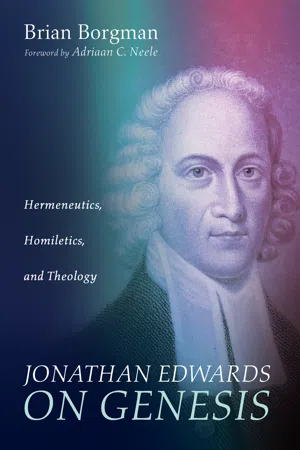
The Jonathan Edwards Renaissance is fully underway, with an increased emphasis on Edwards as an exegete and interpreter of Scripture. In this work, Brian Borgman explores Edwards's exegetical, hermeneutical, and theological treatment of the book of Genesis. This study gives special attention to Edwards's hermeneutics and exegesis of Genesis, his pastoral methods for preaching it, and his theological development of the meaning of "the image of God." The result is a fruitful study on Edwards's interaction with the first book of the Bible.
Information
Chapter One
Introduction
The Edwards “Renaissance”
“Current scholarly interest, a veritable Edwardsean ‘Renaissance,’ remains strong as it builds on seminal twentieth-century research and manuscript studies. There are healthy indications that attention to Edwards’s life and thought will not ebb quickly.” Thus said Helen Westra in 1986.1 That interest in Edwards has not ebbed is attested by the growing number of publications and research centers.2 Popular-level publications on Edwards have kept a steady and even an increasing pace.3 Scholarly works also continue to be produced at a rapid rate.4 Kenneth P. Minkema, writing in 2004, notes, “The number of secondary publications on Edwards fast approaches 4,000, making him the most studied American intellectual figure before 1800.”5 The ebb is nowhere in sight.
This interest in Edwards would have been surprising to many. Ezra Stiles (1727–1795), president of Yale, famously said of the works of Jonathan Edwards that they “in another generation will pass into as transient notice perhaps scarce above oblivion, and when posterity occasionally comes across them in the rubbish of libraries, the rare characters who may read them will be looked upon as singular and whimsical.”6 Stiles was almost correct for a time. Edwards was neglected for a while, but many Edwards scholars point to Perry Miller and his biography of Edwards in 1949 as a turning point in interest in Edwards. “Miller’s biography marked the beginning of a significant scholarly renaissance among historians, theologians, and philosophers interested in Edwards’s life and thought.”7
Edwards’s biographer George Marsden notes in the foreword to The Jonathan Edwards Encyclopedia,
This work is published at a very appropriate time, for during the past couple of generations there has been a remarkable revival of interest in Edwards. Edwards had been highly regarded, especially in New England, for a couple generations after his death. But then he fell out of style. By the early twentieth century he was known chiefly for Sinners in the Hands of an Angry God and was regarded in leading intellectual and theological circles as, even if a genius, primarily a representative of the harsh theology that American Christians should be getting beyond. By the mid-twentieth century he had few professed followers.8
Edwards studies are multidimensional and multifaceted. As Westra commented, “Scholars have written prolifically on Edwards’s revivalist activities, his sulfurous sermons, and his sinewy thought, the complexity and range of his mind in multifarious studies and bibliographic entries on Edwards as philosopher, scientist, theologian, ethicist, logician, typologist, psychologist, proto-romanticist, revivalist, historian, mystic, and literary artist.”9 But one area that seems to have not garnered much attention over the years is Edwards as an exegete, interpreter, and expositor of Holy Scripture.10 This is interesting since Edwards was first and foremost a man of the Bible. Edwards’s life was devoted to and shaped by studying the Scriptures and preaching the Scriptures. In Resolution 28 Edwards wrote, “Resolved, to study the Scriptures so steadily, constantly and frequently, as that I may find, and plainly perceive myself to grow in the knowledge of the same.”11 Edwards, also noted in his diary in 1723,
I had then, and at other times, the greatest delight in the holy Scriptures, of any book whatsoever. Oftentimes in reading it, every word seemed to touch my heart. I felt a harmony between something in my heart, and those sweet and powerful words. I seemed often to see so much light, exhibited by every sentence, and such a refreshing ravishing food communicated, that I could not get along in reading. Used oftentimes to dwell long on one sentence, to see the wonders contained in it; and yet almost every sentence seemed to be full of wonders.12
Recent Scholarship on Edwards as Biblical Interpreter
If Edwards’s love and devotion to Scripture were so central to his thought and life, calling and ministry, why has it been so neglected? David P. Barshinger addresses this:
But despite his acknowledged place in American religious history—not to mention the broader history of Christianity—the role of the Bible in his thought has rarely received the attention it deserves. Yet Edwards clearly stood in the stream of sola scriptura, and Scripture had a formative influence on his thought, which, if ignored, can skew our understanding of the man.13
Douglas Sweeney makes a similar observation:
Three hundred years after his birth, half a century into what some have called the Edwards renaissance, few have bothered to study Edwards’s massive exegetical corpus. While preoccupied with his place in America’s public life and letters—and failing to see the public significance of his biblical exegesis—we have ignored the scholarly work he took most seriously.14
The historian and the theologian must be able to “see things their way.”15 To “see things their way” is to understand and present the times and the thoughts of a historical figure in a way that the historical figure could recognize them as his own.16 To downplay or even ignore the role of the Bible in...
Table of contents
- Title Page
- Foreword
- Acknowledgments
- Abstract
- Author’s Note
- Chapter 1: Introduction
- Chapter 2: Edwards’s Interpretive Tradition, the Enlightenment, and Critical Method
- Part One: Exegetical and Homiletical
- Chapter 3: Jonathan Edwards’s Exegesis of Genesis
- Chapter 4: Jonathan Edwards’s Exegesis of Genesis
- Chapter 5: Edwards’s Use of Genesis in A History of the Work of Redemption
- Part Two: Theological
- Chapter 6: Edwards’s Theology of Man in the Image of God
- Conclusion and Prospect
- Bibliography
Trusted by 375,005 students
Access to over 1.5 million titles for a fair monthly price.
Study more efficiently using our study tools.
Frequently asked questions
Yes, you can cancel anytime from the Subscription tab in your account settings on the Perlego website. Your subscription will stay active until the end of your current billing period. Learn how to cancel your subscription
No, books cannot be downloaded as external files, such as PDFs, for use outside of Perlego. However, you can download books within the Perlego app for offline reading on mobile or tablet. Learn how to download books offline
Perlego offers two plans: Essential and Complete
- Essential is ideal for learners and professionals who enjoy exploring a wide range of subjects. Access the Essential Library with 800,000+ trusted titles and best-sellers across business, personal growth, and the humanities. Includes unlimited reading time and Standard Read Aloud voice.
- Complete: Perfect for advanced learners and researchers needing full, unrestricted access. Unlock 1.5M+ books across hundreds of subjects, including academic and specialized titles. The Complete Plan also includes advanced features like Premium Read Aloud and Research Assistant.
We are an online textbook subscription service, where you can get access to an entire online library for less than the price of a single book per month. With over 1.5 million books across 990+ topics, we’ve got you covered! Learn about our mission
Look out for the read-aloud symbol on your next book to see if you can listen to it. The read-aloud tool reads text aloud for you, highlighting the text as it is being read. You can pause it, speed it up and slow it down. Learn more about Read Aloud
Yes! You can use the Perlego app on both iOS and Android devices to read anytime, anywhere — even offline. Perfect for commutes or when you’re on the go.
Please note we cannot support devices running on iOS 13 and Android 7 or earlier. Learn more about using the app
Please note we cannot support devices running on iOS 13 and Android 7 or earlier. Learn more about using the app
Yes, you can access Jonathan Edwards on Genesis by Brian Borgman in PDF and/or ePUB format, as well as other popular books in Theology & Religion & Biblical Criticism & Interpretation. We have over 1.5 million books available in our catalogue for you to explore.