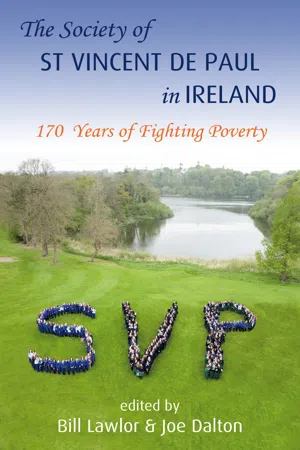
The Society of St. Vincent de Paul is Ireland's largest and best-known voluntary charitable organisation. It was established in Ireland in 1844. Today, there are 1, 235 Conferences, the local unit of the Society, in Ireland with over 10, 000 members and 1, 500 auxiliary members. For the first time, this book records the details of the Society's origins in Ireland and its work in communities all over the country, through the personal recollections of members of the Society and an overview of the services provided to those in need. This collaborative account weaves together the history, people and places of the SVP. It illustrates that, although the changing nature of poverty constantly requires new and flexible forms of response by the Society, it is through the actions of ordinary people that the spirit and vision of the Society of St.Vincent de Paul endures.
- 304 pages
- English
- ePUB (mobile friendly)
- Available on iOS & Android
eBook - ePub
About this book
Trusted by 375,005 students
Access to over 1.5 million titles for a fair monthly price.
Study more efficiently using our study tools.
Information
Section One
Historical Accounts
of the Society of St Vincent de Paul
of the Society of St Vincent de Paul
The Society of Saint Vincent de Paul: The Early History
Picture a quiet Dublin street, Charles Street West, a street that had been a busy thoroughfare before Ormond Bridge was rebuilt, which diverted the traffic to the new Chancery Place. It was not, however, without its inhabitants, and the traders in iron products and small public houses were many, backed by the tenement dwellings of the poor. Thomas Willis (1790–1881), an apothecary who occupied 34 Upper Ormond Quay just around the corner, had carried out a survey of the inhabitants of the parish of St Michan’s. This inquiry, entitled ‘Facts Connected with the Social and Sanitary Conditions of the Working Classes in the City of Dublin’, concerned itself with the living conditions of the parish residents. The report into the overcrowding, the absence of water for the most basic kind of washing, the diseases, amongst other issues, was to create a great deal of concern, which led – sixty years later – to the redevelopment of the area. The northside market was replaced in the last days of the nineteenth century by the present St Michan’s Street (Fisher’s Lane) and this resulted in the clearance of one of the most congested districts in Dublin. In this parish was Newgate Prison, which had been transferred from the city walls in 1773 to Green Street, now probably better known for its courthouse. Here, several of the United Irishmen were imprisoned – and executed – in 1798; in 1848, it held John Mitchel and other members of the Young Ireland party. Mitchel was a good friend of John O’Hagan of the Society of St Vincent de Paul (see below).
Thomas Willis’s study was particularly concerned with the impact of his words. He wrote as an introduction: ‘In placing before the public the result of some inquiries amongst the working classes, I am fully sensible of the risk I incur, in making statements of such a startling nature as to appear incredible to those whose attention has never been directed to such matters.’1
Willis was one of seven men, including two clergymen, who sat down at the White Cross Rooms at 8.30 p.m. on Monday, 16 December 1844 to plan the introduction of the French Society of St Vincent de Paul to Ireland. They would establish five branches throughout the city during the following year.
Willis was a very influential member of the Society of St Vincent de Paul. His work and that of his colleagues and their concerns set the agenda for the Society’s endeavours for the next 168 years. There was an emphasis on giving aid, but an equal emphasis was placed on calling for an improvement in living conditions for all, for better housing, for an adequate welfare system. This remains the Society’s aim today.
Willis was additionally to be a Guardian of the Poor Law in Dublin North (Brunswick Street) until he was sent down to Bantry, Co. Cork, as a medical inspector during the Great Famine. During his time in Bantry, he was given credit for the invention of the hinged or sliding coffin, later made into crosses and presented to various convents: ‘During the frightful famine plague which devastated a large proportion of Ireland in the years 1846–47 that monstrous and unchristian machine, a “sliding coffin” was from necessity used in Bantry Union for the conveyance of the victims to one common grave. The material of this Cross, the symbol of our Redemption, is a portion of one of the machines which enclosed the remains of several hundred of our countrymen during their passage from their wretched huts or the wayside where they died to the pit into which their remains were thrown.’2
Willis was a colourful character, his personal appearance being striking, as a description of the time records: ‘The old medico who wore the broad-brimmed hat of a bishop and the white cravat of a Brummel was a familiar figure in Dublin from the days of George the Third. The favourite post of Dr Willis was at book sales or by the bed-side of the sick poor.’
Willis’s premises, the White Cross Rooms, were leased to the Religious Society of Friends (Quakers) during the Famine to provide a soup kitchen for those affected. The lease has signatures of well-known names such as Joseph Bewley and Jonathan Pim. Even earlier, the district was the original base for the Sick & Indigent Roomkeepers Society, which had a life in adjoining Mountrath Street.
The Poor Law (Ireland) Act had no doubt stirred those men with a social conscience into action. The Poor Law Amendment Act in Britain had exercised minds since 1834, and efforts were in place to make Paris into Prefect Claude de Rambuteau’s ideal of a disease-free city – 20,000 people had died in the cholera epidemic of 1832, just twelve months before the French society was founded. The 1838 Irish Act decreed that relief was only available within a workhouse – unlike the equivalent English Act, which allowed outdoor relief to the poor.
The workhouse was to be a crude solution. On the other hand, we are told by R.B. McDowell that, before the Famine, the first Poor Law Commissioners saw it differently: ‘The poor-law system, they were convinced, was bound to play a mighty part in inaugurating a new era in public life, when the prevalence of official impartiality, efficiency, economy and standardised and scientific methods of administration would raise the moral tone of the whole community.’3
The Freeman’s Journal, in a hard-hitting article, had said that it was well known that they were not ‘enamoured’ by the Poor Law: ‘We have been always of opinion that they were calculated to superadd discontent to misery and to excite wretchedness to outrage, by the exhibition of sleek and well-paid officials, pampered upon the hard-wrung farthings of the poor.’
The newspaper went on to work out the cost per head of the Poor Law for each pauper in the land.4 This gave the Society of St Vincent de Paul its lead. They could cut down bureaucracy through the use of volunteers. They could and would help the many people who, through no fault of their own, were without resources. That was the plan – in many cases it was abandoned, but in many cases, such as in Cork during the Famine, it was a triumph.
Daniel O’Connell died in Italy in 1847, at the age of seventy-one. Despite his charitable record, there is no evidence that he aided the Society, but his son John is recorded in the first SVP minute book as having been a member (although most likely an ‘honorary’ member). However, many of the Vincentians had an alternative view to that of The Liberator. They were from the ranks of Young Ireland. Called the ‘quasi-rebels’ by John Henry Newman, John O’Hagan, the poet and barrister, and Richard D’Alton Williams, the doctor, were but two of these ‘agitators’.
Another man with a conscience, though not known as a Vincentian, was Frederick Lucas, the well-known editor of the Tablet. He wrote several articles on charity and described the desperate conditions of the poor. He also referred specifically to the apathy of the State with regard to these poor, and also the apathy of influential Catholics, who could have done much more: ‘Who except the clergy visit the poor? As far as we laity are concerned, the approved plan seems to be to manage all by a secretary, to avoid all dirty work whenever it can be avoided and to labour by a committee; or we try to do charity by nothing as vulgar as the sweat of the brow, in which all must labour, but by polite, genteel, not over-strained exertion of ladies and gentlemen in white kid gloves. We have already endeavoured to introduce to the favour of our readers a French society for lay persons. We refer to the Society of St Vincent de Paul.’ 5
Frederick Lucas regarded the youthful nature of the original Paris Conference as ‘an accident or more truly a Providence,’ and recites the international society’s report regarding the advantages of youthful membership as valuable training: ‘The Society of St Vincent de Paul habituates us early in life to the practice of Charity. It thus prepares a generation of men who will have learned, at the age of generous dispositions, to see in the world other things besides themselves; who will have taken a sufficiently near view of the miseries of humanity, to be able to apply a remedy when the time comes for them also to occupy a responsible position in the world.’6
Lucas had been at the initial meeting of the SVP in London, which also happened in 1844, and had been offered the presidency of the English society. He declined the honour. Lucas brought the Tablet to Dublin in 1849, and he became a Member of Parliament.
The Irish SVP was formed only fifteen years after the Catholic Emancipation Act. There was an element of emulation of the main Protestant charities, such as the Association for the Relief of Distressed Protestants (ARDP), but when the Poor Law rate was introduced in 1838, there was a feeling amongst the members of the established church that voluntary charity alms-giving was then ‘a thing of the past.’ However, post-Emancipation, middle-class Catholics were intent on mirroring the social concerns – and ambitions – of their Protestant friends and neighbours.
Little is known of the first president of the Society, Redmund Peter O’Carroll (1804–1847), although a brief account of his earlier life is told in Burke’s Vicissitudes of Families.7 He was a married man, aged forty, much older than most of the other initial members. He lived on Great Charles Street, off Mountjoy Square, in a substantial house with his wife and two sons. The sons were later to join the priesthood; one, who joined the Jesuits, had a distinguished career. That son was a professor of modern languages at the Royal College in Dublin and was reputed to speak fourteen languages fluently. He also wrote extensively for the Gaelic Journal, the forerunner for Gaelic League publications.
Redmund O’Carroll was initially law advisor to the Commissioners of National Education. He was then appointed Catholic secretary to the Charitable Bequests Board, at a time when there was difficulty with both Roman Catholic and Protestant bishops when it came to the proper beneficiary of a will. He also formed a friendship with Archbishop Denis Affre of Paris, who was killed on the barricades in his city in 1848. Affre assembled a committee in 1847 to send money to Ireland for the Great Famine, and it was to Dr Daniel Murray, Archbishop of Dublin, and to O’Carroll, that he directed the funds, for O’Carroll was to be the Irish link in distribution. (In a letter dated 27 May 1847, O’Carroll was able to tell Archbishop Murray that the sum of £6,000 had been sent to the Society in Ireland by the international society.)8
O’Carroll, who attended the first meeting of the Society of St Vincent de Paul in the White Cross Rooms, went out to Bray, Co. Wicklow regularly, and there is a warm letter, addressed to the Archdeacon of Dublin, inviting him to call. This letter was dated September 1847 – Redmund Peter O’Carroll was dead one month later, at the age of forty-three.9 He is reputed to have died from typhus; whether he succumbed to this as a result of his Vincentian work we can only speculate. It was not unknown for the ‘visitors’ to be similarly affected when they went to the homes of fever victims.
O’Carroll’s wife, Mary Catherine O’Carroll (née Goold), was governess of the Female Penitent Asylum in Dublin in 1845, and became matron of Grangegorman (Female) Prison shortly after her husband’s death. The writer Maria Luddy tells us that the ‘exclusive use of this prison for women was an innovative and unprecedented step’ in penal history in these islands.10 That Mrs O’Carroll was also a correspondent of Very Rev. Dr Murray is evidenced by a letter, in French, to the Archbishop, dated June 1847, where she refers to a death in her family, ‘and other matters’; her husband and children join her ‘in sending good wishes’ to the Archbishop. 11
Redmund knew his neighbour, Archbishop Murray (1768–1852), very well. Dr Murray was coming to the end of a long life, but he was to outlive his friend. He had a difficult life, and he was at loggerheads with some of the other members of the hierarchy on many issues, and was regarded as an unflattering ‘Castle Catholic’. But he was a man of great principles and he suffered with the population during the years of famine. He had brought the Sisters of Charity, the Loreto Sisters and the Sisters of Mercy to Dublin, and it ...
Table of contents
- Cover
- Halftitle
- Title
- Copyright
- Contents
- Preface
- Foreword
- Editor’s Introduction by Bill Lawlor
- Section One – Historical Accounts of the Society of St Vincent de Paul
- Section Two – The Society of St Vincent de Paul Remembers
- Section Three – The Work of the Society of St Vincent de Paul
- Afterword: Living Out The Eucharist Through Christian Solidarity
Frequently asked questions
Yes, you can cancel anytime from the Subscription tab in your account settings on the Perlego website. Your subscription will stay active until the end of your current billing period. Learn how to cancel your subscription
No, books cannot be downloaded as external files, such as PDFs, for use outside of Perlego. However, you can download books within the Perlego app for offline reading on mobile or tablet. Learn how to download books offline
Perlego offers two plans: Essential and Complete
- Essential is ideal for learners and professionals who enjoy exploring a wide range of subjects. Access the Essential Library with 800,000+ trusted titles and best-sellers across business, personal growth, and the humanities. Includes unlimited reading time and Standard Read Aloud voice.
- Complete: Perfect for advanced learners and researchers needing full, unrestricted access. Unlock 1.5M+ books across hundreds of subjects, including academic and specialized titles. The Complete Plan also includes advanced features like Premium Read Aloud and Research Assistant.
We are an online textbook subscription service, where you can get access to an entire online library for less than the price of a single book per month. With over 1.5 million books across 990+ topics, we’ve got you covered! Learn about our mission
Look out for the read-aloud symbol on your next book to see if you can listen to it. The read-aloud tool reads text aloud for you, highlighting the text as it is being read. You can pause it, speed it up and slow it down. Learn more about Read Aloud
Yes! You can use the Perlego app on both iOS and Android devices to read anytime, anywhere — even offline. Perfect for commutes or when you’re on the go.
Please note we cannot support devices running on iOS 13 and Android 7 or earlier. Learn more about using the app
Please note we cannot support devices running on iOS 13 and Android 7 or earlier. Learn more about using the app
Yes, you can access The Society of St Vincent De Paul in Ireland by Joe Dalton in PDF and/or ePUB format, as well as other popular books in History & Irish History. We have over 1.5 million books available in our catalogue for you to explore.