- 352 pages
- English
- ePUB (mobile friendly)
- Available on iOS & Android
eBook - ePub
About this book
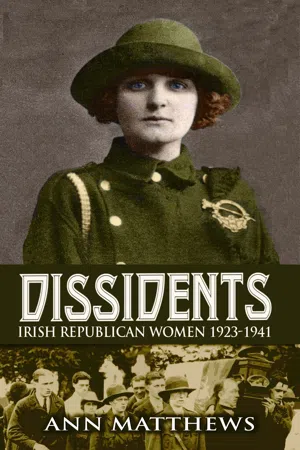
During the War of Independence around 10,000 Irishwomen were actively involved in the fight for Irish freedom. So why, with the outbreak of Civil War and in the years following this conflict, did the role of women in Irish politics steadily decline until by the early 1940s only a handful of women were involved? 'Dissidents' explores the reasons for this decline. From the divisions caused by the signing of the Anglo-Irish Treaty, which led to a fatal splintering of the women's Republican organisation Cumann na mBan, through the effects of internment during the Civil War on female prisoners and the relegation of the majority of women in Irish politics to the margins, Ann Matthews reveals the story of Republican women in the years following Irish independence. She also asks whether they were responsible for their own demise in the political arena, leaving future generations of Irish women without a foundation on which to build.
Information
1
RUMBLINGS OF DISSENSION
The revolution that began in Dublin at Easter 1916, culminated in the signing of the Anglo-Irish Treaty on 6 December 1921, but within a month that Treaty had led to a split in the Irish Republican movement. The vote on acceptance of the Treaty in the Dáil took place on 7 January 1922 and seven days later the sixty-four members of the second Dáil who supported the Anglo-Irish Treaty assembled at the Mansion House, formed the Provisional Government of the Irish Free State and elected an Executive Council. Those elected to the council were Michael Collins, William T. Cosgrave, Éamonn Duggan, Kevin O’Higgins, Patrick Hogan, Patrick McGrath, Eoin MacNeill and Fionán Lynch. Michael Collins was elected as chairman. A general election was due to be held later in 1922 and both sides began a scramble to put their respective points of view before the electorate.
On 17 January 1922, the Ard Chomhairle (National Executive) of Sinn Féin was convened to elect a new standing committee. The Ard Chomhairle had a membership of nearly seventy, drawn from the party’s officer board, its executive and the representatives of all Comhairlí Ceantair (districts). The election yielded a standing committee that was predominantly pro-Treaty, and by late January 1922 ‘the party was overwhelmingly pro-Treaty’.1 At a meeting on 31 January, Michael Collins proposed that the standing committee should ‘recommend to the Ard-Fheis [annual conference], that the vote on acceptance or non-acceptance of the Treaty should be by ballot’.2 Kevin O’Sheil seconded this. Austin Stack proposed an amendment to the resolution, that the voting should be public, and Áine Ceannt seconded it. This modification received the support of Kathleen Lynn and Hanna Sheehy Skeffington, but the Collins motion was passed without amendment.
As a reaction to the pro-Treaty stance of the majority of Sinn Féin, some time between 3 February and 22 February the anti-Treaty side of the IRA met and a new political party, Cumann na Poblachta (The Association of the Republic), was formed. Cumann na Poblachta affirmed its allegiance to the Proclamation of 1916 and to the Declaration of Independence of 21 January 1919, and three trustees were appointed: J. J. O’Kelly (also known as Sceilg, from his surname in Irish – Ó Ceallaigh), Cathal Brugha and Austin Stack. The trustees went to America on a fund-raising mission, accompanied by Countess de Markievicz and Kathleen Barry, and arrived in New York on St Patrick’s Day 1922. They operated under the auspices of the American Association for the Recognition of the Irish Republic (AARIR), launched by Éamon de Valera and Harry Boland in 1920.3 Sceilg said, ‘with the support of Clan na Gael, Cumann na Poblachta raised a substantial amount of money’ and this gave them a significant war chest.4
The anti-Treaty IRA was not the only group taking a negative stance against the Treaty. On 11 January 1922, twenty-six members of the Cumann na mBan (Irishwomen’s Council) executive had met to discuss the Treaty and voted twenty-four to two against acceptance. The two women who supported it were Jennie Wyse-Power and ‘a Miss Mullan from Monaghan’.5 Following the vote, Wyse-Power resigned from the executive. The executive then set a date for a special convention, which was dominated by anti-Treaty delegates, and re-formed as the third incarnation of Cumann na mBan. Unlike Sinn Féin, the Cumann na mBan executive did not allow any discussion, and Mary MacSwiney and Countess de Markievicz were determined that the organisation would be the first Republican organisation to vote against the Treaty, thereby leading the vanguard for the anti-Treaty side.
Mary MacSwiney wrote to the branches in Cork and instructed them to:
Call a special meeting of their branches to discuss the executive resolution. Because the majority of the Deputies of Dáil Éireann have declared for the Free State and this may lead to decrees subversive of the constitution of Cumann na mBan.6
She also told them that, ‘in view of the grave importance of the decisions involved, the executive earnestly hope that each branch will make a special effort to send a delegate’.7
At the rank and file level, Cumann na mBan was riven by arguments about the Treaty. The Cumann na mBan Cork District Council held a meeting to discuss their differences. Twenty-three delegates attended the meeting, representing branches from Bishopstown, Blackpool, Blackrock, Clogheen, Dublin Pike, Cork city (Poblacht na hÉireann), Pouladuff, Shandon, St Finbarr’s, St Patrick’s and Cork University. A motion was put forward by the Poblacht na hÉireann (Republic of Ireland) branch that:
The Cork District Council re-affirms its allegiance to the Irish Republic and condemns without qualification the betrayal of the Republic by the signing of the Treaty in London on December 6 1921 … furthermore it repudiates the action of the sixty-four men who were elected to represent the Republic of Ireland and have foresworn their allegiance to the Republic in voting for this settlement.8
A report on the outcome of the meeting in The Cork Examiner said ‘the motion was defeated by sixteen to seven’. The following day, a complaint from May Conlon claimed that ‘the report was incorrect and the vote was in fact defeated by ten to seven’.9 Regardless of the confusion, it is clear that the majority of the Cork District Council was pro-Treaty.
A special convention of Cumann na mBan was held on 5 February 1922. The Irish Times and the Irish Independent published detailed reports of the convention, with the latter paper reporting that:
At the special convention of Cumann na mBan in Dublin yesterday, a resolution of adherence to the Republican policy was carried by 419 to 63 for an amendment advocating working for the Republic through the Free State.10
Based on the publication of the above figures, Florence O’Donoghue interpreted it as Cumann na mBan ‘registering a practically unanimous vote against the Treaty at their convention’.11 This perspective has endured to the present day. The figures have been accepted without question or careful scrutiny, and have become the accepted story of the voting pattern at the convention. The acceptance of these figures from that time is one of the most successful pieces of propaganda to emerge from this period.
There were 600 delegates present at the convention, with 200 missing because of a rail strike affecting the Cork and Kerry areas. Consequently, the convention did not reflect the opinions of the total membership, and by insisting on going ahead with the convention the leaders actually breached the organisation’s constitution.12 During the debate a question was posed from the floor about Cumann na mBan remaining neutral, but Mary MacSwiney replied that ‘asking Cumann na mBan to remain neutral was akin to asking her to stand neutral while a murderer stabbed her mother to death’. Her motion that ‘Cumann na mBan reaffirm its allegiance to the Republic of Ireland, and therefore cannot support the Articles of Agreement signed in London, 6 December 1921’ was ‘put forward as a substantive motion and was carried by a show of hands’.13 This was the actual vote that determined the organisation’s position on the Republic versus the Treaty. According to Jennie Wyse-Power, as she left the convention with others who voted against MacSwiney’s motion they were taunted with ‘shouts of traitor’.14 In the wake of this convention the anti-Treaty group formed the third Cumann na mBan.
When Cork District Council decided to hold a meeting to discuss the future of the organisation in the city, Mary MacSwiney informed them that she was coming to address them, but the women refused to admit her and said ‘they were not willing to allow themselves be subjected to a two and a half hour harangue of invective, similar to that delivered to the Dáil’.15 The rank and file members simply walked away from the organisation.
After the split, pro-Treaty members of Cumann na mBan were faced with a dilemma, as they did not have a forum to express their point of view. In early March 1922 a small group of women met at 70 St Stephen’s Green in Dublin and formed an ‘alternative organisation’ – Cumann na Saoirse (Irish Freedom Committee) – with Jennie Wyse-Power and Louise Gavan Duffy as the main movers behind it, thus giving a platform to women who wanted to support the Treaty.16
Back in Cork, a row erupted over the name of the new organisation. The pro-Treaty members in Cork refused to use the name Cumann na Saoirse and insisted they were entitled to keep the original name of Cumann na mBan. The row was bitter, but the pro-Treaty members of Cumann na mBan in Cork were determined they were not going to be bullied and they retained the name Cumann na mBan in Cork and operated as a pro-Treaty organisation.
Within months of this split, Cumann na mBan and the political women in Sinn Féin who took the anti-Treaty side found themselves making up part of a Republican triad comprising Cumann na mBan, the IRA and Cumann na Poblachta.
2
THE REPUBLICAN TRIAD, 1922–23
The IRA also fragmented over the issue of the Treaty, with the neutral membership being known as ‘the neutral IRA’, while the anti-Treaty group re-formed as the Republican IRA and became known as anti-Treatyites or ‘Irregulars’.1 The Free State side used the term ‘Irregular’ as a pejorative expression for Republicans who fought against them during the Civil War. It was also used in government documents, particularly in intelligence reports, and by the media and Cumann na Poblachta.
In March 1922, as the anti-Treatyites regrouped, Éamon de Valera went on a tour of the south of Ireland, where he made a series of inflammatory speeches that fuelled the fast-growing discontent among those who opposed the Treaty. F. S. L. Lyons notes that the tone of these speeches could be summarised by one quote from de Valera:
If they accepted the Treaty, and if the Volunteers of the future tried to complete the work the Volunteers of the last four years had been attempting, they would have to complete it, not over the bodies of foreign soldiers, but over the dead bodies of their own countrymen. They would have to wade through Irish blood, through the blood of the soldiers of the Irish Government, and through, perhaps, the blood of some of the members of the Government in order to get Irish freedom …2
On 9 April 1922, the anti-Treaty IRA assembled at the Mansion House in Dublin, adopted a new constitution and elected a new executive as their governing body in direct opposition to the Provisional Government. The new executive of the Republican IRA comprised Liam Lynch, Liam Mellows, Rory O’Connor, Joe McKelvey, Florence O’Donoghue, Seán Moylan, Seán Hegarty, Liam Deasy, Seamus Robinson, Ernie O’Malley, Peadar O’Donnell, Joe O’Connor, Frank Barrett, Tom Maguire, P. J. Ruttledge and Tom Hales.3 At the end of the convention an army council was also formed, comprising Liam Lynch as chief of staff, Joe McKelvey as deputy chief of staff, Florence O’Donoghue as adjutant general, Ernie O’Malley as director of organisation, Joseph Griffin as director of intelligence and Liam Mellows as quartermaster general. Rory O’Connor, Seamus O’Donoghue and Seán Russell were appointed directors of engineering, chemicals and ammunition, respectively.4 They claimed that their legitimacy as defenders of the Republic emanated from the proclamation of 1916, the declaration of the Irish Republic in 1919 and the second Dáil Éireann of 1921.
On Holy Thursday, 13 April 1922, four days after the formation of the anti-Treaty IRA, Rory O’Connor, in a challenge to the authority of t...
Table of contents
- Cover
- Title Page
- Copyright
- Dedication
- Acknowledgements
- Abbreviations
- Introduction
- 1 – Rumblings of Dissension
- 2 – The Republican Triad, 1922–23
- 3 – Internment of Republican Women
- 4 – Kilmainham Female Prison
- 5 – The North Dublin Union
- 6 – Collapse of the Republican Triad, 1924–26
- 7 – Anti-Climax and Reality, 1924–26
- 8 – A New Political Reality
- 9 – The Flanders Poppy and the Easter Lily, 1921–35
- 10 – Commemoration and Conflict in the Irish Free State, 1923–37
- 11 – Into the Political Wilderness
- Appendix 1
- Appendix 2
- Appendix 3
- Appendix 4
- Appendix 5
- Appendix 6
- Appendix 7
- Appendix 8
- Appendix 9
- Appendix 10
- Appendix 11
- Appendix 12
- Appendix 13
- Endnotes
- Bibliography
- About the Publisher
- About the Author
- Also by this Author
Trusted by 375,005 students
Access to over 1.5 million titles for a fair monthly price.
Study more efficiently using our study tools.
Frequently asked questions
Yes, you can cancel anytime from the Subscription tab in your account settings on the Perlego website. Your subscription will stay active until the end of your current billing period. Learn how to cancel your subscription
No, books cannot be downloaded as external files, such as PDFs, for use outside of Perlego. However, you can download books within the Perlego app for offline reading on mobile or tablet. Learn how to download books offline
Perlego offers two plans: Essential and Complete
- Essential is ideal for learners and professionals who enjoy exploring a wide range of subjects. Access the Essential Library with 800,000+ trusted titles and best-sellers across business, personal growth, and the humanities. Includes unlimited reading time and Standard Read Aloud voice.
- Complete: Perfect for advanced learners and researchers needing full, unrestricted access. Unlock 1.5M+ books across hundreds of subjects, including academic and specialized titles. The Complete Plan also includes advanced features like Premium Read Aloud and Research Assistant.
We are an online textbook subscription service, where you can get access to an entire online library for less than the price of a single book per month. With over 1.5 million books across 990+ topics, we’ve got you covered! Learn about our mission
Look out for the read-aloud symbol on your next book to see if you can listen to it. The read-aloud tool reads text aloud for you, highlighting the text as it is being read. You can pause it, speed it up and slow it down. Learn more about Read Aloud
Yes! You can use the Perlego app on both iOS and Android devices to read anytime, anywhere — even offline. Perfect for commutes or when you’re on the go.
Please note we cannot support devices running on iOS 13 and Android 7 or earlier. Learn more about using the app
Please note we cannot support devices running on iOS 13 and Android 7 or earlier. Learn more about using the app
Yes, you can access Dissidents by Ann Matthews in PDF and/or ePUB format, as well as other popular books in History & Irish History. We have over 1.5 million books available in our catalogue for you to explore.