- 448 pages
- English
- ePUB (mobile friendly)
- Available on iOS & Android
eBook - ePub
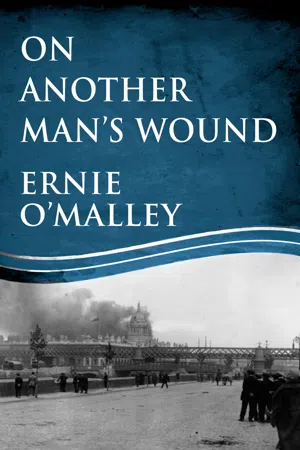
On Another Man's Wound
About this book
'On Another Man's Wound', its title taken from an old Ulster proverb, 'It's easy to sleep on another man's wound', was first published in 1936 and has become the classic account of the years 1916-21 in Ireland. It captures the essence of Ireland at the time, the way people lived, their attitudes, their beliefs, the songs they sang, the legends they knew. O'Malley pictures the Irish landscape magnificently, and his cameo sketches of the great personalities of the Rising and the war that followed bring them into instant focus.
The sequel 'The Singing Flame', which details O'Malley's experiences of the Irish Civil War, and 'Raids and Rallies', covering his comrade's experiences during the War of Independence, are also available from Mercier Press.
Information
Romanesque
15.
October–November 1920
Dublin, Kilkenny
CURFEW NOW LASTED in Dublin from midnight till five in the morning; one could not be out of doors without a permit during those hours. Hold-ups by armed soldiers on the streets increased, more houses were raided at night. Curfew made me keep respectable hours. I had always looked forward to the long talks which lasted till morning while I sat on the floor. Long acrimonious discussions, games of mental ping-pong in which ideas were clarified and hammered into shape, or became molten and fluid at our next meeting. Often enough our oblique imps would switch us away, or one left in despair with a sense of frustration. I was not asked since I was last in town where I had been in the interval. Walks in the night on rainy pavements luminous from street lamps when talk continued at a street corner or hall door. We found it as difficult to go to bed as to get up. Intimate beaks of banter which picked one thoroughly, yet an aloofness that left personal life alone. Books to be read and discussed, calls on friends at unexpected hours; throughout the intimate warmth of friendly Dublin life with an escape to the mountains for a long walk if one got fed up and wanted to be alone.
It was real to sit in St Stephen’s Green watching patterned flower beds around the walloping Clydesdalish bronze horse supporting George II, or the delight of ruffled glint in the leafy trees. Grey-blue and steel-grey skies, patched and streaked with slashes of dark and white clouds, moved slowly to mix to fleeting satisfaction; they brought a cold wind that spiralled worn dead leaves along the path. Children from Cuffe Street stretched on the grass, knarled men from the slums with bitter faces and undersized bodies sat on wooden seats, women gossiped, small girls in bare feet, or with one boot and stocking, carried young brothers half their size, mothering. Nursemaids pushed prams to and fro as they flirted with the red-faced keeper. In the National Gallery there were a few good pictures to be looked at, and books to be read hard in the National Library.
Wind was dull in the city; it was more like a draught, save when a gale swept in. The night sky and the moving moon had nothing to do with city life. I now had the taste of the country firmly in my teeth. There was a definite friendliness and ease about Dublin, but also an air of polite helplessness. It was more tolerant. A quiet aloofness lingered round the mellow austerity of its eighteenth-century houses in a number of large squares, but the mood became strident and frowsy in the blight of the slums. Dignified wealth and open-mouthed poverty alternated their strophe and antistrophe in the capital.
The city’s breweries, distilleries and biscuits were not much of an economic asset; unskilled labour predominated and was quickly affected by trade conditions. A walk through by-streets to St Patrick’s Cathedral and the Coombe, by Thomas Street to the duplicated forms in Guinness’s Brewery, brought one more in touch with the haphazard life and trade of Dublin.
The new Auxiliary force could be seen, moving swiftly in open Crossley tenders, seated on each side with rifles held across their knees. Wearing officers’ khaki tunics, Glengarry bonnets angled, they had a dashing neat appearance. They were conscious of their power and soldierly snap. They felt impressive. People stopped to look at them. ‘Why aren’t they attacked?’ I asked Diarmuid O’Hegarty. ‘It would be easy to lob
an egg.’
an egg.’
‘That will come, don’t fear,’ he said.
Four months ago cadets had been sent out as defence officers to instruct the RIC in the defence of barracks and to strengthen morale. Then they had been formed into an Auxiliary police division, commanded by a divisional staff. Individual companies were moved from place to place throughout Ireland and were controlled directly by the police adviser through their divisional staff.
In the evening time I did Grafton Street between four and six. Cadets and officers were in mufti or uniform; it was easy to pick them out when they wore civvies. We passed each other or sat drinking tea at nearby tables in Mitchell’s café or the Grafton Street Picture House. That was stupid, I would admit to myself, as I drank my solitary tea, for a cup of tea was not worth fighting for; but Dublin was my city and I would not admit the right of foreign troops to deprive me of a habit.
Some of their hip pockets jutted out in rigid lines; all would be armed. I carried a Smith and Wesson .45 and a Parabellum underneath my coat; the revolver seemed to follow the contour of my iliac bone, the automatic was strapped over my heart. I could reach it in a quick draw as if I were fixing my tie. Daily I practised quick draws so that there would be no fumbling when I was in trouble. Weapons were now an undisturbing part of us; they could not be noticed even by one of ourselves. Before I left home, my brother Frank’s service Webley had been sent back from Greece. Then it had looked like a small piece of artillery. It was heavy, awkward, my hand shook when I tried to hold it steady; now it seemed to be as relative and as indispensable as a fountain-pen.
Terence MacSwiney’s hunger strike in an English prison was coming to an end. The result was inevitable; we hoped he would not be released when his body was almost used up. Feeling at home seemed to have sent impulses abroad to the European press; it seemed the most important event that had occurred in Ireland. In Washington women picketed the British embassy, longshoremen walked off British boats. Ireland went into mourning when he died on the seventy-fourth day of his fast. He had become a symbol of part of a new nation: disciplined, hard, clear, unsentimental, uncompromising, a conscious using of vigour to build up strength.
Kevin Barry, a young medical student, was court-martialled in Dublin. He had taken part in an attack on a military lorry. A young English soldier had been killed. After dawn on the morning of the hanging, crowds walked along the streets to Mountjoy under a cold November sky. Outside the gaol gate armoured cars moved through the kneeling people who said the Rosary aloud. Tin-hatted Tommies with fixed bayonets stood in rows on the sides of armoured lorries. A quiet crowd, tense with emotion, hardly speaking to each other. ‘The poor boy, the poor boy,’ a woman cried, ‘God help us all.’ Tears came as she swayed on her knees, both hands held up; those near her began to cry, some could not stop, gulping noises continued for a long time. A girl kept saying aloud, ‘Mother of Perpetual Succour, help us; Mother of Perpetual Succour, help us.’ Aeroplanes circled; with a metallic beat the noise crashed above the rise and fall of Hail Marys. ‘Bad luck to ye, wouldn’t less than that do ye,’ shouted a man who straightened a fist at the sky. Kevin Barry was a symbol of the enthusiasm of youth; resolute in giving, he, for the people, was the nation, which, however warped, futile and misdirected, had youth, life and a spirit of sacrifice.
It had been intended to rescue him by blowing in part of the gaol wall. Rory O’Connor was to be in charge of the demolition party, but the British, alarmed at the gathering crowds, had strongly reinforced the gaol garrison.
Our GHQ Staff had become more organised. Throughout the city were their offices and duplicate offices, and those of government departments of Dáil Éireann, houses where Ministers and Staff officers could be met; others in which they ate and slept. They carried on their work as if they controlled the city. Dublin for over 700 years had been held by the British. It was their sea-opening to the plains and their principal base; for the past hundred years it had been the centre of separatist Ireland. Hidden meshes of either government stretched in tenuous nets below the everyday life, but the enemy web was now nearer to the surface. Dublin Castle, the great symbol of misgovernment in the people’s minds, was again a fortress which higher officials seldom left openly. Towns built around a King John keep or a Tudor castle were again garrisons, their influence varying between their armed strength and the people’s resistance. The gap between the two was becoming more impenetrable; it was deepened by a steady withdrawal of the factors in which a joint life once met.
I saw Mulcahy, the Chief of Staff, to discuss the situation in Munster, talk of operations and read reports. He would spread out a number of half-inch maps as he talked, and point a pencil at barracks or battalion headquarters. He said, ‘I see,’ at intervals when I answered questions about the relative strength of our men and the British.
In general, the Staff were too absorbed in routine to dissect minor points in tactical evolution. Rory O’Connor, Director of Engineering, had not yet devised a simple container for throwing petrol or inflammatory material under pressure from a distance; the blowing up of some men who had been experimenting with a Stokes trench mortar had deprived us of a useful weapon against posts and barracks. We had no armour-piercing bullets. Munitions department had few hand grenades, there were no rifle grenades, no explosives worth talking about. There was no standard landmine for dealing with armoured cars or steel-coated lorries on the roads. A man was lucky if he had two fills for his automatic or revolver; no brigade had more than forty or fifty rounds for each rifle; there was not much shotgun stuff, and it was useful only when it had been refilled with buckshot pellets. It was hard to keep our weapons in repair, harder still to keep arms and stuff dry and clean. Police and military raids were becoming more thorough; they tapped walls, tore up floors, dug up backyards, measured heights and lengths of rooms to try to ferret out hiding-places.
Headquarters Staff officers were always spoken of by their initials: CS, Chief of Staff; ACS, Assistant Chief; MD, Minister of Defence; DO, Director of Organisation; DI, Director of Intelligence; DT, Director of Training; AG, Adjutant-General.1 They signed their names in different ways. Mulcahy used a hieroglyph; some of the others us...
Table of contents
- Cover
- Titel
- Impressum
- CONTENTS
- Preface
- Abbreviations
- Introduction
- Flamboyant
- Gothic
- Romanesque
- Irish Words and Phrases
- Chronology
- About the Author
- About the Publisher
Trusted by 375,005 students
Access to over 1.5 million titles for a fair monthly price.
Study more efficiently using our study tools.
Frequently asked questions
Yes, you can cancel anytime from the Subscription tab in your account settings on the Perlego website. Your subscription will stay active until the end of your current billing period. Learn how to cancel your subscription
No, books cannot be downloaded as external files, such as PDFs, for use outside of Perlego. However, you can download books within the Perlego app for offline reading on mobile or tablet. Learn how to download books offline
Perlego offers two plans: Essential and Complete
- Essential is ideal for learners and professionals who enjoy exploring a wide range of subjects. Access the Essential Library with 800,000+ trusted titles and best-sellers across business, personal growth, and the humanities. Includes unlimited reading time and Standard Read Aloud voice.
- Complete: Perfect for advanced learners and researchers needing full, unrestricted access. Unlock 1.5M+ books across hundreds of subjects, including academic and specialized titles. The Complete Plan also includes advanced features like Premium Read Aloud and Research Assistant.
We are an online textbook subscription service, where you can get access to an entire online library for less than the price of a single book per month. With over 1.5 million books across 990+ topics, we’ve got you covered! Learn about our mission
Look out for the read-aloud symbol on your next book to see if you can listen to it. The read-aloud tool reads text aloud for you, highlighting the text as it is being read. You can pause it, speed it up and slow it down. Learn more about Read Aloud
Yes! You can use the Perlego app on both iOS and Android devices to read anytime, anywhere — even offline. Perfect for commutes or when you’re on the go.
Please note we cannot support devices running on iOS 13 and Android 7 or earlier. Learn more about using the app
Please note we cannot support devices running on iOS 13 and Android 7 or earlier. Learn more about using the app
Yes, you can access On Another Man's Wound by Ernie O'Malley, Cormac O'Malley in PDF and/or ePUB format, as well as other popular books in History & Social Science Biographies. We have over 1.5 million books available in our catalogue for you to explore.