- 352 pages
- English
- ePUB (mobile friendly)
- Available on iOS & Android
eBook - ePub
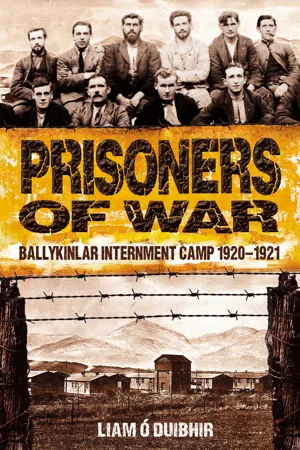
Prisoners of War: Ballykinlar, An Irish Internment Camp 1920-1921
About this book
Ballykinlar Internment Camp was the first mass internment camp to be established by the British in Ireland during the War of Independence. Situated on the County Down coast and opened in December 1920, it became home to hundreds of Irish men arrested by the British, often on little more than the suspicion of involvement in the IRA.
Held for up to a year, and subjected to often brutal treatment and poor quality food in an attempt to break them both physically and mentally, the interned men instead established a small community within the camp. The knowledge and skills possessed by the diverse inhabitants were used to teach classes, and other activities, such as sports, drama and music lessons, helped stave off boredom. In the midst of all these activities the internees also endeavoured to defy their captors with various plans for escape. The story of the Ballykinlar internment camp is on the one hand an account of suffering, espionage, murder and maltreatment, but it is also a chronicle of survival, comradeship and community.
Information
Topic
GeschichteSubtopic
Irische Geschichte1
Internment –
1916 to 1920
1916
In the aftermath of the 1916 Rising, 3,226 men and seventy-seven women were arrested. A total of 1,862 men and five women were served with internment orders under Regulation 14(b) of the Defence of the Realm Act 1914. They were transferred to Britain and temporarily held in various detention centres in England and Scotland, including Knutsford, Stafford, Wakefield, Wandsworth, Woking, Lewes, Barlinnie prison in Glasgow and Perth.1 Some of the internees served their terms of detention in English jails, but the vast majority of the male internees were transferred to the Frongoch internment camp, near Bala in North Wales.
Despite the alien environment, the prisoners used their time to plan for a resumption of war against the British establishment in Ireland. Frongoch later received the title ‘University of Revolution’ as it facilitated the reorganisation of the Irish Volunteers and provided training for men from all over Ireland, who, on their release, were able to use their newly acquired skills in a new phase of the hostilities against Britain. The contacts made in Frongoch formed the blueprint of the intelligence network established during the War of Independence by men from various counties who played prominent roles in that campaign. The internment of such a large number of revolutionaries in one place was a serious mistake on the part of the British, one that would greatly increase the success of the IRA’s operations in the years that followed.2
1918 – the ‘German Plot’
Throughout 1917 the Sinn Féin party reorganised and successfully contested by-elections in four Irish constituencies. At the same time the Irish Volunteers and IRB were also restructuring throughout the country. The success of Sinn Féin in the four by-elections in 1917 concerned the British authorities and they endeavoured to suppress the growing political opposition.
The possible internment of the Sinn Féin leaders was raised at a British cabinet meeting on Friday 19 April 1918. The proposal originated in a memorandum sent to the War Cabinet from the British Home Office and concerned the deportation of the Sinn Féin leaders to England under the Defence of the Realm Regulation No. 14. George N. Barnes, MP for the Gorbals Division, Glasgow, stated that to intern persons under Regulation 14(b) it would first have to be established that they were involved in ‘hostile associations’ with the enemy, i.e. Germany. Barnes advised that the regulation would have to be amended, as he believed it was doubtful that a connection could be proved between the enemy and most of the Sinn Féin leaders.
The British prime minister, Lloyd George, then read from a letter sent by Lord French, British viceroy and lord lieutenant of Ireland, which concerned a plan to deal with a rebellious outbreak against the introduction of conscription to Ireland. He also read letters from Walter Long, secretary of state at the Colonial Office, and Lieutenant-General Bryan McMahon, British military commander-in-chief in Ireland, who stated that armed resistance was a possible outcome if the Military Service Act which allowed for conscription was introduced in Ireland.
Lloyd George was strongly of the opinion that an amendment should be adopted to counter any insurrection. The War Cabinet decided to amend Regulation 14(b) with the insertion of the following:
In any area in respect of which the operation of section one of the Defence of the Realm (Amendment) Act, 1915, is for the time being suspended, this regulation shall apply in relation to any person who is suspected of acting or having acted, or of being about to act in a manner prejudicial to the public safety or the defence of the realm, as it applies in relation to persons of hostile origin or association.
This amendment served as the cornerstone of the British government’s internment policy in Ireland for the foreseeable future.3 Barnes stated that he wished his dissension to be placed on record.
The motive for targeting the leaders of Sinn Féin and many others for arrest and internment originated with the large-scale opposition to the threat of conscription being introduced to Ireland in early 1918. The opposition to the Conscription Bill was an embarrassment to the British government and their reaction comprised of a vicious propaganda campaign in Ireland, Britain and America, supporting the bill. The most significant act came on Wednesday 8 May 1918, when The Times newspaper published a statement from the Dublin-born unionist politician, Edward Carson, stating that the British government had in their possession the clearest evidence of an alliance between Sinn Féin and Germany. The following week, on Friday 17 May 1918, the British government ordered the arrest and internment of all known and prominent members of Sinn Féin on the premise that they were involved with the German government in a plan to smuggle arms into Ireland. That night, in what became known as the ‘German Plot’, seventy-three Sinn Féin members were arrested, including Éamon de Valera, Arthur Griffith, William Cosgrave, Countess Markievicz and other prominent figures throughout the country. No charges were preferred and many received their internment orders only while being transported from Dún Laoghaire to Holyhead in Wales on the mail boat. Those arrested were sent to various jails throughout Britain.
The following day the British government issued a press statement giving reasons for the arrests:
In consequence of the knowledge that certain persons in Ireland have entered into treasonable communication with the German enemy, it is the duty of all loyal subjects to assist his Majesty’s Government in the suppression of this treasonable conspiracy.4
The Sinn Féin leaders had received prior warning of the arrests through Éamon Broy, one of Michael Collins’ spies at Dublin Castle, but decided to use the situation to their advantage, allowing the British government to walk into another misguided manoeuvre.5 Many of the men and women arrested were later selected as candidates for the general election of December 1918, and Sinn Féin effectively used the propaganda of their unjust incarceration to ensure that a number of them would be elected while they were still in British jails.6
The issue of releasing the internees was raised at a cabinet meeting in Downing Street on Wednesday 5 February 1919. The British viceroy and lord lieutenant of Ireland, Lord French, thought it advisable to release those interned following the ‘German Plot’ arrests. The then chief secretary for Ireland, Ian MacPherson, presented the suggestion to the meeting, but some cabinet members felt releasing the prisoners at that point would be perceived as pandering to pressure from Dáil Éireann and Sinn Féin. Winston Churchill, secretary of state for war stated, ‘It would be a disastrous sign of weakness to let out the Sinn Féin prisoners.’ In contrast, MacPherson voiced the opinion that everybody in Ireland was denouncing the British government for keeping the internees locked up in Britain.7
Éamon de Valera, Seán McGarry and Seán Milroy escaped from Lincoln prison in February 1919, and in March the other men and women interned following the ‘German Plot’ arrests were released when the British government ordered a general release of all the prisoners.8
The War of Independence
and the new internment policy
and the new internment policy
The Irish War of Independence began in January 1919 and gradually developed into an intense campaign, with the IRA adopting guerrilla war tactics against the superior military machine of the British Army. The arrest and internment of those suspected of involvement in the Irish Volunteers and Sinn Féin continued into 1919 and 1920 with men being transported to various jails throughout England, including Wormwood Scrubs.9
From February 1920, the British prison authorities were expressing concerns about the indifference of these Irish internees to the prisons’ rules and regulations. In that month seventy internees were being held at Wormwood Scrubs prison. The prison governor, Major Briscoe, had considered the internees to be ‘on the whole a respectable body of men … content to live quietly under the regulations which were approved with much care and thought … ’ until the arrival of Joseph McGrath from Dublin, who had been appointed the officer representing the body of internees. Significantly, Briscoe went on to say that ‘few if any complaints were received by the commissioners until the arrival of McGrath’.10
The chairman of the prison commissioners, Sir Evelyn Ruggles-Brise, raised the issue of indiscipline among the Irish internees with the British home secretary. He suggested that the use of military camps as centres of internment would be more suitable for the growing number of internees. His proposal was based on the British government’s intention of continuing the internment policy as a means of countering the growing threat from the IRA and civilians associated with Sinn Féin. Ruggles-Brise believed the use of military camps in England was the solution, and requested the transfer of internees to the authority of the British military and the War Office.11
The small-scale arrest and internment of IRA and Sinn Féin personnel continued in March 1920. Raids targeted prominent members of Sinn Féin and those suspected of membership of the IRA from different parts of the country. The men arrested in the Ulster counties were transferred to Crumlin Road jail in Belfast, where they were held for one week. While there, a large number of the political prisoners went on hunger strike in solidarity with men making a similar protest in Mountjoy jail in Dublin. After a week at Crumlin Road jail the men were removed in lorries to the Belfast docks, where they were subjected to a vicious assault by a unionist mob who threw, amongst other things, nuts, bolts and lumps of coal at them. Many sustained serious injury and were taken to South Wales on a British naval destroyer without receiving medical treatment. They then went by train to London, where they were transferred to Wormwood Scrubs.
Since the British were not prepared for a large number of men at Wormwood Scrubs continuing hunger strikes to the death, they released them to the care of hospitals in London under the Prisons Temporary Release for Ill Health Act 1913, where they subsequently ended their action. After a few weeks recovering in hospital, they were informed that the British intended to re-arrest them, so they decided to stage a walkout. They made contact with the Irish Self-Determination League in London and arrangements were made to accommodate them with Irish people living in the capital. Their hosts then arrived at the hospital, posing as visitors, and the men walked out with them. All eventually returned to Ireland.12
However, the British internment policy continued throughout Ireland and the number of internees was soon to increase dramatically, forcing the British to look for new, larger places to incarcerate their prisoners – the first of these was Ballykinlar.
2
Bloody Sunday
In the latter part of 1920, the British introduced night-time curfews in the Dublin area, ...
Table of contents
- Acknowledgements
- Introduction
- 1 Internment – 1916 to 1920
- 2 Bloody Sunday
- 3 The Internment Round-Up
- 4 Ballykinlar Camp
- 5 Protecting Wanted Men
- 6 The Murders of Joseph Tormey and Patrick Sloane
- 7 Camp Intelligence and Communications
- 8 Letters, Parcels and the Ballykinlar Post Office
- 9 Education, GAA, Drama and Other Recreation
- 10 Disputes between the Internees and British Military
- 11 The Irish Products League
- 12 Escape Attempts
- 13 The Ballykinlar Newsletters and Photography
- 14 Ballykinlar and the 1921 Elections
- 15 The IRA and British Truce – July 1921
- 16 The Murder of Tadhg Barry
- 17 The Treaty and Release
- Postscript
- Appendix 1
- Appendix 2
- Notes
- Bibliography
- About the Author
- About the Publisher
Trusted by 375,005 students
Access to over 1.5 million titles for a fair monthly price.
Study more efficiently using our study tools.
Frequently asked questions
Yes, you can cancel anytime from the Subscription tab in your account settings on the Perlego website. Your subscription will stay active until the end of your current billing period. Learn how to cancel your subscription
No, books cannot be downloaded as external files, such as PDFs, for use outside of Perlego. However, you can download books within the Perlego app for offline reading on mobile or tablet. Learn how to download books offline
Perlego offers two plans: Essential and Complete
- Essential is ideal for learners and professionals who enjoy exploring a wide range of subjects. Access the Essential Library with 800,000+ trusted titles and best-sellers across business, personal growth, and the humanities. Includes unlimited reading time and Standard Read Aloud voice.
- Complete: Perfect for advanced learners and researchers needing full, unrestricted access. Unlock 1.5M+ books across hundreds of subjects, including academic and specialized titles. The Complete Plan also includes advanced features like Premium Read Aloud and Research Assistant.
We are an online textbook subscription service, where you can get access to an entire online library for less than the price of a single book per month. With over 1.5 million books across 990+ topics, we’ve got you covered! Learn about our mission
Look out for the read-aloud symbol on your next book to see if you can listen to it. The read-aloud tool reads text aloud for you, highlighting the text as it is being read. You can pause it, speed it up and slow it down. Learn more about Read Aloud
Yes! You can use the Perlego app on both iOS and Android devices to read anytime, anywhere — even offline. Perfect for commutes or when you’re on the go.
Please note we cannot support devices running on iOS 13 and Android 7 or earlier. Learn more about using the app
Please note we cannot support devices running on iOS 13 and Android 7 or earlier. Learn more about using the app
Yes, you can access Prisoners of War: Ballykinlar, An Irish Internment Camp 1920-1921 by Liam Ó Duibhir in PDF and/or ePUB format, as well as other popular books in Geschichte & Irische Geschichte. We have over 1.5 million books available in our catalogue for you to explore.