- 416 pages
- English
- ePUB (mobile friendly)
- Available on iOS & Android
eBook - ePub
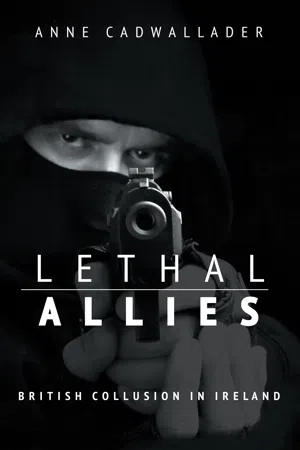
Lethal Allies: British Collusion in Ireland
About this book
'. . . a well-written piece of investigative journalism that asks some deeply troubling questions . . .' - NY Journal of Books
'Cadwallader has written a brave, powerful and forensically detailed book about a shameful and denied aspect of our conflict's history.' - The Irish Times.
'Anne Cadwallader's remarkable book focusses on collusion in the British security forces (the RUC, the British Army, and the UDR) in the mid-Ulster "Murder Triangle". Over 120 people were killed by a loyalist gang operating in mid-Ulster and Cadwallader has created a convincing argument that collusion with certain elements of the security forces was crucial in the committing of these crimes and the lack of proper investigation into many of these crimes' - The Dublin Reader
Farmers, shopkeepers, publicans and businessmen were slaughtered in a bloody decade of bombings and shootings in the counties of Tyrone and Armagh in the 1970s. Four families each lost three relatives; in other cases, children were left orphaned after both parents were murdered. For years, there were claims that loyalists were helped and guided by the RUC and Ulster Defence Regiment members. But, until now, there was no proof.
Drawing on 15 years of research, and using forensic and ballistic information never before published, this book includes official documents showing that the highest in the land knew of the collusion and names those whose fingers were on the trigger and who detonated the bombs. It draws on previously unpublished reports written by the PSNI's own Historical Enquiries Team. It also includes heartbreaking interviews with the bereaved families whose lives were shattered by this cold and calculated campaign.
Information
1
Blooding-In (1972)
What answer from the North?
One Law, one Land, one Throne.
If England drive us forth
We shall not fall alone!
Rudyard Kipling, ‘Ulster 1912’1
If you like a quiet life, Portadown on 12 July is generally not an ideal place. The ‘Orange Citadel’ is usually tense as the annual ‘Twelfth’ parades get under way to the sounds of flutes and thumping drums floating over the town centre and the surrounding housing estates.2 July 1972, however, was particularly tense, even for Portadown. In Northern Ireland the Troubles were just over halfway through their bloodiest year; there were a further twenty-two years to go.
Bloody Sunday, six months earlier, had been a watershed – ending the hopes of many that the civil rights movement could move peacefully towards political and constitutional reform. Young Catholic men were queuing up to join the IRA. By the end of 1972, over 400 people (more than one a day) would be dead.
To set the political scene: on 24 March 1972, Brian Faulkner, the unionist prime minister of Northern Ireland, was informed by London that unionist rule was over.3 Westminster then assumed ‘full and direct responsibility’ for the governing of Northern Ireland.4 Faulkner and the entire unionist community felt ‘betrayed’.5 The prorogation of Stormont was a huge blow to Protestant confidence. The loyalist response was bloody and indiscriminate, but for the first half of 1972, focused almost totally on Belfast. Of the thirty-one loyalist killings in the first half of 1972, thirty were in Belfast, with the remaining one just outside the city.6 Between 1969 (around the time the conflict began) and July 1972, loyalists killed fifty-six people, but no one had been killed in Portadown for sectarian or political reasons for over forty years.7 The town, however, would not remain free of blood for much longer. A nucleus of UVF killers was forming, who soon began spreading death and destruction as far south as Dublin. By the end of 1972, seven people in the town had been killed, some in the most brutal circumstances. Over the next five years, in various permutations, and with the collaboration of others from Dungannon (to the north-west) and villages such as Markethill (to the south), a loyalist gang was to kill more than eighty men, women and children in Mid-Ulster alone – far out of proportion to similar rural communities in Northern Ireland.
So what had changed? Bearing in mind the horrors to come, the question is worth addressing in some detail. For centuries, Portadown had seethed with sectarian tensions, but until July 1972 no one had been killed for decades. One answer lies in the fast-moving political circumstances. On 20 June 1972, British government representatives (and at least one MI6 man) met IRA leaders for secret talks near the border in County Derry. That meeting laid the groundwork for an IRA ceasefire starting on 26 June, contingent on a ‘reciprocal response’. Four days later, a spooked UDA began to organise ‘no-go’ areas, amid fears that London was on the brink of making historic concessions to republicans.
On Friday 7 July, republican leaders met British ministers again, for talks in London at the Chelsea home of the then Minister of State for Northern Ireland, Paul Channon. The talks failed as both sides hopelessly over-estimated each other’s ability to manoeuvre. The fragile IRA ceasefire broke down on 9 July, in a dispute between local republicans and the British Army over the allocation of homes to refugee Catholic families in Lenadoon, Belfast.
In Portadown, community relations – always fragile – were on the slide. The catalyst for the first murder in forty years was the 1972 Orange parade in the town, traditionally held every year on the Sunday before 12 July to commemorate a generation of young men who died in the First World War. Many unionists believed their community’s blood sacrifice at the Somme guaranteed the union. Portadown’s nationalist residents, based in one enclave of the town centred on Obins Street, formed a ‘Resistance Council’, calling on the police to re-route the parade away from their homes. The IRA warned it would ‘take action’ if this was not done, and the UDA threatened counter-action if it was. The scene was set.
On Saturday 1 July, eight days before the parade, nationalists built barricades around their enclave. On 9 July, with just hours to go before the Orangemen marched, the British Army moved in and cleared the barricades, using tear gas and rubber bullets. Once the streets were cleared, the soldiers stood by and watched the parade. It was escorted by at least fifty UDA men dressed in full paramilitary regalia,8 who saluted the Orangemen as they marched through the disputed area9 without any intervention from police or soldiers.a
Three days later, in the early hours of the Twelfth itself, Portadown was rife with rumours of planned attacks and counter-attacks. In one of dozens of localised incursions, a group of Protestantsb was spotted in an alleyway in a Catholic area of the Churchill Park estate.10 Local republicans who can still remember that time say they believed the group was intent on burning Catholic homes.11 Shouts went up and the IRA opened fire. A young Protestant, Paul Beattie, aged nineteen, fell dead. Loyalist fury was intense.
A pathologist’s report to the inquest states that Beattie, an apprentice butcher, was hit by two bullets, one penetrating both his lungs and heart, the second his lower back.12 The report goes on to say that Beattie had been on ‘vigilante patrol’ with his father in a housing estate adjacent to his own and that, at about 2.50 a.m., they had seen ‘two men acting suspiciously’ and had gone to investigate. The two men had disappeared and Beattie and his father had ‘started to look around the houses’.
As they turned a corner, they heard a bottle break and ‘immediately there was a shot’. Beattie said, ‘Daddy, I have been hit. Run,’ then turned himself and ran. There was another shot ‘and he fell face forwards to the ground. His father went to his assistance. A crowd gathered and an ambulance took him to hospital, where he was found to be dead.’ The last line of the pathologist’s report reads: ‘He had a stocking mask over his face at the time.’
At his funeral, a Methodist minister, Rev. R. S. F. Cleland, described the killing as a ‘bestial crime against the law of God’. He appealed to those who thought of vengeance to instead ‘exercise loving kindness, justice and righteousness’.13 Among the 110 wreaths at the funeral were ones from ‘The Officers and Volunteers, Lurgan Battalion UDA’, ‘Edgarstown Loyalists’, ‘Commander and Battalion Portadown UDA’ and various other paramilitary units. An evil genie was released from its bottle.
In an almost immediate retaliation, fifteen shots were fired at a house where a wake was being held for a Catholic woman killed in a car crash. But worse, far worse, was to come.
Within hours, a hooded loyalist gunman attacked McCabe’s Bar in the town, killing both its Catholic owner, Jack McCabe, and a Protestant customer, William Cochrane. Both were shot at close range, the killer getting in close enough to inflict terrible wounds. Jack was shot in the back of the head; William directly in the face. Cochrane, a fifty-three-year-old ex-serviceman and council worker, was particularly unlucky. He was shot simply because he was drinking in what was perceived to be a ‘Catholic bar’.14 McCabe had attended Blackrock College in Dublin, the alma mater of the prosperous southern middle class, before returning to Portadown to run the family business. He was vice-chairman of the local hospital, a school governor and involved in numerous charities.15 Jack’s wife, Eilagh, and their seven children were away on holiday.
The killer was Ralph (Roy) Henry, a thirty-three-year-old former RUC officer from Craigavon.16 At his trial, two juries failed to agree on a verdict, but a third in 1974, held in Downpatrick, found Henry guilty.17 On at least one occasion the public gallery had to be cleared after intimidating gestures were made to witnesses.18 The trial judge ordered a policeman to stand on duty in the public benches to prevent further abuse.c On virtually every appearance in court, Henry shouted, ‘No surrender.’ About a dozen supporters shouted, ‘Keep up the fight,’ as he was taken down to begin his sentence.
In th...
Table of contents
- Cover
- Titel
- Widmung
- Impressum
- Inhalt
- Acknowledgements
- Note on the Author
- Glossary
- List of Main Official Figures in the Book
- Timeline of Attacks
- Introduction
- 1 Blooding-In (1972)
- 2 ‘My God, Not This’ (1973)a
- 3 ‘Killing the Neighbours’ (1974)a
- 4 Turning to Murder (1975)
- 5 ‘The Murderous Cycle Continued’ (Jan–May 1976)a
- 6 ‘A Policeman’s Boots’ (June 1976–Dec 1977)a
- 7 Bombs Know No Borders
- 8 ‘Acquainted with Grief’a
- 9 The ‘Short Arm’ of the Law
- 10 Britannia Waives the Rules
- 11 Ridding the Land of Pestilence
- 12 Her Majesty’s Murderers
- 13 From Dhofar to Armagh
- Conclusion
- Appendix
- Notes
- Bibliography
- About the Author
- About the Publisher
Trusted by 375,005 students
Access to over 1.5 million titles for a fair monthly price.
Study more efficiently using our study tools.
Frequently asked questions
Yes, you can cancel anytime from the Subscription tab in your account settings on the Perlego website. Your subscription will stay active until the end of your current billing period. Learn how to cancel your subscription
No, books cannot be downloaded as external files, such as PDFs, for use outside of Perlego. However, you can download books within the Perlego app for offline reading on mobile or tablet. Learn how to download books offline
Perlego offers two plans: Essential and Complete
- Essential is ideal for learners and professionals who enjoy exploring a wide range of subjects. Access the Essential Library with 800,000+ trusted titles and best-sellers across business, personal growth, and the humanities. Includes unlimited reading time and Standard Read Aloud voice.
- Complete: Perfect for advanced learners and researchers needing full, unrestricted access. Unlock 1.5M+ books across hundreds of subjects, including academic and specialized titles. The Complete Plan also includes advanced features like Premium Read Aloud and Research Assistant.
We are an online textbook subscription service, where you can get access to an entire online library for less than the price of a single book per month. With over 1.5 million books across 990+ topics, we’ve got you covered! Learn about our mission
Look out for the read-aloud symbol on your next book to see if you can listen to it. The read-aloud tool reads text aloud for you, highlighting the text as it is being read. You can pause it, speed it up and slow it down. Learn more about Read Aloud
Yes! You can use the Perlego app on both iOS and Android devices to read anytime, anywhere — even offline. Perfect for commutes or when you’re on the go.
Please note we cannot support devices running on iOS 13 and Android 7 or earlier. Learn more about using the app
Please note we cannot support devices running on iOS 13 and Android 7 or earlier. Learn more about using the app
Yes, you can access Lethal Allies: British Collusion in Ireland by Anne Cadwallader in PDF and/or ePUB format, as well as other popular books in History & British History. We have over 1.5 million books available in our catalogue for you to explore.