- 448 pages
- English
- ePUB (mobile friendly)
- Available on iOS & Android
eBook - ePub
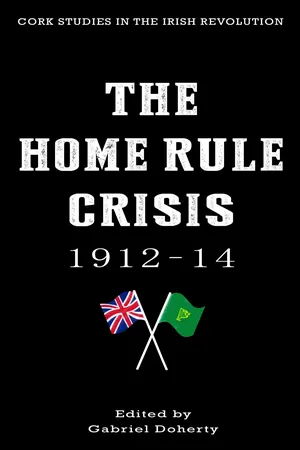
The Home Rule Crisis 1912–14
About this book
The Home Rule Bill, passed by the British parliament in 1912, was due, when it came into effect in 1914, to give Ireland some control over her own affairs for the first time since the Act of Union in 1800. However, this was postponed when the First World War broke out and by the time the war had ended the political landscape in Ireland had changed irrevocably.
The nationalist movement split into the followers of John Redmond who chose to fight for the British in the war in the hope that their loyalty would be rewarded and those on the other side who felt that this was just a delaying tactic and that 'England's difficulty [was] Ireland's opportunity'.
Meanwhile the Unionists were violently opposed to any form of Irish self government, believing that 'Home rule is Rome rule' and this led to the signing of the Ulster Covenant and the establishment of the Ulster Volunteers.
The respected historians who have contributed to this book examine the reaction to the Home Rule Bill across many shades of political opinion across these islands and give a fascinating analysis of what might have been if external events had not overtaken local ones.
Information
1
When histories collide: the third Home Rule bill for Ireland
Thomas Bartlett
The narrative is well known.1 On 11 April 1912 the British Prime Minister, Herbert Henry Asquith, introduced in the British House of Commons the third Home Rule bill for Ireland. Two previous Home Rule bills, both introduced by William Ewart Gladstone, in 1886 and 1893 respectively, had failed, the first in the House of Commons, the second in the House of Lords. The third Home Rule bill, however, had every chance of passing into law, for the Parliament Act of 1911, carried with Irish Party support, meant that the House of Lords could delay designated legislation for only three years – which meant that, all things being equal, Irish Home Rule would become law in 1914. But if this was the major difference between this Home Rule bill and the earlier ones, there was still a remarkable similarity, principally in what was on offer, between all three. As with the 1893 Bill, though not with that of 1886, which had provided for no Irish representation, forty-two Irish MPs would continue to attend at Westminster – which would of course be supreme – and Ireland would remain an integral part of the Empire and United Kingdom. The proposed new legislature to be set up in Dublin would have two chambers: a senate with forty members, and a lower house with 164 members. However, the term ‘legislature’ is undoubtedly rather extravagant, for the powers to be delegated to the new assembly were extremely limited. Matters relating to the monarchy, marriage (a hot topic at the time because of the Ne Temere decree),2 the military, peace or war, foreign affairs, coinage, the law of treason, and trade and navigation – even lighthouses and, curiously, trademarks – were to be outside its remit, while others – such as policing, tax collection, old age pensions, land purchase, national insurance and even the post office – could possibly be delegated to Dublin, but only after a period of years. We may note that in a marked departure from proposals in the earlier Home Rule bills, that proposed by Asquith stipulated that there could be no Irish interference with the existing Irish civil service.3 In addition, a lord lieutenant would reside, as before, in Dublin, but now he would have real power, with the authority to approve or veto legislation, or to delay action of any kind. Admittedly, a sum of around six million pounds would be transferred annually from the British Exchequer, but even here there was a humiliating condition: the money would be paid only in proportion to the receipt of annuities due under the various land acts of the previous twenty years. If Irish farmers failed to pay up, funds from the British Exchequer to Ireland would dry up. Uncharacteristically – for he had accepted the rest without demur – John Redmond, leader of the Irish Party, was moved to complain that this safeguard for the British Treasury meant that ‘the whole revenue of Ireland is thus held in pawn’.4 By any standards, the third Home Rule bill offered a derisory amount of devolved government to Ireland: a legislature shorn of legislative powers, whose prime function, as envisioned in the days of Gladstone, was to act as a collector of British taxpayers’ money previously advanced to Irish tenants to enable them to buy their holdings. Thirty years and more of constitutional and political struggle had, it seemed, produced a legislative mouse.
And yet, as is also well known, this excessively modest measure instantly provoked a series of extravagant, not to say hysterical, reactions that within a short time brought Ireland to the verge of a civil war. Even before Asquith had introduced his bill at Westminster, a nationalist crowd estimated at a half million strong had gathered in anticipation in Dublin city centre to acclaim the coming triumph. When Asquith did introduce the bill, Redmond declared flatly that ‘I personally thank God that I have lived to see this day’ and he hailed the third Home Rule bill as no less than a ‘great treaty of peace between Ireland, England and the Empire’.5 When Asquith visited Dublin in July 1912 he received a rapturous reception at the Theatre Royal: ‘the entire audience rose to their feet,’ reported The Irish Times, ‘and waving hats, handkerchiefs and papers, cheered enthusiastically with a growing rather than a diminishing volume of sound … for close on five minutes.’6 Given the extremely limited amount of devolved government on offer, such euphoria, such triumphalism, is hard to explain.
And, of course, on the opposite side of the case, Conservative and unionist fury at Asquith’s action appeared equally unwarranted. Two days before the bill had been introduced, Andrew Bonar Law, leader of the Conservative Party, with Sir Edward Carson, leader of the Irish unionists at his side, had reviewed a march past at Balmoral, near Belfast, of over 100,000 opponents of the proposed Home Rule bill and Bonar Law had pledged his party’s support in their resistance to that measure. On 12 July he went further: he warned that there were ‘things that were stronger than parliamentary majorities’, and some weeks later, he notoriously averred that ‘I can imagine no lengths of resistance to which Ulster can go in which I should not be prepared to support them.’7 Mobilisation against Home Rule proceeded apace. On ‘Ulster Day’, 28 September 1912, against a background of sectarian rioting in Belfast and elsewhere, and expulsions of Catholics and other deviants from the shipyards, Sir Edward Carson became the first to sign the Ulster Covenant at Belfast City Hall, in which document he and his fellow signatories pledged to use ‘all means which may be necessary to defeat the present conspiracy to set up a Home Rule Parliament in Ireland’. Within weeks, some 500,000 others, men and women, had followed his example and signed. Quite what ‘all means that may be necessary’ signified became clear over the subsequent months, with the purchase of arms, the drilling of armed men, the formation of the Ulster Volunteer Force (UVF) and gun-running at Larne and elsewhere in 1913. And these developments were mirrored on the nationalist side by the later formation of a corresponding force, the Irish Volunteers, and by the attempt to secure arms from abroad. As tempers flared, military preparations increased and the political temperature rose, it seemed that a civil war between opponents and supporters of the third Home Rule bill was inevitable, probably some time in 1914.
So far so conventional. Yet the puzzle remains: how could such a truncated piece of proposed legislation, one devoid of any Irish nationalist input, and one deliberately designed to set up such a toothless institution, arouse such elation on the one part and such horror on the other, so much so that civil war would quickly appear unavoidable?
In his review of Anglo-Irish constitutional relations between 1912 and 1972 Nicholas Mansergh addressed this question of the glaring disparity between what was offered and the extreme reactions that the bill produced. So far as Redmond was concerned, Mansergh noted, the limited nature of the bill was very much a secondary consideration. For him, and by extension nationalist Ireland, ‘[the bill] proposed to reconstitute a parliament for Ireland, all Ireland’, and ‘it was the “example” of [the parliament at] College Green that counted, not the powers or the lack of them to be vested in it’. Once a parliament was restored, Mansergh continued, Redmond believed that ‘much else would be added and the psychological gain would more than compensate for restrictions that were little short of humiliating’.8 There is undoubtedly much in this insight; and unionists at the time would have concurred that the third Home Rule bill represented precisely that ‘thin end of the wedge’ (or staging post to complete separation of Ireland from Britain) that they feared would mean ruination and destruction for them. Whatever else, the Home Rule parliament envisaged in 1912, precisely because it was so evidently flawed in its structure and restricted in its powers, could never prove a final settlement, and therein lay the danger for unionists.
Further unionist objections, though the word seems inadequate, to Home Rule for all Ireland have been well rehearsed in the literature. Unionists claimed – possibly with an eye to winning British support – that Home Rule would strike a blow at the integrity of the British Empire, even presage its break-up. Then there was the self-pitying charge that Home Rule was ‘the most nefarious conspiracy that has ever been hatched against a free people’ and that unionists had done nothing to deserve being prised from the embrace of mother England and handed over to their enemies. As Carson put it (quoting a report produced by the Belfast Chamber of Commerce protesting against the 1893 Act): ‘We can imagine no conceivable reason – no fault that we have committed – which will justify the treatment which this Bill prepares for us.’9 It was confidently asserted that Home Rule must mean both financial ruin, with Ulster money being drained to bail out feckless southern peasants, and industrial decay, since a Dublin parliament dominated by agriculturalists would legislate against the industrialised north-east. Home Rule, as well, would produce social chaos, with those, as Carson put it, ‘whose capacity has never been applied towards the practical advancement of the material interests of the country’, men who were demonstrably unfitted to rule, being placed over the natural governors.10 Home Rule in short was ‘ridiculous’, for it was a farcical proposition that the Irish could govern themselves, and the thing must end in complete ruination.11 Lastly, Home Rule was Rome Rule: as the Rev. Dr William McKean, a former Presbyterian moderator, put it in his sermon on ‘Ulster Day’ 1912: ‘The Irish Question is at bottom a war against Protestantism; it is an attempt to establish a Roman Catholic Ascendancy in Ireland to begin the disintegration of the empire by securing a second parliament in Dublin.’12
And yet, while conceding that unionist fears and anxieties – and determination to resist Home Rule – were undoubtedly real, it is still difficult to reconcile the modest measure of devolution on offer with the apocalyptic consequences that unionists argued would inevitably flow from it, or indeed with the triumphalism with which nationalist Ireland viewed the proposed measure. Perhaps one way of doing so is to concede from the beginning that Home Rule itself was not at stake here, that is to say, that the crisis sparked off by the third Home Rule bill was not really about Home Rule at all: that in essence Home Rule was always more about image than substance.13 And that image, for both unionists and nationalists, was refracted through Irish history.
When Asquith rose in the Commons to propose his Home Rule bill ‘for the better government of Ireland’, he declared that it signalled ‘the most urgent and most momentous step towards the settlement of the controversy which, as between ourselves and Ireland, has lasted for more than a century’.14 Asquith’s time frame – more than a hundred years – for the Irish demand for Home Rule may have struck some of his listeners as rather odd. After all, Gladstone’s conversion to Home Rule had been in 1886, just under thirty years earlier, and while Irish demands f...
Table of contents
- Cork studies in the Irish revolution
- Acknowledgements
- List of Contributors
- Introduction
- The 1912 Home Rule bill: then and now
- 1 When histories collide: the third Home Rule bill for Ireland
- 2 The politics of comparison: the racialisation of Home Rule in British science, politics and print, 1886–1923
- 3 Literary provocateur: revival, revolt and the demise of the Irish Review, 1911–14
- 4 Liberal public discourse and the third Home Rule bill
- 5 Ulster ‘will not fight’: T. P. O’Connor and the third Home Rule bill crisis, 1912–14
- 6 Myopia or utopia? The discourse of Irish nationalist MPs and the Ulster question during the parliamentary debates of 1912–14
- 7 The All-for-Ireland League and the Home Rule debate, 1910–14
- 8 The Murnaghan memos: Catholic concerns with the third Home Rule bill, 1912
- 9 ‘Resigned to take the bill with its defects’: the Catholic Church and the third Home Rule bill
- 10 ‘Neither Whigs, Tories, nor party politicians’? The Church of Ireland and the Ulster crisis, 1910–14
- 11 Irish Presbyterians and the Ulster Covenant
- 12 ‘Grotesque proceedings’? Localised responses to the Home Rule question in Ulster
- 13 The Ulster Volunteer Force, 1913–14
- 14 The persistence of Liberal Unionism in Irish politics, 1886–1912
- 15 The role of the leaders: Asquith, Churchill, Balfour, Bonar Law, Carson and Redmond
- 16 The centenary commemoration of the third Home Rule crisis
- 17 The third Home Rule bill in British history
- About the Author
- About the Publisher
Trusted by 375,005 students
Access to over 1.5 million titles for a fair monthly price.
Study more efficiently using our study tools.
Frequently asked questions
Yes, you can cancel anytime from the Subscription tab in your account settings on the Perlego website. Your subscription will stay active until the end of your current billing period. Learn how to cancel your subscription
No, books cannot be downloaded as external files, such as PDFs, for use outside of Perlego. However, you can download books within the Perlego app for offline reading on mobile or tablet. Learn how to download books offline
Perlego offers two plans: Essential and Complete
- Essential is ideal for learners and professionals who enjoy exploring a wide range of subjects. Access the Essential Library with 800,000+ trusted titles and best-sellers across business, personal growth, and the humanities. Includes unlimited reading time and Standard Read Aloud voice.
- Complete: Perfect for advanced learners and researchers needing full, unrestricted access. Unlock 1.5M+ books across hundreds of subjects, including academic and specialized titles. The Complete Plan also includes advanced features like Premium Read Aloud and Research Assistant.
We are an online textbook subscription service, where you can get access to an entire online library for less than the price of a single book per month. With over 1.5 million books across 990+ topics, we’ve got you covered! Learn about our mission
Look out for the read-aloud symbol on your next book to see if you can listen to it. The read-aloud tool reads text aloud for you, highlighting the text as it is being read. You can pause it, speed it up and slow it down. Learn more about Read Aloud
Yes! You can use the Perlego app on both iOS and Android devices to read anytime, anywhere — even offline. Perfect for commutes or when you’re on the go.
Please note we cannot support devices running on iOS 13 and Android 7 or earlier. Learn more about using the app
Please note we cannot support devices running on iOS 13 and Android 7 or earlier. Learn more about using the app
Yes, you can access The Home Rule Crisis 1912–14 by Gabriel Doherty in PDF and/or ePUB format, as well as other popular books in History & Irish History. We have over 1.5 million books available in our catalogue for you to explore.