- 256 pages
- English
- ePUB (mobile friendly)
- Available on iOS & Android
eBook - ePub
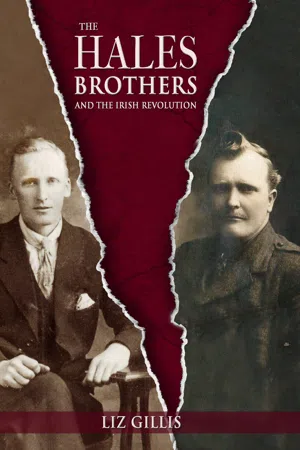
The Hales Brothers and the Irish Revolution
About this book
The story of the Hales family from Bandon epitomises the whole revolutionary period in Ireland. They were involved from the establishment of the Irish Volunteers in West Cork and were closely associated with well-known revolutionary figures, including Michael Collins, Tom Barry and Liam Deasy. Both Seán and Tom were company commanders in the IRA in the area. The signing of the Anglo-Irish Treaty in December 1921 split the family and led to the two brothers taking opposing sides in the Civil War that would follow.
Tom Hales was the most senior Republican officer on the scene of the chaotic ambush at Béal na mBláth that led to the shooting of Michael Collins. Seán Hales was himself assassinated in Dublin by Republicans, following a vote in Dáil Éireann to allow the Provisional Government to increase its powers to penalise Republican prisoners.The story of these brothers and the rest of the family gives a unique insight into life in Ireland in this tumultuous period.
Information
1
EARLY YEARS
In the early 1900s no one, either in Ireland or Great Britain, could have imagined that by the 1920s Ireland would have won partial independence from Britain through force of arms. Most Irish people at the time believed that the best they could hope for was Home Rule, a limited form of self-government. This dramatic change was the result of actions by a revolutionary generation who were willing to assert their right to freedom by any means necessary. What made this particular generation different to their predecessors was the central role played by the IRB.1 Founded in 1858, the IRB, despite many failures in its early years, did not go away or disband. Instead it reorganised and adapted until at last, under the leadership of men like Bulmer Hobson, Denis McCullough, Seán MacDiarmada and, most importantly, Tom Clarke in the early 1900s, it became a cohesive body that brought together many young men who at that moment in time were looking for an opportunity to right the wrongs that had been done to their country by Britain.
The new, invigorated leadership of the IRB realised that if they were to have any chance of achieving the aim of winning independence from Britain, they would need the support of the people – a mass movement. Previous experience had shown that mass movements were capable of achieving goals; for example, Daniel O’Connell and the Catholic Association and their success at winning Catholic Emancipation in 1829, or Charles Stewart Parnell and the Land League and their success at gaining rights for tenant farmers in the late 1870s and 1880s.
The mass movement favoured by the IRB was the Irish Volunteers, an armed militia they were instrumental in setting up in November 1913, ostensibly to safeguard the introduction of Home Rule but in reality to be used by the IRB to win complete independence by force. They were helped by the fact that in the early years of the twentieth century there was a younger generation who were becoming increasingly politicised and questioning the status quo in Ireland. Many of this generation did not believe that Home Rule was the best solution for Ireland and felt that they, the ordinary citizens, would not benefit from its introduction. The most radical young men joined the reorganised IRB, turning it into a more determined and ruthless organisation, and their sense of idealism and belief in a better future for Ireland made a huge difference when compared to the previous failed attempts to win Irish freedom in the years 1798, 1803, 1848 and 1867. In cities, towns and villages all over the country, young men and women sought to play their part in this revolutionary movement by swelling the ranks of the nationalist organisations now available to them.
County Cork, and in particular West Cork, was to play a vital role in the events that took place between 1913 and 1924. The young men and women there had grown up hearing stories of the Famine of the 1840s, which had a devastating effect on that area of the country, most notably in Skibbereen, and of the evictions of tenant farmers in the years that followed, as well as the mass emigrations that took place. These stories helped instil in them a belief that only Irish people, and not a foreign government, should determine Ireland’s future, and that future could be achieved only by severing the link with Britain completely. Ironically, it was Bandon, a staunchly loyalist town in West Cork, that found itself at the heart of the revolutionary movement.
Central to this movement was the Hales family of Knocknacurra, Ballinadee, a small townland a few miles outside Bandon. The Hales children grew up hearing stories of England’s oppression of Ireland. Their father, Robert, was born in Knocknaun, Cork, in 1849, when the Famine was showing no signs of ending and West Cork was experiencing first-hand the full devastation of this tragedy. The early years of Robert’s life no doubt influenced him greatly and helped form his political beliefs. A loyal supporter of William O’Brien, he joined the All for Ireland League and was radically opposed to the landlord system which prevailed in Ireland at the time.2 It seems he was also, for a time, a member of the IRB.
Robert married in 1867 and with his wife, Margaret, had nine children: Bessie (1874), Anne (1878), Hannah (1879), Seán (1880), Donal (1884), Robert (1886), Madge (1890), William (1891) and Tom (1892). On his farm in Knocknacurra he raised cattle and sheep; he was quite successful at this as his cattle were entered into shows in Bandon and won commendations.3 Both Robert and Margaret were fluent Irish speakers, a tradition they passed on to their children. Their father’s influence would greatly determine the path the Hales children later chose to follow.
On 16 May 1907 Robert Hales’ cattle were seized by the sheriff’s office because he had failed to pay rent the previous September. Two cows were removed and taken to the Bandon Pound to be sold by the authorities to recoup the money owed. Feeling a sense of injustice at the treatment of their father, Seán and Tom sought to get his cattle back. Together with a number of their friends, they set about planning their operation and were quite prepared to use violence if necessary. Recalling the events of 20 May 1907, Tom Hales wrote:
On one occasion two of my father’s cows were in Bandon Pound, behind locked gates and guarded by twenty R.I.C. men. The Sherriff [sic] had arrived to proceed with the sale and removal to Cork. About twenty Ballinadee men, armed with ash plants, in a sudden organised attack, scattered the policemen, broke open the gate and rescued the cattle. The police used their batons freely, but the reliable ash plants, weilded [sic] by the powerful Ballinadee men, proved better weapons and soon rendered their hands and arms useless. The cattle were, by a pre-arranged plan, driven off to a destination from which the Sherriff never afterwards recovered them. This was an example of combined organisation and physical courage unequalled in those days. The plan was captained by my brother, Seán Hales, in co-operation with the O’Donoghues, Finns, McCarthys, Collins, etc., all of whom were afterwards the leading men in the Ballinadee Company. The above-named were the first in the assault on Bandon Pound; each had a special part allotted to him under the leadership of Seán Hales. Seán and a few others had, of course, a short-term holiday in His Majesty’s prison afterwards, and several were on the run for some months.4
Because of the raid, Seán and two friends, James O’Donovan of Gallows’ Hill, Bandon, and John Deasy of Derrycool, Bandon, were arrested. Seán was detained at around 4 a.m. on the morning of 21 May at his father’s home. All three were put on trial at a special sitting of the court in Bandon courthouse on 22 May and charged with ‘unlawfully and forcibly breaking into the pound at Bandon and rescuing cattle which were rightfully seized and impounded there by the Sheriff’s bailiff ’.5
The newspapers of the day were full of accounts of the raid. Sergeant McGovern, Royal Irish Constabulary (RIC), who was present at the pound when it occurred, testified in court:
… about a quarter to twelve I was standing near the pound gate, which I had under observation. Acting-Sergeant White, Constables Cooper and Kiernan [present also was Sergeant Humphries] were near him [Seán Hales]. The gate was locked. There was a crowd of about a hundred around the gate. I saw John Hailes [sic] in that crowd: he was standing less than a yard outside the pound gate … The demeanour of the crowd was quiet … a young fellow who I did not know shoved the gate. There was a rush on the gate then, and it was burst open. About fifty people went into the pound yard and commenced to hunt the cattle. He and the four policemen who were with him got between the cattle and the gate. Acting-Sergeant White and I attempted to close the gate. We were unable to do so owing to the pressure of the crowd. Amongst the people he [Sergeant McGovern] saw James Donovan [sic] and John Hailes. James Donovan was striking at one of the cows with a large stick. He was endeavouring to drive her towards the gate past me. Hailes was pushing the other cow out … The pound was a scene of tumult. The crowd succeeded in shoving the cows and the police out through the gate. I held one of the cows with Acting Sergeant White as long as I could … The crowd successfully carried off the cows down the street. They were cheering and shouting.6
The three men were found guilty and sentenced to two weeks’ imprisonment. This early action was the first indication of the leadership skills utilised by the Hales during the years of the Irish revolution.
At this time the cultural and nationalist revival had a firm foothold throughout the country. Organisations such as the GAA and the Gaelic League, of which the Hales were members, brought together many young people from all social classes, and through such bodies they realised they shared similar political views. Nationalists (Home Rulers), Republicans, trade unionists, socialists and other activists gathered and talked openly about how a better future for their country could be achieved. Through these organisations, the first cohesive steps towards revolution began to appear.
In 1913 and 1914 the establishment of three organisations in particular would help change the course of Irish history: the ICA, the Irish Volunteers and Cumann na mBan respectively.7 Of these, it was the Volunteers that would impact on the Hales significantly. William Keyes McDonnell established the first company of Irish Volunteers in West Cork on the instructions of the organisation’s leader, Eoin MacNeill.8 Despite the fact that West Cork had quite a large loyalist population, thus making recruitment for the Volunteers difficult, McDonnell did eventually succeed. The first Volunteer company to be formed was the Kilpatrick Company, and others soon followed.
Tom Hales was the first member of his family to enrol in the Irish Volunteers, in 1913. However, with the outbreak of the First World War in August 1914, his siblings soon followed his lead. ‘The family decided they wouldn’t join the British Army, so they started up their own company of Volunteers.’9 Of the nine Hales children, six became involved in the movement: Tom, Seán, Robert and William joined the Irish Volunteers, while their brother Donal, who lived in Italy, later became a Republican Envoy in Genoa during the War of Independence. Their sister Madge, although as Republican as her brothers, did not join Cumann na mBan, as it was safer for her if she was not known to the authorities, who would have been aware of who was a member of Cumann na mBan.10 This was certainly the case in the War of Independence, when many women were used as intelligence operatives, and in Madge’s case, as will later be seen, her role as an arms smuggler between Ireland and Italy meant it was better for her if she had no known connection with Cumann na mBan.
Soon after the outbreak of the First World War the Irish Volunteers, which numbered approximately 180,000 members, split. John Redmond, leader of the Irish Parliamentary Party (IPP), pledged the Volunteers to fight on the side of the Allies during the war, as by doing this he hoped to guarantee the introduction of Home Rule. Many in the Volunteers, especially those like the Hales, who were also members of the IRB, did not agree, believing the freedom of their own country came before the freedom of any other nation.
There were now two groups: the National Volunteers, who followed John Redmond, and the Irish Volunteers, who were still under the leadership of Eoin MacNeill. Although numerically small, many of those now in the Irish Volunteers were seen as radicals and extremists whose only aim was to free Ireland completely from British rule. As a result of the split the IRB had more control over the Irish Volunteers and immediately set about planning the events that would eventually lead to the Easter Rising in 1916.
Early in 1915 the Ballinadee Company of the Irish Volunteers was formed, owing to a request from Seán Hales to Terence MacSwiney, vice-O/C of the Cork Brigade, to come to Ballinadee to organise a company there.11 Seán had written to MacSwiney, stating:
They would muster up to 100 men, nearly all over six feet. This sweeping statement caused much amusement but there was something to it, for Ballinadee could rightly boast fine specimens of manhood, with Bob Hales a champion in two counties. The Ballinadee Company was successfully established in 1915.12
Soon the Ballinadee Company had earned the reputation of being ‘the most prominent … the best organized, the best equipped and best armed Company of Volunteers in West Cork’ and the Hales brothers were at the helm of it.13 Tom, although twelve years younger than Seán, was O/C of the company and, together with neighbours and friends, built it up from twenty-four men in 1915 to nearly 100 by Easter 1916. The training of the Ballinadee Company began in earnest:
Parades were held on two evenings a week and a route march on Sundays. These marches were usually to neighbouring towns or villages, and one of their objects was to encour...
Table of contents
- ACKNOWLEDGEMENTS
- ABBREVIATIONS
- INTRODUCTION
- 1 EARLY YEARS
- 2 EASTER RISING
- 3 HOMECOMING AND REORGANISATION
- 4 1919–1920: FIGHTING FOR INDEPENDENCE
- 5 JANUARY–JULY 1921
- 6 TRUCE AND TREATY
- 7 DIVISION
- 8 ATTEMPTS AT UNITY
- 9 THIRD ARMY CONVENTION AND CIVIL WAR
- 10 BROTHERS AT WAR
- 11 THE DEATH OF COLLINS
- 12 SUSPICION, ARREST AND ASSASSINATION
- 13 AFTERMATH
- CONCLUSION
- APPENDIX 1
- APPENDIX 2
- APPENDIX 3
- Appendix 4
- APPENDIX 5
- APPENDIX 6
- APPENDIX 7
- APPENDIX 8
- ENDNOTES
- BIBLIOGRAPHY
- ABOUT THE AUTHOR
- ABOUT THE PUBLISHER
Trusted by 375,005 students
Access to over 1.5 million titles for a fair monthly price.
Study more efficiently using our study tools.
Frequently asked questions
Yes, you can cancel anytime from the Subscription tab in your account settings on the Perlego website. Your subscription will stay active until the end of your current billing period. Learn how to cancel your subscription
No, books cannot be downloaded as external files, such as PDFs, for use outside of Perlego. However, you can download books within the Perlego app for offline reading on mobile or tablet. Learn how to download books offline
Perlego offers two plans: Essential and Complete
- Essential is ideal for learners and professionals who enjoy exploring a wide range of subjects. Access the Essential Library with 800,000+ trusted titles and best-sellers across business, personal growth, and the humanities. Includes unlimited reading time and Standard Read Aloud voice.
- Complete: Perfect for advanced learners and researchers needing full, unrestricted access. Unlock 1.5M+ books across hundreds of subjects, including academic and specialized titles. The Complete Plan also includes advanced features like Premium Read Aloud and Research Assistant.
We are an online textbook subscription service, where you can get access to an entire online library for less than the price of a single book per month. With over 1.5 million books across 990+ topics, we’ve got you covered! Learn about our mission
Look out for the read-aloud symbol on your next book to see if you can listen to it. The read-aloud tool reads text aloud for you, highlighting the text as it is being read. You can pause it, speed it up and slow it down. Learn more about Read Aloud
Yes! You can use the Perlego app on both iOS and Android devices to read anytime, anywhere — even offline. Perfect for commutes or when you’re on the go.
Please note we cannot support devices running on iOS 13 and Android 7 or earlier. Learn more about using the app
Please note we cannot support devices running on iOS 13 and Android 7 or earlier. Learn more about using the app
Yes, you can access The Hales Brothers and the Irish Revolution by Liz Gillis in PDF and/or ePUB format, as well as other popular books in History & Historical Biographies. We have over 1.5 million books available in our catalogue for you to explore.