A priest and his housekeeper abandon a baby girl on the doorstep of a house near the Black Church in Dublin's north inner city in February 1923. Three local women notice the couple's suspicious behaviour and apprehend them. The two are handed over to the police, charged and sent for trial. A month later, a young doctor is shot dead on the streets of Mohill, Co. Leitrim. The two incidents are connected, but how?
In the days following the shooting of Dr Paddy Muldoon, the name of a local priest was linked to the killing and rumours abounded of a connection to the events in Dublin a month earlier and also that an IRA gang had been recruited to carry out the murder. However, despite an investigation at the time, the murder remained unsolved for almost 100 years. Now, newly discovered archive material from a range of sources, including the Muldoon family, has made it possible to piece together the circumstances surrounding the doctor's death, and reveals how far senior figures in the Church, State and IRA were willing to go to cover up a scandal.
eBook - ePub
The Murder of Dr Muldoon
A Suspect Priest, A Widow's Fight for Justice
- 288 pages
- English
- ePUB (mobile friendly)
- Available on iOS & Android
eBook - ePub
About this book
Information
Topic
GeschichteSubtopic
Irische GeschichteChapter 1
On the morning of 18 January 1923, Rita Lee Muldoon set off by train for Dublin.1 She was making the journey as part of her duties to help look after the business of her husband Paddy’s medical dispensary, a practice covering an area around the town of Mohill in south County Leitrim. Her trip started at Dromod station, the point at which the Midland Great Western railway service came closest to Mohill as it made its way from Sligo to Dublin.
The train journey to Dublin would have taken Rita through the towns of Longford and Mullingar, by now well established as centres of control by the nascent Irish Free State. In 1921 the Irish War of Independence had ended with a truce between the British and Irish sides. After difficult negotiations, a treaty was finalised that would bring about peace between Britain and Ireland. However, disagreement over the terms of this treaty within Ireland itself led to the reshaping of the conflict from a reasonably straightforward fight against the British to horrific domestic strife during 1922. The Civil War hampered the establishment of the Irish Free State, but by early 1923 the conflict had for the most part been reduced to acts of sabotage and revenge: roads and railways were targeted, locomotives and bridges demolished. Only weeks before Rita’s journey to Dublin, stations in Ballybunion, Listowel and Sligo were destroyed by the anti-Treaty forces.
As Rita sat looking out at the wintry landscape unfolding across the north midlands, she had time to reflect on the events of the previous evening. It was the first time she had become fully aware of Fr Edward Ryans’ inherent violence and menace. Regardless of this, she was determined to pursue the priest in order to ensure that he did the right thing by his housekeeper, who was by now in the later stages of her pregnancy.
Rita’s involvement with the local Mohill District Nursing Association, a voluntary group providing child welfare and midwifery services and other medical assistance to the poor, gave her an insight into the plight of young, and sometimes single, pregnant women in the area. When Mary Kate Gallogly’s pregnancy came to her attention, probably through the nursing association, Rita became determined to ensure that the young woman be treated with the respect she deserved.2 Even if that meant going up against the local priest.
***
Paddy and Rita Muldoon had been married almost five and a half years by January 1923. They had a young and growing family and were well settled in Mohill, a town familiar to Paddy because it lay about eight miles south of his family home.
Michael Patrick Muldoon, known as Paddy, was born on 3 September 1891, near the village of Fenagh in South Leitrim. The Muldoons were farmers and had lived in the townland of Cloodrumin for over half a century.3 His father, Patrick Muldoon, was already a thirty-five-year-old widower when he married Paddy’s mother, Mary Anne Duignan in January 1871 in the Catholic church at nearby Drumcong. Patrick Muldoon Senior had a modest farm but managed through hard work and good fortune to increase the holding to sixty acres when he acquired a plot from his brother, who emigrated to England around 1865.4 By 1911 the Muldoon family were comfortable enough to have added a second floor to their house and to employ a young servant girl. The census of that year also reveals a sad reality of the times: Mary Anne Muldoon had given birth to fifteen children, but only nine still lived.
Paddy was the youngest of the family, born in 1891, and he benefited from that position. Three of his older brothers, James, Thomas and Joseph, and a sister, Roseanne, had emigrated to the west coast of America between 1898 and 1910. They regularly sent money home to their parents, remittances which most likely financed the enlarging of the family home and helped provide a good education for Paddy. He attended St Mary’s College, the Marist secondary school in Dundalk. From there he went on to study medicine at the National University of Ireland in Dublin.5 Paddy attended university during the significant period of the 1916 Rising and its aftermath, and it was during these tumultuous times that he met and fell in love with Rita Lee.
Margaret, known as Rita, was four years younger than Paddy. Although they both came from relatively prosperous backgrounds in rural Ireland, Rita’s family were firmly in the middle class. The Lees, who sometimes went by the grander-sounding surname of Hession-Lee, were a Catholic family that had made significant progress up the social ladder. Rita’s father, Bernard Lee, was originally from Roundstone in County Galway but had moved to nearby Clifden, attracted by the better opportunities there. He married Margaret Hession and they had a family of four girls and four boys. Bernard was a successful merchant and publican who ran his business from the premises in Market Street that is now occupied by Vaughan’s pub and bistro. His daughters went to good schools and Rita’s older sisters, May and Delia, had the privilege of attending finishing schools in France. Rita and her younger sister, Imelda, were sent to the Dominican nuns in Eccles Street, Dublin. Two of her brothers, Michael and Alfred, qualified as doctors, while Bernard Ambrose, or Amby as he was known, became a solicitor.6
Unusually for women in Ireland at that time, Rita Lee had continued her education to university level, studying medicine in Dublin. A strikingly attractive woman, she was not particularly tall, but had a heart-shaped face and high cheekbones. In photographs from the early 1920s she has a strong, direct gaze. The family was undoubtedly proud of Rita’s academic achievements, which is why it must have dismayed them when she decided, quite suddenly, to abandon her medical studies to get married.7
On 14 August 1917, just two days before his registration as a doctor, Paddy Muldoon married Margaret Lee at the Catholic church in Clifden, County Galway. She was just twenty-one years old; he was twenty-five. Rita was already expecting their first child when they married.
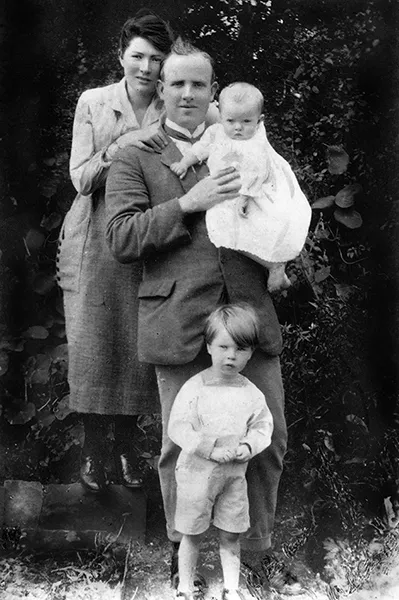
Paddy and Rita Muldoon with their two oldest children, Llew and Olwyn, in 1920. (© The Muldoon/Donnelly family.)
The recently qualified doctor and his new wife left Ireland almost immediately, a decision likely influenced by a desire to put some distance between themselves and their families, who were not happy about the circumstances of the marriage. Paddy and Rita moved to Wales so that Paddy could take up a position assisting a general practitioner, Dr Howell Evans, who described his practice as ‘a large panel and colliery practice in Monmouthshire where exceptional opportunities daily occur of gaining experience in Surgery, Midwifery, and General Practice’.8 Paddy and Rita’s first child, Patrick Bernard Llewellyn, known as Llew, was born in Monmouthshire on 30 January 1918, just five-and-a-half months after they were married.9
Despite the reasons for their move to Wales, it appears that shortly after the birth of Llew the Muldoons desired to return to their home country. Neither, it seemed, wanted to raise a child in exile. They had been in Wales for just six months when the young doctor applied to move back to Ireland, to his home county of Leitrim, where a large public medical practice, known as the Rynn Dispensary District of Mohill, about eight miles from where Paddy had grown up, had become vacant in March 1918.
His application met with some resistance, however. The Local Government Board in Dublin didn’t want the vacancy filled at the time, particularly by a young doctor whose expertise could be utilised on the Western Front. The board’s main priority was providing doctors for the Royal Army Medical Corps, as Britain remained engaged in the Great War. This meant that there was effectively a ban on recruitment. However, the Mohill Board of Guardians, reflecting the growing nationalist and anti-conscription fervour at the time, disregarded the Local Government Board’s request that the position not be filled and set about appointing Paddy Muldoon. This resulted in the Local Government Board relenting and agreeing to confirm his position, initially on a temporary basis.10
Rita and Paddy Muldoon arrived back in Ireland with their young child at a time when the world was facing one of the greatest medical challenges of the twentieth century: the Spanish flu pandemic.11 The flu was sweeping through the community of South Leitrim just as Paddy was taking over the practice. The run-up to the general election of December 1918, which saw Sinn Féin emerge as the dominant political force in Ireland, helped spread the outbreak of the flu, with its mass meetings and countrywide movement of party activists. In such an unprecedented medical emergency, the Rynn Dispensary area, sixteen miles long and six miles broad, was lucky to have the services of a young, energetic doctor.12
A local newspaper reported on the challenges facing the young Muldoon: ‘He was on his feet night and day attending his patients. No distance or circumstances hindered him in the discharge of his onerous duties and his name was popular in every household in South Leitrim.’13 By the time the Spanish flu pandemic had worked its way through the world’s population, which included more than 20,000 victims in Ireland, ...
Table of contents
- About the Authors
- Prologue
- Chapter 1
- Chapter 2
- Chapter 3
- Chapter 4
- Chapter 5
- Chapter 6
- Chapter 7
- Chapter 8
- Chapter 9
- Chapter 10
- Chapter 11
- Chapter 12
- Chapter 13
- Chapter 14
- Chapter 15
- Chapter 16
- Chapter 17
- Chapter 18
- Chapter 19
- Epilogue
- Endnotes
- Bibliography
- Acknowledgements
Trusted by 375,005 students
Access to over 1.5 million titles for a fair monthly price.
Study more efficiently using our study tools.
Frequently asked questions
Yes, you can cancel anytime from the Subscription tab in your account settings on the Perlego website. Your subscription will stay active until the end of your current billing period. Learn how to cancel your subscription
No, books cannot be downloaded as external files, such as PDFs, for use outside of Perlego. However, you can download books within the Perlego app for offline reading on mobile or tablet. Learn how to download books offline
Perlego offers two plans: Essential and Complete
- Essential is ideal for learners and professionals who enjoy exploring a wide range of subjects. Access the Essential Library with 800,000+ trusted titles and best-sellers across business, personal growth, and the humanities. Includes unlimited reading time and Standard Read Aloud voice.
- Complete: Perfect for advanced learners and researchers needing full, unrestricted access. Unlock 1.5M+ books across hundreds of subjects, including academic and specialized titles. The Complete Plan also includes advanced features like Premium Read Aloud and Research Assistant.
We are an online textbook subscription service, where you can get access to an entire online library for less than the price of a single book per month. With over 1.5 million books across 990+ topics, we’ve got you covered! Learn about our mission
Look out for the read-aloud symbol on your next book to see if you can listen to it. The read-aloud tool reads text aloud for you, highlighting the text as it is being read. You can pause it, speed it up and slow it down. Learn more about Read Aloud
Yes! You can use the Perlego app on both iOS and Android devices to read anytime, anywhere — even offline. Perfect for commutes or when you’re on the go.
Please note we cannot support devices running on iOS 13 and Android 7 or earlier. Learn more about using the app
Please note we cannot support devices running on iOS 13 and Android 7 or earlier. Learn more about using the app
Yes, you can access The Murder of Dr Muldoon by Ken Boyle,Tim Desmond in PDF and/or ePUB format, as well as other popular books in Geschichte & Irische Geschichte. We have over 1.5 million books available in our catalogue for you to explore.