![]()
Tour 1
Telemachus, Nestor
Telemachus, 8 a.m.
The Sandycove Martello Tower, known as the Joyce Tower, stands on a rocky headland one mile southeast of Dun Laoghaire, off the coast road. To get there take the train to Sandycove Station and walk down to the sea, where the Tower on Sandycove Point will be clearly visible. Cars should be parked by the harbour as the Tower is on a narrow road. Turn off Sandycove Avenue at the harbour and walk up past the distinctive white house designed as his own residence by the Irish architect Michael Scott, who also designed the present Abbey Theatre, the central bus station in Store Street and other notable public buildings. Follow the path behind the house leading to the Tower.
Coincidentally enough, the order for the building of this tower, and others in the area, was dated 16 June 1804. Altogether about fifty towers of similar design were erected at strategic points on the Irish coast, of which more than half guarded the shores of County Dublin. The name ‘Martello’ comes from Mortella Point in Corsica, where the original tower was captured, and later copied, by the British. The expected Napoleonic invasion, however, never took place, and most of the towers were demilitarised in 1867. The Sandycove Tower was one of those retained, along with the nearby battery where frequent artillery practice was a source of discomfort, according to Weston St John Joyce (no relative), to nearby residents whose windows were shattered by the concussions.
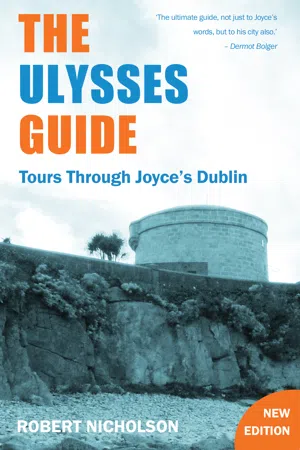
1. Sandycove Point, looking eastwards from the coast road. The ladder may be seen beneath the door of the Tower, and the structure visible to the left of the Tower, behind the rooftop, was an outdoor privy. Eason Collection EAS 1760, courtesy of the National Library of Ireland.
2. Sandycove Point in 1904: A map from the lease signed by Oliver Gogarty. The dotted line around the Tower and battery shows the War Department boundary line with its boundary stones. The ‘creek’ of the bathing place can be seen to the right of the battery. Courtesy of the James Joyce Museum.
To their relief the positions were demilitarised in 1897, and in 1904 the Tower was available for rent at the sum of £8 a year. The letting was taken by Joyce’s friend and the model for Buck Mulligan, Oliver St John Gogarty, in August 1904. Gogarty’s plan was to establish the Tower as an omphalos or new Delphi where he could invite other young writers and kindred spirits to join him in the preaching of a modern Hellenism and more convivial pursuits. James Joyce, who arrived on 9 September, was probably more interested in having a roof over his head. His friendship with Gogarty was already cooling and he left precipitately during the night of 14/15 September, never to return.
Gogarty stayed in the Tower regularly, and continued to occupy it up to 1925. Many literary friends visited him there, including George Russell (‘A.E.’) who painted a picture on the roof, Padraic Colum, Seamus O’Sullivan, Arthur Griffith and possibly also W. B. Yeats, who was reluctantly persuaded to take a swim in the Forty Foot. The Tower might well be known now as ‘Gogarty’s Tower’ had Joyce not used it as the setting for the opening of Ulysses. His implication that he himself had paid the rent effectively meant that he stole the Tower for posterity.
The James Joyce Museum, originally run by the Joyce Tower Society, was officially opened by Sylvia Beach, the publisher of Ulysses, on Bloomsday 1962. The members of the Society, a voluntary organisation, were brave but unable to carry the financial and administrative burden of running a museum, and within two years it was placed in the hands of the regional tourism organisation. In 2019 it is being transferred to Dun Laoghaire–Rathdown County Council, under whose auspices, by a somewhat Viconian twist, the day-to-day staffing is supplied by volunteers from the recently-formed Friends of Joyce Tower Society. They keep it open on a daily basis throughout the year. For up-to-date information on opening hours, call the museum at (01) 280 9265 or consult the Society’s website (www.joycetower.ie).
Access to the Tower is through the modern exhibition hall, added in 1978. Pass the admission desk and turn right through the new doorway in the base of the tower. At the back of the gunpowder magazine is a narrow spiral staircase leading up to the rooftop, where Ulysses begins.
‘Stately, plump Buck Mulligan came from the stairhead, bearing a bowl of lather on which a mirror and a razor lay crossed. A yellow dressinggown, ungirdled, was sustained gently behind him on the mild morning air.’ Around the central gunrest, which Mulligan mounts for his parody of the Mass, and the step beneath the parapet run two rails which supported a gun carriage, swivelling from the pivot in the centre.
Stephen Dedalus, ‘displeased and sleepy’, follows Mulligan from the stairs and watches as he anticipates the whistle of the departing mailboat (the jet of steam in the harbour would have been visible a couple of seconds before the sound reached the tower). The step across the doorway where Stephen leaned his arms has since been removed to make access easier. ‘Chrysostomos’, the word which occurs to him as he observes the gold fillings in Mulligan’s teeth gleaming in the sunlight, means ‘golden-mouthed’, a reference to St John Chrysostomos, who was an early father of the Church and, appositely enough, a namesake of Mulligan and his original, Gogarty, who both have ‘St John’ as a middle name. While Mulligan shaves, he and Stephen talk about their companion Haines and his nightmare about a black panther. Haines’s real-life counterpart was Gogarty’s Anglo-Irish friend Samuel Chenevix Trench, and Joyce, as we shall see, had good cause to remember the nightmare. Mulligan then calls Stephen to look at ‘The snotgreen sea. The scrotumtightening sea.’
‘Stephen stood up and went over to the parapet. Leaning on it he looked down on the water and on the mailboat clearing the harbourmouth of Kingstown.’ Kingstown, named to celebrate the departure of King George IV in 1821, reverted to its original name of Dun Laoghaire with the coming of Irish independence in 1922. To the east can be seen the Muglins, a small island with a beacon, and on the next point at Bullock is another Martello tower of almost identical design. To the north, on the far side of the bay, is Howth Head, where Bloom proposed to Molly. Nearby on Sandycove Point is the half-moon battery built with the Tower, beside the Forty Foot bathing place. According to Thom’s Directory, most of the houses presently on Sandycove Point were there in Joyce’s time (but the house next door is entirely modern). Stephen, however, can only look at ‘the ring of bay and skyline’ and compare it in his mind to the bowl into which his dying mother had vomited. Mulligan’s teasing about his appearance only makes his mood worse as they walk around the Tower arm in arm.
‘They halted, looking towards the blunt cape of Bray Head that lay on the water like the snout of a sleeping whale.’ Bray Head is not, in fact, visible from the Tower – it is to the south beyond Killiney, whose hill with an obelisk is on the skyline – and scholars continue to agonise over whether this is a genuine slip or a deliberate error. Some diehards have drawn comfort from the possibility that the word ‘towards’ does not necessarily mean that they were looking at the Head.
Following his argument with Stephen, Mulligan goes downstairs, leaving Stephen to brood alone while the sun, by now somewhere over the Muglins, disappears behind a cloud. His reverie about his mother reaches an anguished climax just as Mulligan returns to bid him to breakfast.
Stephen descends halfway down the stairs to enter ‘the gloomy doomed livingroom of the tower’. To the left is the fireplace between the two window shafts (called ‘barbacans’ by Joyce); to the right is the heavy door opened by Haines to let in ‘welcome light and bright air’ from the sunny side of the building. It is unused now, and the huge key is on display downstairs. None of the original furniture (mainly supplied by Gogarty from his family home in Parnell Square) remains, but the room has now been refurnished from the evidence of contemporary documents to give an impression of the scene as it was at the time, with a shelf around the walls, a small cooking range and beds in the corners. The floor was in fact wooden rather than ‘flagged’, and Haines’s hammock was probably Joyce’s invention as there was nothing to sling it from.
It was here, on the night of 14 September 1904, that Joyce, Gogarty and Trench were sleeping when Trench had a nightmare about a black panther which he dreamed was crouching in the fireplace. Half-waking, he reached for a gun and loosed off a couple of shots to scare the beast away before going back to sleep. Gogarty promptly confiscated the gun. ‘Leave the menagerie to me,’ he said when Trench’s nightmare returned, and fired the remaining bullets at the saucepans over Joyce’s head. Joyce leapt out of bed, flung on his clothes and left the Tower immediately. He walked all the way into Dublin and appeared at the National Library at opening time. He never returned to the Tower, and the following evening he and Nora Barnacle made their decision to leave Ireland.
The big door was the only way in and out of the Tower, and was approached by a step ladder attached to the outside wall. As the three men begin their breakfast, Haines sees the old woman coming with the milk, and they have time to exchange a page of dialogue before she reaches the top of the ladder.
Haines, anxious to try out his Irish on a native, speaks to her in Gaelic, which Joyce does not attempt to reproduce. Haines’s original, Trench, was a keen student of the Gaelic Revival and took every opportunity to air his Connemara Gaelic, which was unfortunately marred by a strong Oxford accent.
The milkwoman is paid her bill (somewhat reluctantly) by Mulligan and leaves. Mulligan, obviously hopeful of getting money or drink from his friends, urges Stephen to ‘Hurry out to your school kip and bring us back some money’ and encourages Haines to add Stephen’s Hamlet theory to his collection of Irish studies. Stephen embarrasses him by asking tactlessly, ‘Would I make any money by it?’
Mulligan gets dressed and the three leave the Tower to walk to the Forty Foot. Before following their path, it is worth lingering in the Tower to view the collection, which includes several of Joyce’s possessions and manuscript items, first editions of Ulysses and other works, and all sorts of photographs, paintings and miscellaneous Joyceana. Joyce’s guitar, waistcoat and travelling trunk may be seen, as well as one of the two death masks made by the sculptor Paul Speck in Zurich. Among the Ulysses trivia are the key pocketed by Stephen, a Plumtree’s Potted Meat pot and an original photograph of Throwaway, the outsider which won the Ascot Gold Cup and indirectly led to Bloom’s hasty departure from Barney Kiernan’s. The bookshop at the entrance has currently suspended operations but may return to business with the new régime.
Leaving the museum, turn left down the path along the top of the cliff, where Mulligan chants his ‘ballad of Joking Jesus’ on the way to the bathing place.
Stephen follows with Haines, foreseeing correctly that Mulligan will obtain the key from him and prevent him returning to the Tower. He explains to Haines how he is the servant of two masters – Britain and the Roman Catholic Church – and a third ‘who wants me for odd jobs’; this last, though unspecified, is probably Irish nationalism. In his mind he has a vision of the Church and its banishment of all those who dared contest its dogmas.
The sign at the entrance to the bathing place once read, ambiguously, ‘FORTY FOOT GENTLEMEN ONLY’. The latest wisdom on the mysterious origins of the name suggests that an offshore fishing ground gave the title to what became known as the Forty Foot Hole. The bathing place itself is only half that depth and has a long and colourful history. Probably established as a men’s bathing place by the soldiers of the battery garrison in the early 1800s, it was maintained by regular bathers who in 1880 formed the Sandycove Bathers’ Association. The granite screening wall protecting bathers from the east wind and the public gaze was built in the 1890s, while the concrete shelters, erected in 1969, replaced a Victorian structure on the same spot. Nude bathing, once very much the custom at the Forty Foot has declined since women starting bathing there in the 1970s, although the Sandycove Bathers’ Association remained by constitution an all-male body up to 2014. In 2015 responsibility for the Forty Foot was taken over by the County Council, and the Association retains only a social rôle.
Stephen has awaited the moment when Mulligan will demand the key, and has even gone out of his way to the Forty Foot to give Mulligan the opportunity. Finally he has to prompt him by announcing his departure, and the ‘usurper’ does what is expected of him....