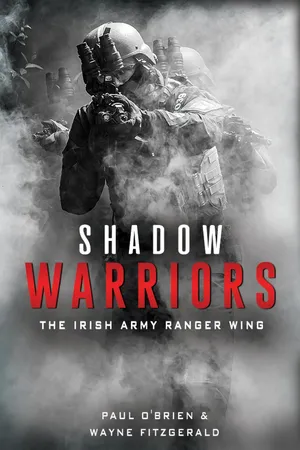
In the spring of 1980, the Irish Department of Defence sanctioned the establishment of a new unit within the Irish Defence Forces and the Irish Army Ranger Wing (ARW) came into being. In the decades that followed, its soldiers have been deployed on active service at home and abroad, generally without the knowledge of the wider public. The ARW is made up of seasoned men from across the island, who are selected through tough competition. Only the best of the best make it through and are trained in an extraordinary range of specialist skills. Being one of these elite operators takes more than simply being a skilled soldier – it means believing you are the best.
Shadow Warriors tells the story behind the creation of the ARW, from its origins in specialist counter-terrorism training in the late 1960s and the preparation of small unconventional units in the 1970s to the formation of the ARW itself in 1980 and its subsequent history. The first and only authoritative account in the public domain of this specialist unit, authors Paul O'Brien and Sergeant Wayne Fitzgerald have been granted access to the closed and clandestine world of Ireland's Special Forces, who train hard, fight harder and face unconventional types of warfare, yet prefer to stay out of the limelight.
- 160 pages
- English
- ePUB (mobile friendly)
- Available on iOS & Android
eBook - ePub
About this book
Information
1
Wars without Fronts
In the aftermath of the Second World War, colonies throughout the world that for centuries had yielded an abundance of materials and wealth to European empires began to grow restless. With many of these empires struggling to rebuild after the war, anti-colonialists began to question and oppose the occupation of their lands by these foreign powers. Peaceful protest soon gave way to violent uprisings and insurgencies in many countries, as nationalist forces fought the colonists. Throughout the 1950s and the early 1960s the world was ablaze with what were to become known as ‘Small Wars’. Burma, Indochina, Egypt, Palestine and Algeria were some of the many countries that erupted into violence. In the 1960s, inspired by these uprisings, as well as Mao’s Chinese revolution of 1949 and Castro’s Cuban revolution of 1953–59, other countries followed suit. In many instances, the fighting disintegrated into bitter guerrilla warfare, with the insurgencies and counter-insurgencies brutal in their extremes.
While the terrain and the customs of those fighting for their independence varied considerably, one factor that tended to unify each separate conflict was the support of Russia and China for one side and the United States and its allies for the other. The spread of communist doctrine and anti-imperialism enabled Eastern Bloc powers to gain a foothold in countries throughout the world struggling for independence. While the United States disliked colonial rule, their disdain stemming from their own fight for freedom against the British, they initially believed that propping up colonial empires was essential when it came to stemming the socialist tide. As a result, by the late 1960s the Cold War was being fought by proxy in the jungles of South-East Asia, on the plains of Africa and in the mountainous regions of South America.
Alongside this, the post-war generation in America and Western Europe was becoming radicalised, with many openly questioning and protesting their government’s involvement in these overseas conflicts. It was during this turbulent period that a number of violent left-wing revolutionary groups and right-wing extremists emerged. Terrorist acts soon followed.
In July 1968 three armed members of the Popular Front for the Liberation of Palestine hijacked El Al Flight 426 as it flew from Rome to Tel Aviv. The plane, with a crew of ten and thirty-eight passengers, was diverted to Algiers by the hijackers, who demanded the release of fellow Palestinians imprisoned in Israel. Forty days of tense negotiations between the hijackers and authorities followed, with the passengers eventually being released unharmed when sixteen Arab prisoners were released. The Palestinian Liberation Organisation’s United Nations observer, Zehdi Lahib Terzi, in relation to the seizure of flight 426, is quoted in The New Yorker as stating that this hijacking ‘awakened the media and public opinion much more … than 20 years of pleading’ by the Palestinians.1
This terrorist act received a lot of media attention and, as a result, was seen by many other extremist organisations as an effective tool for bringing attention to a cause that would otherwise be ignored by both the media and governments. Other groups quickly emerged, such as the Provisional Irish Republican Army (Ireland), the Weathermen (USA), the Black Panthers (USA), the Symbionese Liberation Army (USA) and the Baader-Meinhof gang (Germany). Within a short period of time, these organisations, and others, turned to violent tactics, from rioting and setting off bombs, to assassinations and hijackings. Weapons and explosives were easily accessible at the time, including modern, compact, rapid-fire sub-machine guns that were easily concealable. Automatic pistols, manufactured almost entirely of plastic, were easy to disassemble and conceal, enabling them to be brought through airport scanners with ease. Targets chosen were more often than not designated ‘soft’ (i.e. easy to attack), enabling terrorists to inflict maximum damage and casualties. Guerrilla warfare, long thought to be a rural phenomenon, became increasingly urbanised.
Governments throughout the world initially struggled to contain these actions, as many were unprepared for the onslaught of terrorist attacks that occurred from the late 1960s and into the 1970s. At this time, no dedicated counter-terrorist force existed in any European country. Then one terrorist act occurred that would change everything.
On 5 September 1972 Palestinian Black September terrorists broke into the quarters of the Israeli team at the Munich Olympic Village, taking eleven hostages, two of whom were subsequently murdered. The Germans were unprepared for such a situation and their handling of the incident was to have far-reaching repercussions.
Negotiations between the German authorities and the group commenced, with the terrorists demanding the release of a number of their Palestinian associates held in Israeli jails, along with two founders of the Red Army Faction, a far-left militant organisation. They also demanded a chartered flight to Cairo to secure their getaway. After repeated threats by the terrorists against the hostages, the German government informed them that their demands would be met. They would be flown from the Olympic Village to Fürstenfeld Airport, where they would board a Lufthansa flight to Cairo.
However, in reality the German police were planning to neutralise the terrorists at the airfield. Police officers took up positions there, some dressed as air and ground crew, with police marksmen taking up posts overlooking the plane on the runway. All were tasked with killing or capturing the terrorists as they boarded the plane.
As the helicopters carrying the terrorists and their hostages approached the field, some police officers decided that the mission was too risky and stood down, leaving only a five-man team of marksmen to take out the terrorists. Instead of the expected five terrorists accompanying the remaining hostages, the police discovered that there were in fact eight of them. As the terrorists and hostages left the helicopters and approached the plane, the order was given to open fire.
A gunfight commenced, which resulted in the deaths of all the hostages, one policeman and five of the eight terrorists. None of the police marksmen were trained snipers and so they mostly missed their moving targets. Two of the police officers were hit by so-called ‘friendly fire’. The operation from start to finish was an unmitigated disaster and a huge embarrassment for the German government. To add salt to the already smarting wounds of Germany, the government was forced to release the surviving terrorists the following month, after a Lufthansa airliner on a flight from Damascus to Frankfurt was hijacked.
In the aftermath of the debacle, the German government took steps to ensure that, in the future, its country would have an effective counter-terrorism response. This decision paved the way for the formation of the first dedicated intervention unit in Europe: the famous Grenzschutzgruppe 9, more commonly referred to as GSG 9.
The French soon followed suit with the formation of GIGN. The British, who had resurrected the Special Air Service (SAS) in the aftermath of the Second World War for the Malayan crisis, directed their 22 SAS (the name of the regular, active-duty regiment of the SAS) to develop a counter-terrorism capability.2
While some countries began to organise and counter the increasing terrorist threat, others attempted to appease such groups by succumbing to their demands, paying ransoms and releasing prisoners. This, more often than not, only exacerbated the problem. With terrorist organisations now receiving international recognition through the medium of television, their message was reaching a much larger audience and, for that reason, they were eager to continue with their actions.
Increasingly a new global war was emerging, where new strategies and tactics would have to be devised and deployed. Reconnaissance, counter-terrorism, counter-insurgency and intelligence gathering would be just some of the skills needed by these new units. This new war would be one without fronts, and those operating in this war would have to adapt and overcome numerous obstacles in order to triumph.
2
Inception
Since the formation of the Irish Defence Forces in 1924, the army had been run along conventional lines, similar to other armies throughout the world. Austerity had for decades affected the force, resulting in minimal investment in equipment. However, the Irish Defence Forces’ participation in the United Nations missions to Lebanon in 1958 and to the Congo from 1960 to 1964 opened up new horizons. Though overseas service highlighted many shortcomings, these missions enabled the force to work with other armies, use new equipment and recognise their need to adapt.
In 1968 a core training group of officers was chosen to plan and conduct a specialist course to train soldiers for small unit operations. This group included officers from the Military College at the Curragh Camp in Co. Kildare, such as Commandant Eamon Quigley, Captain Des Swan, Captain Jimmy Farrell and Lieutenant Harry Johnson. They were joined by Lieutenants John Vize, Joe Fallon, Des Travers and R. E. M. Heaslip. Initial administrative delays did not deter the soldiers from their mission, and within a short period of time a provisional syllabus had been drawn up, suitable training grounds had been selected, equipment secured and it was ensured that all course instructors were at the peak of their physical prowess. A section from this group was also detailed to undergo specialist training at the United States Army Ranger School located at Fort Benning, Georgia. Those completing this course would then add elements of what they learned to the syllabus for the Irish course.
The US Army Rangers are America’s original force of elite soldiers. Their origins date back to the seventeenth- and eighteenth-century wars between colonists and Native American tribes. However, the modern US Army Rangers were actually founded in Ireland, in 1942, during the Second World War. Many US troops were stationed in the North of Ireland at the time, before moving to England. And so it was here, at the behest of Colonel Lucian Truscott, that General George Marshall authorised the establishment of an American unit ‘along the lines of the British Commandos’. On 19 June 1942 the 1st Ranger Battalion was sanctioned, recruited and began training in Carrickfergus, Co. Antrim.
In the years that followed, the Rangers were deployed in a number of theatres of war, including Korea and Vietnam. The conflict in Vietnam in particular, which began in 1955, was a precursor of the guerrilla-style insurgencies that have come to define modern combat. Military instructors, many having served in South-East Asia, studied the tactics used against them in the war and developed counter-insurgency measures, as well as working out how to emulate some insurgency actions. The Rangers then incorporated these tactics into their training.
In early 1969 Captain Farrell and Lieutenant Johnson reported to the Ranger Training Brigade at Fort Benning. The purpose of the course they undertook was to train soldiers as combat leaders while they endured great mental and physical stresses. Training was divided into three phases and consisted of precisely 19.6 hours of training each day, to be conducted at three separate geographical locations. Military timing is precise and, after years of running the course, the instructors knew exactly how long they could push the men. Soldiers were trained in a number of general skill sets, including fieldcraft, planning and executing daily patrolling, performing reconnaissance and ambushes, as well as raids against dispersed targets. Training missions simulated the stress that a soldier would feel in combat and in doing so enabled the candidate to plan and organise while becoming inoculated against these pressures. Leadership was an important factor of the training; the participants learned to lead from the front, striking hard and fast.
The course also provided the students with practical experience in the application of the tactics and techniques used in Ranger operations over various terrains, including wooded, lowland swamp and mountainous environments. The candidate was taught how to sustain themselves and their subordinates, and to maintain their e...
Table of contents
- Abbreviations
- Introduction
- 1. Wars without Fronts
- 2. Inception
- 3. ‘We are Rangers’
- 4. The Special Assault Group
- 5. The Army Ranger Wing
- 6. Trial and Error
- 7. Aid to the Civil Power
- 8. The Long War
- 9. The ARW Overseas
- 10. Somalia
- 11. East Timor
- 12. Liberia
- 13. Chad
- 14. Mali
- 15. Making the Cut Today
- 16. In the Cross Hairs
- 17. By Neptune’s Beard
- 18. Drop Zone
- 19. Close Quarter Battle
- 20. Bí Úllamh1
- Conclusion
- Appendix
- Bibliography
- Recommended Reading
- Acknowledgements
- Endnotes
- About the Authors
- About Mercier Press
Trusted by 375,005 students
Access to over 1.5 million titles for a fair monthly price.
Study more efficiently using our study tools.
Frequently asked questions
Yes, you can cancel anytime from the Subscription tab in your account settings on the Perlego website. Your subscription will stay active until the end of your current billing period. Learn how to cancel your subscription
No, books cannot be downloaded as external files, such as PDFs, for use outside of Perlego. However, you can download books within the Perlego app for offline reading on mobile or tablet. Learn how to download books offline
We are an online textbook subscription service, where you can get access to an entire online library for less than the price of a single book per month. With over 1.5 million books across 990+ topics, we’ve got you covered! Learn about our mission
Look out for the read-aloud symbol on your next book to see if you can listen to it. The read-aloud tool reads text aloud for you, highlighting the text as it is being read. You can pause it, speed it up and slow it down. Learn more about Read Aloud
Yes! You can use the Perlego app on both iOS and Android devices to read anytime, anywhere — even offline. Perfect for commutes or when you’re on the go.
Please note we cannot support devices running on iOS 13 and Android 7 or earlier. Learn more about using the app
Please note we cannot support devices running on iOS 13 and Android 7 or earlier. Learn more about using the app
Yes, you can access Shadow Warriors by Paul O'Brien,Wayne Fitzgerald in PDF and/or ePUB format, as well as other popular books in History & Military & Maritime History. We have over 1.5 million books available in our catalogue for you to explore.