- 320 pages
- English
- ePUB (mobile friendly)
- Available on iOS & Android
eBook - ePub
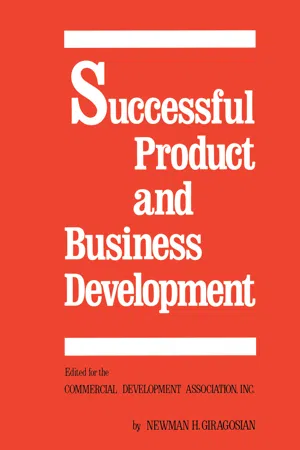
Successful Product and Business Development, First Edition
About this book
This book shows how the people carrying out industrial commercial development perform the vital functions and deals with the organization and structure of commercial development. It describes the change in thinking of chemical companies from a product-oriented outlook to a business-oriented one.
PART I
INTRODUCTION AND SCOPE OF COMMERCIAL DEVELOPMENT
1
PAST, PRESENT, AND FUTURE OF COMMERCIAL DEVELOPMENT
DOI: 10.1201/9781003209935-2
My only instructions from the Book Committee were: “Tell it like it was; tell it like it is; tell it like it is going to be.” That assignment is best left to future historians, for it is difficult for an active participant in a dynamic function to be completely objective about it, particularly if he has a fierce affection for it. Therefore, based on my own experiences and those of some colleagues, I will try to tell it like I think it was, like I think it is, and as I hope it will be.
In addition, commercial chemical development was, is, and will be different in different companies. It is not a “thing,” but a concept, and a concept flexible enough to be modified to suit the individual needs of each company’s philosophy of doing business. Nevertheless, there has been a mainstream, the course of which is clear enough to follow, though it must be remembered that there were many side streams, even many eddies, during its formative period.
Like I Think It Was
From Frail Beginnings
If the nostalgia is stripped away, it is somewhat embarrassing from the vantage of our present sophistication to look back on commercial chemical development as it was in the 1940s. It now seems rather like an octopus, arms going out in all directions and not much body. It was really a collection of all those individual auxilliary functions that contributed to the sale of products, with the specific exception of statistical market research.
To put this into proper perspective, however, it must be recognized that at that time the chemical industry itself was somewhat unsophisticated and parochial. The country was at war, and so the chemical industry’s orientation was toward maximizing production. Commercial problems were minimal. Even for a number of years after the war, there was a “seller’s market” during which the emphasis was on filling pent-up demand, not on developing new commercial techniques. In the universities, chemistry and chemical engineering students were oriented toward technical functions upon graduation; it is doubtful that many daydreamed about glorious careers in the commercial aspects of the industry.
Nevertheless, from this most unlikely nucleus, commercial chemical development was formed. It started as a small step away from the strictly technical functions. When a problem arose in a customer’s plant involving the use of a product, it became customary to send a technical expert to help solve it. The function was primarily technical in nature, and the supplier was providing a “technical service.” The small step was that this function did involve the individual in contact with other companies and so introduced the need for qualities other than the technical ability—primarily those of personality. There was then, is now, and probably always will be some trepediation among sales executives at letting technical experts visit customers for fear that “some clown is going to say the wrong thing and wreck everything we built up with them over many years.” Fortunately, there were not many clowns among technical service people, and even if one did pull a gaffe once in a while, it was obvious that their contribution far outweighed any disadvantages. Technical service became a distinct function.
In 1943, the Technical Service Association was formed, which became the forerunner of the Commercial Chemical Development Association (the word “chemical” was dropped in 1970). Technical service thus was the key link in the evolution of commercial chemical devleopment, and remains today one of the activities that qualifies a person for membership in CDA.
Market Development
One of the principal functions of early commercial development was that of market development. The research function at that time was the darling of the industry; they turned out new products at a prodigious rate. Many of these products were quite different from the current line of the company, so that it was inefficient to have the sales department handle them, particularly because it detracted from their primary function. Thus a new function crystallized—that of finding markets for new products. This activity required a combination of technical training and commercial skills. This balance of abilities was so different from that required in other activities that market development became recognized as a distinct function.
Developing markets for new chemicals is difficult, as shown by the fact that only about 10,000 chemicals among the millions of possibilities have sales in excess of $1,000. New techniques had to be developed to increase the probability of success of introducing a new product. The procedures used for established products had to be modified. Gradually, new procedures for obtaining sales of these new products evolved.
Market development had many successes, some of them spectacular, but it became increasingly obvious that this was an expensive procedure that could not be justified for every product that could be turned out by research. A vacuum existed, which commercial development people were fortunately well qualified to fill. Rather than simply attempting to develop markets for any new product, commercial development began to participate in the managerial decisions as to which products to market. It must be emphasized that this was not limited to statistical market research but involved all those factors that enter into a management decision of this type, including specifications desired by the market, maximum price the market would tolerate, probability of success under various conditions, and so on. Indeed, in many companies, a commercial development group was established as part of the research department, with the primary purpose of assisting research management in project selection.
Applications Research
Applications research as a separate function then began to evolve. In a product-oriented industry, it seemed axiomatic that it was the responsibility of the purchaser to evaluate the performance properties of the products offered by various suppliers. The suppliers’ interests seemed to be limited to assuring the “quality”; that is, the chemical composition of the product. It seemed obviously inefficient for all potential suppliers to be gathering sales data through making the same comparisons among competitive products. Also, the laboratory data that could be obtained sometimes did not necessarily correlate with plant performance. To many it seemed a great waste of time and money.
Nevertheless, it soon became apparent that in the sale of performance chemicals, applications research data provided a competitive edge. Of course, the buyers had to redo many of the tests, but the data increased the probability the product would work for them and so in effect reduced their cost by eliminating obviously unsuitable products. Still, applications research by a supplier was, and is, very expensive. It is impractical to test most products for every possible application. Even in the areas selected, it is necessary to know which tests, if any, are significant and which conditions should be used. These questions required field contact for the answers, and so applications research was recognized as a phase of commercial development. In many companies, the applications research laboratory reported to the commercial development department.
The Commercial Development Association
The Technical Service Association started with fewer than 20 charter members. The early meetings were primarily informal exchanges of information among people in a new function who were not sure what directions their work would be taking.
The early meetings were 1-day affairs, with the participants telling each other how to conduct various aspects of commercial development. Later, programs were devoted to the chemical requirements of specific industries, and these became prime source material for market studies.
More recently, programs on broader subjects such as “Profit Trends” have become popular and more frequent.
From the beginning the meetings were informal, with a substantial portion of the time provided for personal contact among members. The members needed each other for the efficient conduct of their jobs, because an answer to a particular problem could be obtained either through one key telephone call or through weeks of effort. The esprit among members built upon the recognition of this common need exists to this day.
The operation of the association is interesting as it has been a significant factor in the acceptance and growth of commercial development. When the association was formed, relatively little power was delegated by the members to the officers; almost all important questions had to be referred back to the members for decisions. And the members did participate. They are people who have opinions on almost every issue, and the annual business meetings became something to look forward to. Never to be forgotten is the meeting where one venerable member demanded to know why the president’s reception for members (a euphemism for a free cocktail party) had been eliminated that year. Told the reason was a tight budget, he promptly proposed that it be held anyway, and, budget be damned, the members voted to hold it.
As the association grew in size, additional operating authority was ceded to the Executive Committee, though all questions affecting the basic nature of the association remain the province of the general membership. The Executive Committee consists of five officers (including the past president) and four directors. Because each has an equal vote, the Executive Committee is a form of legislature; the officers carry out the resolutions of the Executive Committee, with a limited opportunity to introduce broad programs of their own. In the early 1970s, the work load on the officers and the committee chairpeople apparently became excessive. As a result, a paid, part-time executive director was employed to help with the chores, though all responsibility and authority remains with the Executive Committee.
Like I Think It Is
The Chemical Industry
Commercial chemical development is not, of course, an independent entity complete unto itself; it must adjust to the industry it serves. Thus to understand the stresses and strains within commercial development as it evolved to satisfy the changing needs of the chemical industry, it is first necessary to examine the principal trends within that industry. In the early days, the industry was primarily concerned with products made by classical chemical synthesis. When these chemicals were in turn used for their physical properties—for example, as paints, pharmaceuticals, cleaning compounds, and so on—those operations were considered related, but distinct industries. There has been indeed a general grouping known as the “chemical processing industries,” but this by...
Table of contents
- Cover
- Half Title
- Title Page
- Copyright Page
- Foreword
- Preface
- Contributors
- Contents
- Part I Introduction and Scope of Commercial Development
- Part II Managing the Function
- Part III Interrelationships
- Part IV Other Aspects of Commercial Development
- Part V Selected Case Histories of Commercial Development Projects
- Bibliography
- Index
Trusted by 375,005 students
Access to over 1.5 million titles for a fair monthly price.
Study more efficiently using our study tools.
Frequently asked questions
Yes, you can cancel anytime from the Subscription tab in your account settings on the Perlego website. Your subscription will stay active until the end of your current billing period. Learn how to cancel your subscription
No, books cannot be downloaded as external files, such as PDFs, for use outside of Perlego. However, you can download books within the Perlego app for offline reading on mobile or tablet. Learn how to download books offline
Perlego offers two plans: Essential and Complete
- Essential is ideal for learners and professionals who enjoy exploring a wide range of subjects. Access the Essential Library with 800,000+ trusted titles and best-sellers across business, personal growth, and the humanities. Includes unlimited reading time and Standard Read Aloud voice.
- Complete: Perfect for advanced learners and researchers needing full, unrestricted access. Unlock 1.5M+ books across hundreds of subjects, including academic and specialized titles. The Complete Plan also includes advanced features like Premium Read Aloud and Research Assistant.
We are an online textbook subscription service, where you can get access to an entire online library for less than the price of a single book per month. With over 1.5 million books across 990+ topics, we’ve got you covered! Learn about our mission
Look out for the read-aloud symbol on your next book to see if you can listen to it. The read-aloud tool reads text aloud for you, highlighting the text as it is being read. You can pause it, speed it up and slow it down. Learn more about Read Aloud
Yes! You can use the Perlego app on both iOS and Android devices to read anytime, anywhere — even offline. Perfect for commutes or when you’re on the go.
Please note we cannot support devices running on iOS 13 and Android 7 or earlier. Learn more about using the app
Please note we cannot support devices running on iOS 13 and Android 7 or earlier. Learn more about using the app
Yes, you can access Successful Product and Business Development, First Edition by N. Giragosian in PDF and/or ePUB format, as well as other popular books in Business & Business General. We have over 1.5 million books available in our catalogue for you to explore.