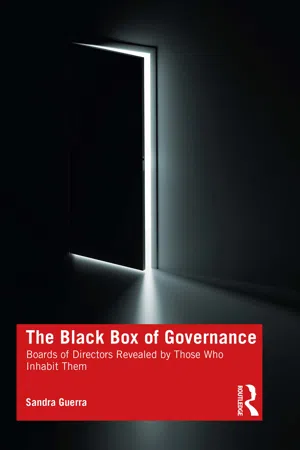
The Black Box of Governance
Boards of Directors Revealed by Those Who Inhabit Them
- 304 pages
- English
- ePUB (mobile friendly)
- Available on iOS & Android
About this book
In the world of corporate governance, the board of directors is often viewed as the "black box" of companies: only the board members who are seated at the meeting table understand how this "decision-making machine" works. In this book, a board member with over 25 years' experience pulls off the lid and shows both how boards have worked and how they could work.
This book is grounded in extensive research in three different surveys: one with more than 100 Brazilian directors, another with 340 board members from 40 countries, and a final one with 103 Brazilian directors serving on 238 boards. It also includes interviews with Ira Millstein, Sir Adrian Cadbury, Robert Monks and Mervyn King. The inner-workings of the board of directors are revealed:
âą What keeps directors awake at night
âą Obstacles to efficient decision-making
âą Behavioral dynamics, both within the board and in relation to the management
âą Pitfalls that arise from individual and group biases
Based on these insights and the author's own consulting and board experience, the book presents a guide to behavioral tools enabling directors and executives to confidently navigate the boardroom, improving interactivity and the efficiency of the decision-making process. Intended for directors and executives who are directly involved in the board's activities, as well as for leaders responsible for strategy implementation, this book provides a behavioral compass for all those interacting with the "black box."
Frequently asked questions
- Essential is ideal for learners and professionals who enjoy exploring a wide range of subjects. Access the Essential Library with 800,000+ trusted titles and best-sellers across business, personal growth, and the humanities. Includes unlimited reading time and Standard Read Aloud voice.
- Complete: Perfect for advanced learners and researchers needing full, unrestricted access. Unlock 1.4M+ books across hundreds of subjects, including academic and specialized titles. The Complete Plan also includes advanced features like Premium Read Aloud and Research Assistant.
Please note we cannot support devices running on iOS 13 and Android 7 or earlier. Learn more about using the app.
Information
Part I
The Black Box
Chapter 1
The Decision-Making Machine
Chapter Summary
- A brief historical evolutionary background of corporate governance in the world from the 17th century to the regulatory advances and improvements in policies and practices that have been adopted since the financial crisis that got underway in 2007/2008.
- Interviewees such as Adrian Cadbury, Ira Millstein, Mats Isaksson, Robert Monks and Mervyn King discuss the workings of boards of directors (BoDs), identify obstacles, acknowledge the existence of failures and point out possible causes.
- The operation of BoDs, the highest corporate governance body, is scrutinized from the point of view of its roles, responsibilities, structure, dynamics and processes. A structural X-ray of the so-called black box.
- Right at the outset in this first chapter, a small box alerts you to the tensions in the relationship between board members and executives, giving a preview of the detailed breakdown of this topic that can be found in Chapter 3.
- Even though they are in accordance with the latest regulatory requirements and best Corporate Governance practices, BoDs fail: why? The answer for this will be sought over the course of the next few chapters.
- A caselet describing the dilemma of an independent board experiencing a dysfunctional situation opens and concludes the chapter, covering the chapter conceptual discussions.âGood boards are pretty uncomfortable places and thatâs where they should be,â was a statement made by Sir Christopher Hogg,1 the former chairman of the Financial Reporting Council, the United Kingdomâs regulatory body, in an article that I read a few years ago. And I can guarantee that I experienced this for three long months, while I argued about the viability of the Blue Bird Project with SanMartĂnâs BoD. There were nine directors in total, and I was the only independent one.In February 2016, the executives began a series of meetings to present us with one of the most ambitious projects that was in progress in the group, which also promised to be one of the most profitable ones. At the end of the first meeting, my eight fellow board members already seemed to be convinced by the potentially extraordinary figures in terms of profitability, whereas I was uneasy. The risk potential seemed high to me. The executives had already assured us that the risk management model was being complied with; all the permits for the construction work had been issued; and the project had positive technical reports from environmentalists and lawyers who specialized in the environmental area. Nevertheless, I was still not totally convinced.At the meetings that followed, I remained uncomfortable. The more the executives gave reassurances regarding the reliability of the numbers and the unlikelihood of a major environmental disaster, the more I clung to my suspicions. I questioned each aspect so thoroughly that I ended up by creating an almost hostile environment in relation to my role as an independent board member. I reached the point where I could feel that the atmosphere was very tense.Fearing that the decision would be postponed, the chairman, who also held the position of Chief Executive Officer (CEO), silenced my solitary voice: âRelax, you are new to this sector. Just wait and see the leap that the shares will take at the end of the quarter, when the Blue Bird Project is announced.â There was no need to wait until the end of March. Fifteen days after the announcement, the market had already established the price of the companyâs shares, which had risen by 25%. Despite this apparent momentary happy ending for SanMartĂn, the future would show that I was rightâŠ*
There Is Only One Certainty: Boards Fail
If we start off with the scandals it seems to me that boards were not doing their job, they were not asking the right questions and they were not carrying out properly the functions of a board. The key thing that a board does is to appoint and monitor the chief executive, giving him/her as much support as they can, ensuring that he/she continues down the path that the board has set, because it is the board that decides the companyâs strategy, what its goals are, what its purpose is, and most important of all â what its values are. In the period when these companies went astray, boards were not carrying out their functions, they were quite prepared to let the executives do what they wanted and there were further problems such as incentive arrangements which encouraged risk taking and greed. I cannot explain what happened during that period: we saw the disaster building up, we observed an extraordinary disparity between the earnings of a few executives at the top and the rest of the workforce. This is something that a board should be concerned about because the company needs to be able to rely on a stable workforce, with there being the feeling throughout the entire company that the pay structure is fair, so that everyone feels as if they part of the company, that they have all contributed to its results. When there is a huge gap between those at the top and the rest of the workforce there are marked social implications, the people in the workforce do not feel that they are valued, and the top executives become detached, they donât feel as if theyâre part of the company. There is a deterioration in the relationships and it is the boardâs job to be aware of this. After all, some companies got into trouble, not because of their structure as a whole, but because the people in charge did not tackle the problems that had been identified.Basically, in both cases, what we are talking about here is the result of greedy behavior on the part of the board and the executives, isnât it?Yes, we are talking about greed, and sadly, about the ability of a few individuals who benefited from acting in a mercenary way. And that is what is wrong, it should not be possible for the executives who are at the top to be able to manipulate the compensation system by means of bonuses and options, however they may benefit in terms of the compensation paid by companies, which, at the end of the day, means that it is the customers and the community who are paying for the greed of a few. This is wrong, but it is the boards of these companies who are responsible.As a distant observer, what would be the signs of a dysfunctional board?The most obvious sign is when the board is dominated by a single individual, whether it be the chairman of the board, the CEO or, occasionally, one of the external directors. So dominance â the silence of the external directors or the excessive power of a single person â is a clear sign that the board is not working properly. The key point here is that dominance prevents the board from operating properly: if someone merely listens, if there is no contribution from everyone, this indicates a dysfunctional board. On a go...
Table of contents
- Cover
- Half Title
- Title Page
- Copyright Page
- Dedication
- Table of Contents
- Foreword by Ira Millstein
- Foreword by Sérgio Rial
- Foreword by Karina Litvack
- Acknowledgments
- Introduction
- Part I The Black Box
- Part II Thinking Outside the Box
- Bibliography
- List of Figures
- List of Tables
- List of Graphs
- About the Author
- Index