Increasing public health concern about healthy lifestyles has sparked a greater demand among consumers for healthy foods. Natural ingredients and environmental friendly food production and processing chains are more aligned to meeting the demand for healthy food. There is a wide array of food additives and chemicals that have nutritional value. The biotechnological food production processes, therefore, vary for different types of food chemicals and ingredients accordingly.
Biotechnological Production of Natural Ingredients for Food Industry explains the main aspects of the production of food ingredients from biotechnological sources. The book features 12 chapters which cover the processes for producing and adding a broad variety of food additives and natural products, such as sweeteners, amino acids, nucleotides, organic acids, vitamins, nutraceuticals, aromatic (pleasant smelling) compounds, colorants, edible oils, hydrocolloids, antimicrobial compounds, biosurfactants and food enzymes.
Biotechnological Production of Natural Ingredients for Food Industry is a definitive reference for students, scientists, researchers and professionals seeking to understand the biotechnology of food additives and functional food products, particularly those involved in courses or activities in the fields of food science and technology, food chemistry, food biotechnology, food engineering, bioprocess engineering, biotechnology, applied microbiology and nutrition.
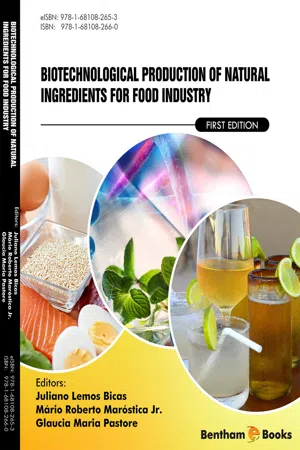
eBook - ePub
Biotechnological Production of Natural Ingredients for Food Industry
- English
- ePUB (mobile friendly)
- Available on iOS & Android
eBook - ePub
Biotechnological Production of Natural Ingredients for Food Industry
About this book
Information
Topic
BiowissenschaftenSubtopic
BiotechnologieBiotechnological Production of Amino Acids and Nucleotides
Volker F Wendisch*, Dorit Eberhardt, Marius Herbst, Jaide V. K. Jensen
Faculty of Biology & CeBiTec, Bielefeld University, D-33615 Bielefeld, Germany
Abstract
L-amino acids and nucleotides find various applications in food biotechnology. L-glutamic acid and its salts as well as 5’-nucleotides are used as flavor enhancers. Other L-amino acids are used as food or feed additives, in parenteral nutrition or as synthons for the chemical and pharmaceutical industries. L-amino acids and nucleotides are synthesized from precursors of central carbon metabolism. Based on the knowledge of the biochemical pathways microbial fermentation processes of food, feed and pharma amino acids and of nucleotides have been developed. Production strains of Corynebacterium glutamicum, which has been used safely for more than 50 years in food biotechnology, and Escherichia coli are constantly improved using metabolic engineering approaches. Research towards new processes is ongoing. Fermentative production of L-amino acids in the million-ton-scale has shaped modern biotechnology and its markets continue to grow steadily.
Keywords: Corynebacterium glutamicum, Escherichia coli, Essential amino acids, Feed additives, Flavor enhancers, Food additives, GMP, IMP, L-pyrrolysine fermentation, L-selenocysteine, Metabolic engineering, MSG, Nucleotides, Production strain development, Proteinogenic amino acids, XMP.
* Address correspondence to Volker F. Wendisch: Faculty of Biology & CeBiTec, Bielefeld University, Universit tsstr. 25, D-33615 Bielefeld, Germany; Email: [email protected].
INTRODUCTION
As the building blocks of proteins, amino acids play an important role in human and animal nutrition. Essential amino acids cannot be synthesized by humans and animals and need to be taken up with the food or feed. Addition of essential amino
acids improves feed quality and reduces manure. In the feed industry L-lysine is produced by fermentation in the million-ton scale while D,L-methionine is produced chemically. The amino acids L-glutamic acid and its salts finds application as flavor enhancer and annually about three million tons are obtained by fermentation. Since nucleotides provide the “umami” taste as glutamate, they are used as flavor enhancers and produced mainly by fermentation. This review focuses on microbial fermentation processes of food, feed and pharma amino acids and of nucleotides. Metabolic engineering of producing strains mainly Corynebacterium glutamicum and Escherichia coli is emphasized.
GLUTAMIC ACID, ITS SALTS AND 5’-NUCLEOTIDES AS FLAVOR ENHANCERS
Professor K. Ikeda discovered and isolated monosodium glutamate (MSG) in the early beginning of the 20th century in protein hydrolysates of “konbu”, seaweed (Laminaria japonica) [1], while investigating the relationship between the chemical structure of a substance and its smell and taste [1]. “Konbu” is responsible for the dominant and distinct taste of the traditional Japanese soup base “dashi” [2]. Ikeda used methods and steps of classical chemistry and finally low-pressure evaporation resulted in the crystallization of a single substance, which could be identified as glutamic acid [1]. This substance, which elicits the specific taste of “umami”, is the fifth taste quality besides salty, sweet, bitter and sour upon which the human taste is based [1]. Glutamate became more and more important after World War II, where especially protein-rich meat was very rare in Japan and MSG was used for seasoning tasteless food [2]. But for this purpose traditional production of L-glutamate by decomposition of soybean and wheat proteins followed by extraction in an industrial scale, like it was performed by Ajinomoto at this time [3], was too expensive and research started to aim at fermentative production of glutamic acid [4].
In the first approaches the synthesis of L-glutamate was achieved by fermentative production of 2-oxoglutaric acid with subsequent chemical conversion to glutamate. High yields for 2-oxoglutaric acid of about 50% on sugar basis were reported with the use of some bacteria of the genus Pseudomonas. Although several methods for the conversion of 2-oxoglutaric acid to L-glutamate had been developed, a one-step synthesis of L-glutamate from glucose and ammonia would have been superior [4]. In the 1950s, Japanese researchers of Kyowa Hakko Kogyo isolated a coryneform soil bacterium, which first was named Micrococcus glutamicus No. 534 [5] and later Corynebacterium glutamicum [6]. Studies showed that this bacterium was able to secrete glutamic acid under biotin limiting conditions, which finally led to a fermentation process with considerably reduced costs for the direct production of glutamate from cheap sugar and ammonia [6]. This was the starting point of the large-scale fermentative glutamate production with a steadily increasing mark...
Table of contents
- Welcome
- Table of Contents
- Title Page
- BENTHAM SCIENCE PUBLISHERS LTD.
- FOREWORD
- PREFACE
- List of Contributors
- Introductory Overview of Biotechnological Additives
- Alternative Sweeteners: Current Scenario and Future Innovations for Value Addition
- Biotechnological Production of Amino Acids and Nucleotides
- Biotechnological Production of Organic Acids
- Vitamins and Nutraceuticals
- Biotechnological Aroma Compounds
- Natural Colorants from Microorganisms
- Microbial Single-Cell Oils: Precursors of Biofuels and Dietary Supplements
- Biotechnological Production of Hydrocolloids
- Natural Antimicrobial Compounds
- Use of (Bio) Surfactants in Foods
- Production and Applications of Food Enzymes
Trusted by 375,005 students
Access to over 1.5 million titles for a fair monthly price.
Study more efficiently using our study tools.
Frequently asked questions
Yes, you can cancel anytime from the Subscription tab in your account settings on the Perlego website. Your subscription will stay active until the end of your current billing period. Learn how to cancel your subscription
No, books cannot be downloaded as external files, such as PDFs, for use outside of Perlego. However, you can download books within the Perlego app for offline reading on mobile or tablet. Learn how to download books offline
Perlego offers two plans: Essential and Complete
- Essential is ideal for learners and professionals who enjoy exploring a wide range of subjects. Access the Essential Library with 800,000+ trusted titles and best-sellers across business, personal growth, and the humanities. Includes unlimited reading time and Standard Read Aloud voice.
- Complete: Perfect for advanced learners and researchers needing full, unrestricted access. Unlock 1.5M+ books across hundreds of subjects, including academic and specialized titles. The Complete Plan also includes advanced features like Premium Read Aloud and Research Assistant.
We are an online textbook subscription service, where you can get access to an entire online library for less than the price of a single book per month. With over 1.5 million books across 990+ topics, we’ve got you covered! Learn about our mission
Look out for the read-aloud symbol on your next book to see if you can listen to it. The read-aloud tool reads text aloud for you, highlighting the text as it is being read. You can pause it, speed it up and slow it down. Learn more about Read Aloud
Yes! You can use the Perlego app on both iOS and Android devices to read anytime, anywhere — even offline. Perfect for commutes or when you’re on the go.
Please note we cannot support devices running on iOS 13 and Android 7 or earlier. Learn more about using the app
Please note we cannot support devices running on iOS 13 and Android 7 or earlier. Learn more about using the app
Yes, you can access Biotechnological Production of Natural Ingredients for Food Industry by Juliano Lemos Bicas,Mário Roberto Maróstica,Glaucia Maria Pastore, Juliano Lemos Bicas, Mário Roberto Maróstica, Glaucia Maria Pastore in PDF and/or ePUB format, as well as other popular books in Biowissenschaften & Biotechnologie. We have over 1.5 million books available in our catalogue for you to explore.