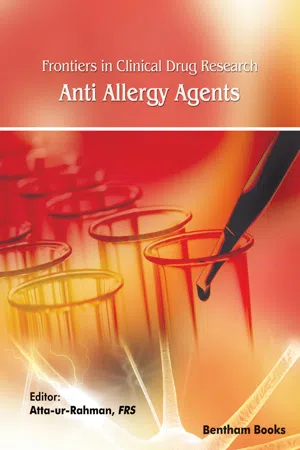
Frontiers in Clinical Drug Research - Anti-Allergy Agents is a book series comprising of a selection of updated review articles relevant to the recent development of pharmacological agents used for the treatment of allergies. The scope of the reviews includes clinical trials of anti-inflammatory and anti-allergic drugs, drug delivery strategies used to treat specific allergies (such as inflammation, asthma and dermatological allergies), lifestyle dependent modes of therapies and the immunological or metabolic mechanisms that are of interest to researchers as targets for new drugs. The fourth volume of this series brings 5 reviews which cover the following topics: Anti-inflammatory and Immunomodulatory properties of medicinal plant products
Helminth therapy: a new tool for treatment of allergic diseases
An overview of anti-allergic medications in paediatric population
In-silico approaches in drug discovery and design of anti-allergic agents
Microbiota and allergy: possible Interventions Frontiers in Clinical Drug Research - Anti-Allergy Agents will be of interest to immunologists and drug discovery researchers interested in anti-allergic drug therapy as the series provides relevant cutting edge reviews written by experts in this rapidly expanding field.
- English
- ePUB (mobile friendly)
- Available on iOS & Android
eBook - ePub
Frontiers in Clinical Drug Research - Anti-Allergy Agents: Volume 4
About this book
Information
Topic
MedicineSubtopic
ImmunologyHelminth Therapy: A New Tool for Treatment of Allergic Diseases
Dalia S. Ashour*
Medical Parasitology Department, Faculty of Medicine, Tanta University, Gharbyia, Egypt
Abstract
The reduced prevalence of allergic disorders in patients infected with helminths and in experimental animal models has prompted the concept of helminth therapy (HT). It was the successful outcome of cooperation between parasitologists, immunologists and epidemiologists, based on the host-parasite immune regulatory interactions. This new approach aims at helping allergic patients especially those with unmet medical needs such as treating severe steroid-resistant asthmatic patients. Although HT is successful in regulating the proinflammatory responses in the host, it may predispose to possible risk of side effects of live worm infections. Thus, it would be more practical to isolate and characterize specific helminth-derived products. Epidemiological and experimental studies of HT in allergic diseases were very promising. However, there are some considerations that should be taken in account for further clinical trials. This chapter highlights the interaction between helminth infection and allergic diseases, the current status of HT, its challenges and future perspectives.
Keywords: Airway hypersensitivity, Allergic disorders, Clinical trials, Helminth therapy, Helminth-derived products, IL-10, Immune regulation, Necator americanus larvae, Self-treatment, Treg cells, Trichuris suis ova.
* Corresponding author: Dalia S. Ashour: Medical Parasitology Department, Faculty of Medicine, Tanta University, Gharbyia, Egypt; Tel: 00201093727625; E-mail: [email protected]
INTRODUCTION
Allergic diseases are increasing in the recent decades especially in Western industrialized countries on the contrary to their low prevalence in the developing countries which may be attributed to low exposure to infectious agents including helminths [1].
An inverse global distribution of allergic and autoimmune diseases and helminths infections is noticed [2-4]. Helminths are mainly prevalent in sub-Saharan Africa, Asia, and South America [5]. While allergic diseases are described more in the developed countries [6]. Control of helminth infections in industrialized countries in the past three decades had a great influence on the increased
incidence of allergic disorders [7]. Additionally, epidemiological studies have reported that helminths-infected populations showed decreased prevalence of some immunopathological disorders; either Th1-related autoimmune diseases or aberrant Th2-related allergic diseases. Thus, it was suggested that the immune system has coevolved to function in the presence of the immunoregulatory arm of helminth infections, while this immunomodulatory component that would normally prevent allergic and autoimmune diseases become weakened in the absence of helminths [8, 9]. The most accepted explanation is the hygiene hypothesis.
Hygiene Hypothesis
Strachan, in 1989, hypothesized that increased hygiene that results in reduced exposure to infections is responsible for the increased allergic disorders. Currently, this hypothesis is known as the “hygiene hypothesis” [10]. In addition to improved personal hygiene and health care, urbanization decreased the exposure to infectious agents and their products. Consequently, the insufficient stimulation of the immune system by different organisms allows uncontrolled expression of inflammatory molecules [4], thus explaining the increased prevalence inflammatory bowel diseases (e.g., Crohn’s disease and ulcerative colitis), autoimmune disorders (e.g., type 1 diabetes and multiple sclerosis) [11] and allergic diseases in Western countries [12].
Helminths induce T helper (Th)2 immune response, thus, lack of childhood infections allow the expansion of the Th2 responses towards different allergens. Hence came the idea that helminth infection can protect from allergic disorders [13]. It is clear now that the interaction between helminth infection and allergy involves T regulatory (Treg) cells that dampen both Th1 and Th2 effector responses [14]. Therefore, the hygiene hypothesis has been extended to include the role of these cells and other immunomodulatory mechanisms involved in the interaction between helminth infection and allergy [1].
This coincidence between helminth infections and the decreased allergic disorders in patients and animal models has evolved the concept of helminth therapy (HT) and the search for helminths molecules with anti-allergic and anti-inflammatory potential and also exploring the mechanisms underlying the interface between allergy and helminth infections.
Allergy
Allergy is a hypersensitivity immune response initiated by exposure to allergens. Allergic disorders include asthma, allergic rhinoconjunctivitis, skin allergies, food and drug allergies and anaphylaxis [15]. Rising prevalence of atopic disorders has been described in the developed countries since the end of World War II [16] and currently constitutes a public health problem affecting at least one-fifth of the world's population [1, 17].
Approximately, 300 million people suffer from asthma worldwide [18]. According to the British Allergy Foundation, 1 in 3 people suffer from allergy at some time in their lives in the United Kingdom [19]. The incidence of asthma varies between 5 and 17% (average 8%) and allergic rhinitis ranges between 23 and 44% (average 30%) in 12 European countries [20]. An average increase in the prevalence of childhood asthma of 4.3% per year from 1980 to 1996 in the United States [21]. On the other hand, decreased prevalence...
Table of contents
- Welcome
- Table of Content
- Title
- BENTHAM SCIENCE PUBLISHERS LTD.
- PREFACE
- List of Contributors
- Anti-inflammatory and Immunomodulatory Properties of Medicinal Plant Products
- Helminth Therapy: A New Tool for Treatment of Allergic Diseases
- An Overview of Anti-Allergic Medications in Paediatric Population
- In-Silico Approaches in Drug Discovery and Design of Anti-Allergic Agents
- Microbiota and Allergy: Possible Interventions
Trusted by 375,005 students
Access to over 1.5 million titles for a fair monthly price.
Study more efficiently using our study tools.
Frequently asked questions
Yes, you can cancel anytime from the Subscription tab in your account settings on the Perlego website. Your subscription will stay active until the end of your current billing period. Learn how to cancel your subscription
No, books cannot be downloaded as external files, such as PDFs, for use outside of Perlego. However, you can download books within the Perlego app for offline reading on mobile or tablet. Learn how to download books offline
Perlego offers two plans: Essential and Complete
- Essential is ideal for learners and professionals who enjoy exploring a wide range of subjects. Access the Essential Library with 800,000+ trusted titles and best-sellers across business, personal growth, and the humanities. Includes unlimited reading time and Standard Read Aloud voice.
- Complete: Perfect for advanced learners and researchers needing full, unrestricted access. Unlock 1.5M+ books across hundreds of subjects, including academic and specialized titles. The Complete Plan also includes advanced features like Premium Read Aloud and Research Assistant.
We are an online textbook subscription service, where you can get access to an entire online library for less than the price of a single book per month. With over 1.5 million books across 990+ topics, we’ve got you covered! Learn about our mission
Look out for the read-aloud symbol on your next book to see if you can listen to it. The read-aloud tool reads text aloud for you, highlighting the text as it is being read. You can pause it, speed it up and slow it down. Learn more about Read Aloud
Yes! You can use the Perlego app on both iOS and Android devices to read anytime, anywhere — even offline. Perfect for commutes or when you’re on the go.
Please note we cannot support devices running on iOS 13 and Android 7 or earlier. Learn more about using the app
Please note we cannot support devices running on iOS 13 and Android 7 or earlier. Learn more about using the app
Yes, you can access Frontiers in Clinical Drug Research - Anti-Allergy Agents: Volume 4 by Atta-ur-Rahman in PDF and/or ePUB format, as well as other popular books in Medicine & Immunology. We have over 1.5 million books available in our catalogue for you to explore.