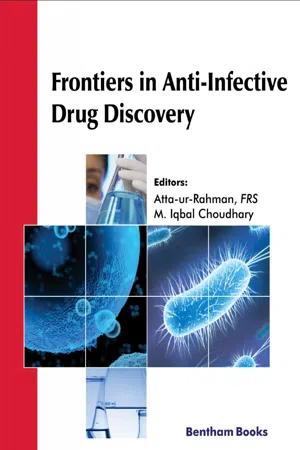
This book series brings updated reviews to readers interested in advances in the development of anti-infective drug design and discovery. The scope of the book series covers a range of topics including rational drug design and drug discovery, medicinal chemistry, in-silico drug design, combinatorial chemistry, high-throughput screening, drug targets, recent important patents, and structure-activity relationships. Frontiers in Anti-Infective Drug Discovery is a valuable resource for pharmaceutical scientists and post-graduate students seeking updated and critically important information for developing clinical trials and devising research plans in this field. The eighth volume of this series features 8 chapters that cover methods for antimicrobial drug discovery (with 2 chapters that focus on genomics) as well as updates on drug development against Helicobacter pylori and emerging coronaviruses, among other interesting topics: - Eradication of Helicobacter pylori Infection with Non-Bismuth Quadruple Concomitant Therapy - Drug Discovery Strategies Against Emerging Coronaviruses: A Global Threat - Opportunities Offered By Fragment-Based Drug Design in Antibiotic Development - Phage therapy as a Tool for Control of Foodborne Diseases: Advantages and Limitations - Subtractive Genomics Approaches: Towards Anti-Bacterial Drug Discovery - Recent Advances in the Discovery of Antimicrobials through Metagenomics - Phyto-Nano-Antimicrobials: Synthesis, Characterization, Discovery, and Advances - Aptamers as Anti-infective Agents
eBook - ePub
Frontiers in Anti-Infective Drug Discovery: Volume 8
- English
- ePUB (mobile friendly)
- Available on iOS & Android
eBook - ePub
Frontiers in Anti-Infective Drug Discovery: Volume 8
About this book
Information
Topic
MedicineSubtopic
PharmacologyRecent Advances in the Discovery of Antimicrobials through Metagenomics
Daljeet Singh Dhanjal, Reena Singh*, Chirag Chopra*
School of Bioengineering and Biosciences, Lovely Professional University, Phagwara, Punjab, India
Abstract
Natural products obtained from the microbes have been reported as substitutes to contemporary drugs obtained from plants. With the increasing need for new therapies, new natural products are being explored using the traditional methods. As only a small fraction of microbes can be cultured in the laboratory, many microbes continue to remain unexplored for their ability to synthesize secondary metabolites. In the past few decades, the reduced cost of DNA sequencing and developments in computational tools have made the Metagenomic Approach effective and popular. Uncultured microbes can be studied through bioprospecting of the unexplored geographical niches. Moreover, Bioinformatics tools have enabled us to find the gene clusters that, in metagenomics, imply the real potential of finding novel open reading frames (ORFs). Screening of genomes for secondary metabolite-genes like non-ribosomal peptide synthases (NRPS) and polyketide synthases (PKS), has resulted in the discovery of new or previously known metabolites. Technological advancement and innovations in the culture-independent approach have allowed us to explore novel chemistries from environmental samples to identify the molecules of therapeutic value. This chapter will discuss the methods for identifying secondary metabolite genes from the genome, and the new approaches for functional metagenomic screening toward the discovery of antimicrobials. Moreover, insights into this approach will be provided to generate opportunities to explore natural products for combating the global demand for novel antibiotics.
Keywords: Antimicrobial, Bioinformatics, Bioprospecting, Metagenomics, Mining, Multi-Drug Resistance, Non-Ribosomal Peptide Synthases, Polyketide Synthases, Secondary Metabolite-Regulated Expression, Substrate-Induced Gene Expression.
* Corresponding authors Reena Singh & Chirag Chopra: School of Bioengineering and Biosciences, Lovely Professional University, Phagwara, Punjab, India; Tel: +91 96220 22616; E-mails: [email protected]; [email protected]
INTRODUCTION
Infectious diseases are the primary cause of morbidity and mortality globally. Human intervention and massive usage of antimicrobial compounds have contributed to the progression of drug-resistance in microorganism [1, 2]. As a result, microorganisms are becoming resistant to multiple drugs, making the treatment difficult and expensive and are becoming a worldwide threat [3]. The multi-drug resistant (MDR) microbial species include Acinetobacter, Escherichia coli, Klebsiella pneumoniae, Salmonella spp., Shigella spp., Staphylococcus aureus, Streptococcus pneumoniae, and Neisseria gonorrhoeae [4]. Some reports have stated that N. gonorrhoeae is evolving and becoming resistant to broad-spectrum drugs cephalosporin and fluoroquinolones. It has also been classified as the priority pathogen by the world health organization (WHO) [5]. On the other hand, various synthetic medicines like aspirin, diclofenac, and Ibuprofen are readily available in the market and widely used for treating different diseases. However, their association with minor side-effects like headaches and back pain and severe side-effects like toxicity, breathlessness and haemorrhage are grave matters of concern. These challenges have caused a shift towards the exploration of natural products [6, 7].
Nature provides a generous niche for a large variety of medicinal plants, marine and terrestrial organisms and microbes, from which new antimicrobial agents can be obtained [8]. Different microbes produce a diverse variety of structurally different compounds. Such compounds obtained from microbes as penicillin, gentamicin, omegamycin, and streptomycin, have encouraged the discovery of newer and better compounds, that can act as sedatives, pain killers, heart stimulators, and show anti-cancer activity [9]. A definitive characteristic of any medicine, whether man-made or natural is that it should be effective, non-toxic, target-specific, non-mutagenic, non-irritant and stable [10]. These variations in chemical structures of compounds help us in developing new compounds as well as scaffolds, which can help us to meet the demand and need of new drugs for treating critical human diseases [11].
Culture-dependent approaches have enabled the discovery of new bioactive molecules but are limited by the fact that many microbes continue to remain unexplored and uncultivable [12]. As a result, a large variety of microbes is expected to stay elusive if we rely only on the traditional culture-dependent approach [13]. Thus, to have better insights into the microbes, metagenomics has emerged as a valuable tool to unearth most unexplored microbes. We can now understand the diverse biochemical pathways of uncultured microbes and surpass the limitations of culture-dependent approaches [14]. The approaches used in bioprospecting the metagenomes for useful genes or ORFs have bene summarized in Fig. (1). Proximally-located genes generally encode the enzymes involved in the biosynthesis of metabolites. These genes together form a cluster called the biosynthetic gene cluster (BGC). Metagenomics entails the construction of metagenomic libraries, their...
Table of contents
- BENTHAM SCIENCE PUBLISHERS LTD.
- PREFACE
- LIST OF CONTRIBUTORS
- Eradication of Helicobacter pylori Infection with Non-Bismuth Quadruple Concomitant Therapy
- Drug Discovery Strategies Against Emerging Coronaviruses: A Global Threat
- Opportunities Offered by Fragment-Based Drug Design in Antibiotic Development
- Phage Therapy as a Tool for Control of Foodborne Diseases: Advantages and Limitations
- Subtractive Genomics Approaches: Towards Anti-Bacterial Drug Discovery
- Recent Advances in the Discovery of Antimicrobials through Metagenomics
- Phyto-Nano-Antimicrobials: Synthesis, Character-ization, Discovery, and Advances
- Aptamers as Anti-Infective Agents
Trusted by 375,005 students
Access to over 1.5 million titles for a fair monthly price.
Study more efficiently using our study tools.
Frequently asked questions
Yes, you can cancel anytime from the Subscription tab in your account settings on the Perlego website. Your subscription will stay active until the end of your current billing period. Learn how to cancel your subscription
No, books cannot be downloaded as external files, such as PDFs, for use outside of Perlego. However, you can download books within the Perlego app for offline reading on mobile or tablet. Learn how to download books offline
Perlego offers two plans: Essential and Complete
- Essential is ideal for learners and professionals who enjoy exploring a wide range of subjects. Access the Essential Library with 800,000+ trusted titles and best-sellers across business, personal growth, and the humanities. Includes unlimited reading time and Standard Read Aloud voice.
- Complete: Perfect for advanced learners and researchers needing full, unrestricted access. Unlock 1.5M+ books across hundreds of subjects, including academic and specialized titles. The Complete Plan also includes advanced features like Premium Read Aloud and Research Assistant.
We are an online textbook subscription service, where you can get access to an entire online library for less than the price of a single book per month. With over 1.5 million books across 990+ topics, we’ve got you covered! Learn about our mission
Look out for the read-aloud symbol on your next book to see if you can listen to it. The read-aloud tool reads text aloud for you, highlighting the text as it is being read. You can pause it, speed it up and slow it down. Learn more about Read Aloud
Yes! You can use the Perlego app on both iOS and Android devices to read anytime, anywhere — even offline. Perfect for commutes or when you’re on the go.
Please note we cannot support devices running on iOS 13 and Android 7 or earlier. Learn more about using the app
Please note we cannot support devices running on iOS 13 and Android 7 or earlier. Learn more about using the app
Yes, you can access Frontiers in Anti-Infective Drug Discovery: Volume 8 by Atta-ur-Rahman,M. Iqbal Choudhary, Atta-ur-Rahman, M. Iqbal Choudhary in PDF and/or ePUB format, as well as other popular books in Medicine & Pharmacology. We have over 1.5 million books available in our catalogue for you to explore.