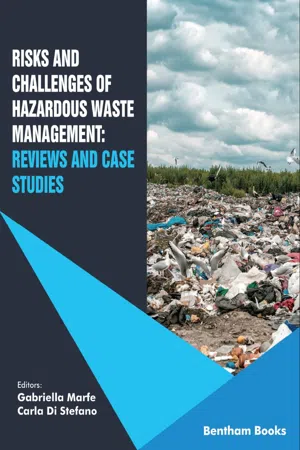
This reference presents reviews and case studies of hazardous waste management in a selection of cities. The overarching themes of the compiled topics include 1) the problems of healthcare waste management, 2) case studies of hazardous waste mismanagement, 3) health risks associated with environmental waste, issues in environmental health and 4) grassroots environmentalism.
The volume initially presents reviews and case studies from developing countries, including countries in South America (Argentina), Africa (Algeria and Nigeria), and Asia (India). The latter chapters of the book focus on environmental issues in Campania, a region in Italy. These chapters also provide an insight into the impact of the COVID-19 pandemic on waste management practices in this region.
Risks and Challenges of Hazardous Waste Management is an insightful reference for management trainees, professionals and researchers associated with waste management and environmental health firms. Readers will gain insights into current issues and practices in the respective industries. The reviews and case studies presented in the reference are also useful to professionals involved in risk assessment studies.
eBook - ePub
Risks and Challenges of Hazardous Waste Management: Reviews and Case Studies
- English
- ePUB (mobile friendly)
- Available on iOS & Android
eBook - ePub
Risks and Challenges of Hazardous Waste Management: Reviews and Case Studies
About this book
Information
Hazardous Waste Management in India: Risks and Challenges Associated with Hazardous Waste
Arvind Kumar Shukla1, 2, 3, *, Sandhya Shukla3
1 School of Biotechnology and Bioinformatics, D.Y. Patil University, Plot No.50, Sector- 15, C.B.D. Belapur, Navi Mumbai, 400614, Maharashtra, India
2 School of Biomedical Convergence Engineering, Pusan National University, Yangsan 50612, Korea
3 Inventra Medclin Biomedical Healthcare and Research Center, Katemanivli, Kalyan, Thane, 421306, Maharashtra, India
Abstract
Today, there are major environmental challenges associated with hazardous waste management in India. In this regard, hazardous production is increasing rapidly and it's required proper management to be improving the future of India. In this context, the Indian government's policy and legislation are not working properly on Hazardous Waste Management (HWM), thereby triggering enormous public health issues. The effective Hazardous waste (HW) treatment practices are of paramount importance to protect human health, and in addition, this is a social responsibility for the safety of the future generation. This chapter reviews the current situation on the rules and regulations of HWM and policy to adopt new successful approaches and techniques that are used worldwide to address this issue in India. Current systems in India cannot cope with the volumes of waste generated by an increasing urban population because of the lack of adequate infrastructure but these challenges will allow to transforming barriers in good opportunities for sustainable growth.
Keywords: Biomedical hazardous waste, Hazardous waste management, India, Municipal hazardous solid waste, Urbanization.
* Corresponding author Arvind Kumar Shukla: School of Biotechnology and Bioinformatics, D.Y. Patil University, Plot No.50, Sector- 15, C.B.D. Belapur, Navi Mumbai, 400614, Maharashtra, India;
E-mail: [email protected]
Introduction
Many developing countries such as India are facing many difficulties in the management of hazardous waste with related health problems such as cancer, diabetes and other infectious diseases. Currently, in India, continuous industrialization happens, therefore, a higher amount of hazardous waste is pro-
duced because of poor management systems and lack of adoption of technologies to overcome this problem.
The first example of this situation is an accident at India's Bhopal plant, methyl isocyanate (MIC) gas leak accident, which is the responsible of the Union Carbide Corporation of the USA. The deaths of at least 2,000 citizens resulted from operational accidents, structural defects, repair deficiencies, training shortages, and safety-threatening economic steps, according to current and former staff, business scientific records, and the Chief Scientist of the Indian Government [1].
Currently, in India, manufacturing operations, farming and agro-factories, medical facilities, shopping centers, households, and the informal sector are the primary sources of hazardous solid waste, but they are neither recognized nor regulated by the Indian government. Hazardous waste has been described as “any material, including domestic and radioactive waste, which, due to its quantity and/or corrosive, reactive, ignitable, poisonous and contagious characteristics, can cause harmful environmental and human health consequences. This material is non-degradable, highly toxic, and even lethal at very low concentrations. It can be biologically magnified and poses potential risks to human health [2].
Approximately 90% of residual waste is currently dumped instead of properly landfilled [3, 4]. In this case, the more successful proactive HWM must be followed immediately. To do this, a new management structure and hazardous waste disposal systems had to be implemented. These days, the HWM program is an inefficient and hazardous waste has a negative impact on public health, the atmosphere, and the economy [5]. India's Mini...
Table of contents
- Welcome
- Table of Content
- Title
- BENTHAM SCIENCE PUBLISHERS LTD.
- PREFACE
- FOREWORD
- List of Contributors
- Healthcare Waste: A Challenge for Best Management Practices in Developing Countries
- A Review of the Knowledge, Attitude, and Practices of Healthcare Wastes Workers (HCWS) on Medical Waste in Developing Countries
- Blood Exposure Accidents: Knowledge and Evaluation of Health Professional in the Emergency Pavilion of the Hospital of Batna City
- Hazardous Waste Management in India: Risks and Challenges Associated with Hazardous Waste
- The E-waste Situation in India and Health Impact on Population
- Hazardous Waste Management and Geological Aspects in Campania (A Case Study)
- Environmental and Human Health Issues in Campania Region Italy
- A Case Study on Grassroots Environmentalism for Health and Sustainability in the Land of Fires (Italy)
- The Outbreak of the Pandemic of Coronavirus Disease 2019 and its Impact on Medical Waste Management
Trusted by 375,005 students
Access to over 1.5 million titles for a fair monthly price.
Study more efficiently using our study tools.
Frequently asked questions
Yes, you can cancel anytime from the Subscription tab in your account settings on the Perlego website. Your subscription will stay active until the end of your current billing period. Learn how to cancel your subscription
No, books cannot be downloaded as external files, such as PDFs, for use outside of Perlego. However, you can download books within the Perlego app for offline reading on mobile or tablet. Learn how to download books offline
We are an online textbook subscription service, where you can get access to an entire online library for less than the price of a single book per month. With over 1.5 million books across 990+ topics, we’ve got you covered! Learn about our mission
Look out for the read-aloud symbol on your next book to see if you can listen to it. The read-aloud tool reads text aloud for you, highlighting the text as it is being read. You can pause it, speed it up and slow it down. Learn more about Read Aloud
Yes! You can use the Perlego app on both iOS and Android devices to read anytime, anywhere — even offline. Perfect for commutes or when you’re on the go.
Please note we cannot support devices running on iOS 13 and Android 7 or earlier. Learn more about using the app
Please note we cannot support devices running on iOS 13 and Android 7 or earlier. Learn more about using the app
Yes, you can access Risks and Challenges of Hazardous Waste Management: Reviews and Case Studies by Gabriella Marfe,Carla Di Stefano in PDF and/or ePUB format, as well as other popular books in Biological Sciences & Environmental Science. We have over 1.5 million books available in our catalogue for you to explore.