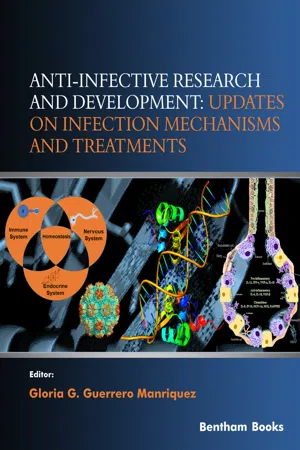
This volume of Frontiers in Anti-Infective Agents provides updates on the most recent studies about anti-infective agents, their mechanism of action, the relevant molecular targets and their implication in the development of novel antibiotics that have properties similar to their corresponding compounds of natural origin. The initial chapter covers the mode of action of natural antimycobacterial compounds such as nordihydroguaiaretic acid, ?-mangostin and allicin, as well as antimicrobial peptides and their role in the innate and adaptive immune response leading to the decrease of microbial resistance. This is followed by updates on tuberculosis treatment concerning the immunological role of cells (airway epithelial cells, macrophages, neutrophils and T cells) along with their products (chemokines, cytokines) and other processes such as autophagy that influence the outcome of the host immune response to the infection. Contributors have also reviewed the latest knowledge in the cellular and molecular mechanisms that trigger a protective, immune response and the identification of the molecular targets for vaccine development, all of which are a key priority to develop control measures against Babesia species like Babesia bovis and Babesia bigemina. Additionally, the neuro-endocrine and neuro-immune mechanisms behind host responses against stress and environmental stimuli during infections are also covered in separate chapters. The volume also provides updates related to Helicobacter pylori pathogenesis. The reviews presented in Anti-infective Research and Development provide timely updates for scholars and professionals associated with the field of antimicrobial research and development.
eBook - ePub
Anti-infective Research and Development: Updates on Infection Mechanisms and Treatments
- English
- ePUB (mobile friendly)
- Available on iOS & Android
eBook - ePub
Anti-infective Research and Development: Updates on Infection Mechanisms and Treatments
About this book
Trusted by 375,005 students
Access to over 1.5 million titles for a fair monthly price.
Study more efficiently using our study tools.
Information
Topic
MedicineNatural Products with Antimicrobial Activity for Mycobacterium tuberculosis
Silvia Guzmán-Beltrán*, Fernando Hernández-Sánchez, Omar M. Barrientos
Departamento de Investigación en Microbiología, Instituto Nacional de Enfermedades Respiratorias Ismael Cosío Villegas, CDMX, Mexico
Abstract
Tuberculosis (TB) is an infectious disease caused by Mycobacterium tuberculosis. TB is one of the top ten causes of death in the world and it is highly prevalent, characterized by the constant occurrence of drug-resistant cases, and confounded by the incidence of respiratory diseases caused by nontuberculous mycobacteria (NTM). The anti-TB drugs commonly used are insufficient and have multiple adverse effects. Therefore, a new strategy to eradicate this infectious disease is required. The implementation of new anti-TB drugs together with host-directed therapy (HDT) can decrease the duration of treatment and improve the TB patients’ health. It is proposed that natural products are an enormous source of bioactive compounds to treat TB. They can be new anti-TB drugs or agents for HDT.
Keywords: Allicin, Antimycobacterial compounds, Baicalin, α-Mangostin, Host-Directed Therapy (HDT), Nordihydroguaiaretic acid, Pasakbumin A, Tuberculous and nontuberculous mycobacteria, (10-15) Tuberculosis.
* Corresponding author Silvia Guzmán-Beltrán: Departamento de Investigación en Microbiología, Instituto Nacional de Enfermedades Respiratorias Ismael Cosío Villegas, CDMX, Mexico; Tel: 548717005117; E-mail: [email protected]
INTRODUCTION
TB has become a global health problem. It is estimated that one-third of the population in the world is infected with latent M. tuberculosis, and only 10% of infected individuals develop an active disease [1]. The TB-patients require long-term antibiotic treatment (6–12 months), and patient non-compliance with the complete therapeutic regime could lead to the emergence of multi- and extensively-drug resistant M. tuberculosis strains (MDR and XDR) [2]. MDR and XDR have already become a global health threat requiring extended treatment lengths, and there are increasing numbers of resistant TB cases, coupled with an increase of NTM lung infection cases [3]. There are 10 drugs that are currently
approved for treating TB [4]. The first-line anti-TB drugs are isoniazid (INH), et-hambutol (EMB), pyrazinamide (PZA), and rifampicin (RIF). The first three anti-TB drugs are synthetic, while RIF is a semi-synthetic compound, derived from chemical modifications of the rifamycin B, the natural metabolites of Amycolatopsis mediterranei, and a soil bacterium [5]. There have been a few anti-TB agents under preclinical and clinical evaluations, and, probably, a combination regimen containing various new drugs with different effects that kill bacteria, leads to the design of successful drug regimens for TB treatment. Most of the promising anti-TB drug candidates in preclinical and clinical trials are synthetic compounds, with a limited spectrum of antimicrobial activity [6]. Additional alternatives are required to treat TB. Host-directed therapy (HDT) is a new strategy that involves directly targeting host factors rather than pathogen components [7]. The ideal HDT is to generate an immune response that promotes the antimicrobial mechanisms in the host cells and decreases the exacerbated inflammation caused during infection without consequences for the host [8]. In the present report, several natural compounds able to directly kill mycobacteria and enhance the immune response are described. These promising compounds could be an HDT alternative to treat TB.
Tuberculosis
TB is one of the major causes of health problems worldwide. According to the World Health Organization, it is estimated that approximately 10 million are affected by this infectious disease and 1.5 million people died in 2018 because of it [9]. M. tuberculosis is the causative agent of TB that can spread from person to person through microscopic droplets. The common site of TB infection is the lung (pulmonary TB), but it can also transmit to other parts of the body causing tuberculous meningitis, osteoarticular tuberculosis, and miliary tuberculosis [10]. In recent years, treatments currently available against TB have become inefficient due to the emergence of MDR and XDR strains [9]. Several mechanisms are involved in the development of these resistant TB forms, such as overexpression of drug efflux pumps, alteration in membrane permeability, modification of drug, and alteration of target site [11]. In addition, the frequency of pulmonary disease caused by NTM has increased and most NTM are resistant to different anti-TB drugs.
In the last decade, there has been a renewed focus on the development of drugs to treat TB, and several compounds are being evaluated in clinical trials. While new drugs in development may appear promising, their efficacy and safety for use in humans remain to be validated, which requires cost and time [12]. The current anti-TB drugs are very expensive and cause adverse side effects on the human body and, in certain disease conditions, are inefficient. Therefore, it is necessary to develop novel, effective, and affordable anti-TB drugs [9, 13].
Potential Actions of Natural Compound as Antituberculosis Agents
Nature has been a major source of compounds used in traditional and modern medicine and plants and microbes provide a wide diversity of bioactive molecules. Natural compounds are a better alternative with possibly minor side effects used currently [14]. To evaluate the potential of molecules from natural products, it is fundamental to consider their mode of action (Fig. 1). For example, compounds should be able to inhibit the mycobacterial envelope. They should inhibit the synthesis of mycolic acids, a specific component of Mycobacterium, located at the outer layer of the cell wall, another target is the peptidoglycan synthesis, a principal constituent of the bacterial wall. DNA replication inhibition, DNA gyrase inhibition, and may arrest DNA synthesis and bacterial replication. Transcription and translation inhibition, RNA polymerase inhibition or blocking ribosomes function should also be considered. Other mechanisms are blocking the membrane potential like the loss of proton motive force or by inhibition of ATP synthesis [5]. And the last mechanism efficient is the generation of reactive nitrogen and oxygen species (RNOS), as they provoke damage to macromolecules and then bacterial death [6].
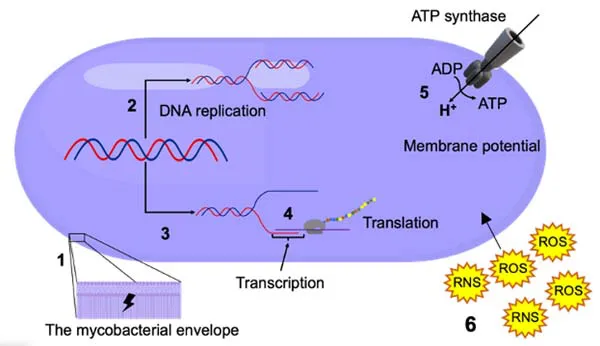
Mode of action of diverse antituberculosis natural compounds. The compounds able to inhibit: the mycobacterial envelope (1), DNA replication (2), transcription (3), translation (4), and membrane potential (5). ATP, Adenosine triphosphate; ADP, adenosine diphosphate and H+, hydrogen ion and production of reactive oxygen species (ROS) and reactive nitrogen species (RNS) (6).
Action Against Mycobacterial Cell Surface
The most widely known mode of action of antibacterial agents is the rupture of the cell wall and membrane integrity. Diverse n...
Table of contents
- Welcome
- Table of Content
- Title
- BENTHAM SCIENCE PUBLISHERS LTD.
- PREFACE
- List of Contributors
- The Anti-Infective Agents
- Natural Products with Antimicrobial Activity for Mycobacterium tuberculosis
- Induction and Activation of Intracellular Antimicrobial Molecules for Mycobacterial Control
- Immune Response Against M. tuberculosis in Human Pulmonary Tuberculosis
- Inducing Autophagy to Eliminate Intracellular Bacteria
- Neuro-Immune-Endocrine Interactions During Infections
- Regulation of Haemoglobin, Haem Uptake by FrpB Family Proteins in Helicobacter pylori
- Molecular Mechanisms of Babesia Invasion: Potential Targets for Vaccine Development
Frequently asked questions
Yes, you can cancel anytime from the Subscription tab in your account settings on the Perlego website. Your subscription will stay active until the end of your current billing period. Learn how to cancel your subscription
No, books cannot be downloaded as external files, such as PDFs, for use outside of Perlego. However, you can download books within the Perlego app for offline reading on mobile or tablet. Learn how to download books offline
Perlego offers two plans: Essential and Complete
- Essential is ideal for learners and professionals who enjoy exploring a wide range of subjects. Access the Essential Library with 800,000+ trusted titles and best-sellers across business, personal growth, and the humanities. Includes unlimited reading time and Standard Read Aloud voice.
- Complete: Perfect for advanced learners and researchers needing full, unrestricted access. Unlock 1.5M+ books across hundreds of subjects, including academic and specialized titles. The Complete Plan also includes advanced features like Premium Read Aloud and Research Assistant.
We are an online textbook subscription service, where you can get access to an entire online library for less than the price of a single book per month. With over 1.5 million books across 990+ topics, we’ve got you covered! Learn about our mission
Look out for the read-aloud symbol on your next book to see if you can listen to it. The read-aloud tool reads text aloud for you, highlighting the text as it is being read. You can pause it, speed it up and slow it down. Learn more about Read Aloud
Yes! You can use the Perlego app on both iOS and Android devices to read anytime, anywhere — even offline. Perfect for commutes or when you’re on the go.
Please note we cannot support devices running on iOS 13 and Android 7 or earlier. Learn more about using the app
Please note we cannot support devices running on iOS 13 and Android 7 or earlier. Learn more about using the app
Yes, you can access Anti-infective Research and Development: Updates on Infection Mechanisms and Treatments by Gloria G. Guerrero Manriquez in PDF and/or ePUB format, as well as other popular books in Medicine & Medical Microbiology & Parasitology. We have over 1.5 million books available in our catalogue for you to explore.