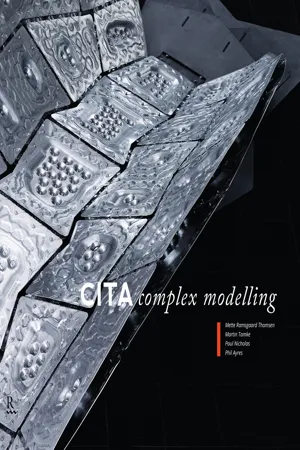
CITA Complex Modelling investigates the infrastructures of architectural design models. By questioning the tools for integrating information across the expanded digital design chain, the book asks how to support feedback between different scales of design engagement moving from material design, across design, simulation and analysis to specification and fabrication. The book conveys the findings of the Complex Modelling research project a five-year framing project supported by the Independent Research Fund Denmark. Undertaken at CITA, the Centre for Information Technology and Architecture, The Royal Danish Academy of Fine Arts, School of Architecture, Complex Modelling asks how new interdisciplinary methods for adaptive parametrisation, advanced simulation, machine learning and robotic fabrication can be orchestrated within novel workflows that expand the agency of architecture.
eBook - ePub
CITA Complex Modelling
- English
- ePUB (mobile friendly)
- Available on iOS & Android
eBook - ePub
CITA Complex Modelling
About this book
Information
Topic
ArchitectureSubtopic
Architecture GeneralINFORMATION RICH DESIGN
A key insight in Complex Modelling is that the integration of machine learning in the networked model enables adaptive parametrisation and breaks the reductionism inherent to parametric modelling. As our models are able to intersect with information drawn from the world around us through the sensing and simulation of environment and structural and material behaviour, we encounter the dilemma of the information-rich but data-heavy design model. Complex Modelling exposes the nature and sheer volume of the information of future modelling paradigms that seek to design for performance and optimise material deployment. These processes introduce radically new scales and types of data into design modelling.
Complex Modelling examines the idea of information-rich design through a focus on machine learning. By employing machine learning across the networked model, we combine analytical methods for evaluation and classification with creative methods for design generation and evolution. Machine learning is different from parametric strategies in that models are not explicitly defined but rather trained on data sets. This means that the information-rich design environment acts as a source of training data. Data can be brought in as a predefined data set or generated continually, and their associated models can be trained either discretely or continuously.
Here, models exist in multiples, in thousands of models, which are spawned by the generative system to then be analysed by the learning system. Models are no longer singular endpoints, where finding the optimum represents the end of the modelling process. Instead, models learn from other models. They belong to processes of expansion, increasing in number and in complexity at each step of evolution (1).
Machine learning presents new practices for architecture. In Complex Modelling, we examine three central emergent practices (2). Firstly, we investigate new modes of mapping and characterising solution spaces in non-explicit ways. Secondly, by intersecting machine learning with simulation, we develop alternate strategies for performance prediction, which avoids brute-force calculation. And thirdly, we extend the adaptability of design information by applying machine learning onto sense data gathered from the fabrication process.
In Learning to be a Vault, unsupervised machine learning is used to map solution spaces and categorise outputs into observable classifications thereby letting the designer navigate these high-order design spaces more easily (3). In Lace Wall, neural networks are interfaced with simulation in order to optimise structural morphology and enhance performance. Here, machine learning is interfaced with multiscale simulation strategies. At the scale of the element, a genetic algorithm is used to optimise the topology of the cable network for both performance and fabrication requirements, and at the scale of the structure, an artificial neural network ...
Table of contents
- Foreward
- ADAPTIVE PARAMETRISATION
- INTEGRATING ANALYSIS
- MULTISCALE MODELLING
- INFORMATION RICH DESIGN
- TOPOLOGICAL MODELLING
Trusted by 375,005 students
Access to over 1.5 million titles for a fair monthly price.
Study more efficiently using our study tools.
Frequently asked questions
Yes, you can cancel anytime from the Subscription tab in your account settings on the Perlego website. Your subscription will stay active until the end of your current billing period. Learn how to cancel your subscription
No, books cannot be downloaded as external files, such as PDFs, for use outside of Perlego. However, you can download books within the Perlego app for offline reading on mobile or tablet. Learn how to download books offline
Perlego offers two plans: Essential and Complete
- Essential is ideal for learners and professionals who enjoy exploring a wide range of subjects. Access the Essential Library with 800,000+ trusted titles and best-sellers across business, personal growth, and the humanities. Includes unlimited reading time and Standard Read Aloud voice.
- Complete: Perfect for advanced learners and researchers needing full, unrestricted access. Unlock 1.5M+ books across hundreds of subjects, including academic and specialized titles. The Complete Plan also includes advanced features like Premium Read Aloud and Research Assistant.
We are an online textbook subscription service, where you can get access to an entire online library for less than the price of a single book per month. With over 1.5 million books across 990+ topics, we’ve got you covered! Learn about our mission
Look out for the read-aloud symbol on your next book to see if you can listen to it. The read-aloud tool reads text aloud for you, highlighting the text as it is being read. You can pause it, speed it up and slow it down. Learn more about Read Aloud
Yes! You can use the Perlego app on both iOS and Android devices to read anytime, anywhere — even offline. Perfect for commutes or when you’re on the go.
Please note we cannot support devices running on iOS 13 and Android 7 or earlier. Learn more about using the app
Please note we cannot support devices running on iOS 13 and Android 7 or earlier. Learn more about using the app
Yes, you can access CITA Complex Modelling by Mette Ramsgaard Thomsen, Martin Tamke,Paul Nicholas,Phil Ayres, Martin Tamke, Paul Nicholas, Phil Ayres in PDF and/or ePUB format, as well as other popular books in Architecture & Architecture General. We have over 1.5 million books available in our catalogue for you to explore.