The knowledge of plant responses to various abiotic stresses is crucial to understand their underlying mechanisms as well as the methods to develop new varieties of crops, which are better suited to the environment they are grown in. Environmental Stress Physiology of Plants and Crop Productivity provides readers a timely update on the knowledge about plant responses to a variety of stresses such as salinity, temperature, drought, oxidative stress and mineral deficiencies. Chapters focus on biochemical mechanisms identified in plants crucial to adapting to specific abiotic stressors along with the methods of improving plant tolerance. The book also sheds light on plant secondary metabolites such as phenylpropanoids and plant growth regulators in ameliorating the stressful conditions in plants. Additional chapters present an overview of applications of genomics, proteomics and metabolomics (including CRISPR/CAS techniques) to develop abiotic stress tolerant crops. The editors have also provided detailed references for extended reading to support the information in the book. Environmental Stress Physiology of Plants and Crop Productivity is an informative reference for scholars and researchers working in the field of botany, agriculture, crop science and physiology, soil science, and environmental sciences.
eBook - ePub
Environmental Stress Physiology of Plants and Crop Productivity
- English
- ePUB (mobile friendly)
- Available on iOS & Android
eBook - ePub
Environmental Stress Physiology of Plants and Crop Productivity
About this book
Information
Topic
Scienze biologicheSubtopic
BotanicaRole of Plant Growth Regulators in Abiotic Stress Tolerance
Sakshi Sharma1, Inderpreet Kaur2, *, Avinash Kaur Nagpal3, *
1 Department of Botany, DAV College, Amritsar, Punjab 143005, India
2 Department of Chemistry, Centre for Advanced Studies, Guru Nanak Dev University, Amritsar, Punjab 143005, India
3 Department of Botanical and Environmental Sciences, Guru Nanak Dev University, Amritsar, Punjab 143005, India
Abstract
Plants are frequently exposed to different types of stressful environmental conditions, which have adverse effects on their growth, development, and productivity. These conditions, such as salinity, drought, floods, chilling, freezing, UV exposure, pollution, nutritional deficiencies, metal toxicity, etc., are collectively known as abiotic stressors and hinder plants from fully expressing their genetic potential. With advancements in scientific fields such as genetics and molecular biology, it has become easier to understand that under abiotic stress, a myriad of responses are triggered in plants. These changes include alterations in gene expression to changes in cell metabolism to avoid or tolerate the stress. The intensity of these plant responses depends on affected tissue, age of the plant, type of stress posed, duration and severity of stress, etc. It has been observed that plant growth regulators such as auxins, abscisic acid, cytokinins, ethylene, gibberellins, jasmonic acid, brassinosteroids, salicylic acid, polyamines, strigolactones, etc., which influence the growth and differentiation in plants, also have very important roles in regulating the stress tolerance in plants. This chapter is a comprehensive account of literature based on the role of different plant growth regulators in the regulation of tolerance of plants towards abiotic stressors. The contents of this chapter include a brief discussion about different types of abiotic stressors, their effects on plants, and responses developed in plants against them. There is also a detailed discussion about plant growth regulators, their role in the normal functioning of plants, followed by their contribution and underlying mechanisms in building abiotic stress tolerance in plants.
Keywords: Abscisic acid, Auxins, Brassinosteroids, Cytokinins, Ethylene, Gibberellins, Jasmonic acid, Polyamines, Salicylic acid, Strigolactones.
* Corresponding Author Avinash Kaur Nagpal & Inderpreet Kaur: Department of Botanical and Environmental Sciences, Guru Nanak Dev University, Amritsar, Punjab 143005, India; Tel: +91-94174-26060, 2258802-09 Ext. 3423 (O); Fax: 0183-2258819, 20; E-mail:[email protected] and Department of Chemistry, Centre for Advanced Studies, Guru Nanak Dev University, Amritsar, Punjab 143005, India; Tel: +91-8427662766, +91-183-2258802 to 9, Extn.-3285(O); E-mail:[email protected]
INTRODUCTION
Abiotic stress in plants is a cumulative adverse effect of non-living environmental factors on the plants affecting their physiology, growth, development, and yield [1]. Plants are immobile in nature and highly susceptible to ever-changing environmental and climatic conditions, including abiotic stress. The latter results in the malfunctioning of different physiological, biochemical, and molecular mechanisms, ultimately decreasing the plant yield [2]. Demand for agricultural products has increased enormously with the increasing human population. However, the impact of different abiotic stressors has posed a grave danger to plant growth, fertility, and agricultural productivity [3].
Abiotic stress on plants is posed by environmental conditions (physical or chemical) such as drought, water logging, UV exposure, excessive heat, chilling, frosting, soil salinity, mineral toxicity, pollution, and nutritional deficiencies (Fig. 1) [1, 4, 5]. Plants have developed various methods to adapt to these abiotic stressors, in turn causing a reduction in biomass and yield [3]. It is extremely important to manage abiotic stress on plants as it limits the agricultural yield affecting the economy of countries, and the livelihood of the farmers is dependent on these crops [5]. To improve the yield and sustainability of crops, it is necessary to understand the factors and mechanisms behind plant responses to different abiotic stressors [3]. The severity of plant responses is dependant on different factors such as affected part or tissue of the plant, growth stage, and conditions of plant, species or ecotypes of plant, type and intensity of abiotic stress, duration of exposure to the stress, etc [6, 7].
Plants are able to perceive even minor unfavourable alterations in environmental conditions and start a myriad of stress responses for coping with the situation and establishing homeostasis [8, 9]. Plant growth regulators, which play a vital role in the regulation of the growth and development of plants, are instrumental in tolerating and combating abiotic stress in plants [10]. Different plant growth regulators, such as abscisic acid, cytokinins, auxins, gibberellins, ethylene, jasmonic acid, salicylic acid, brassinosteroids, polyamines, strigolactones, etc. have an extensive role in developing and maintaining abiotic stress tolerance in plants [11-13]. Considering these facts, this chapter has been written as an attempt to compile information on adverse effects of different types of abiotic stressors on plants, responses of plants to these stressors, the role of different plant growth regulators in stress tolerance and crop improvement, regulation of tolerance of plants towards abiotic stressors.
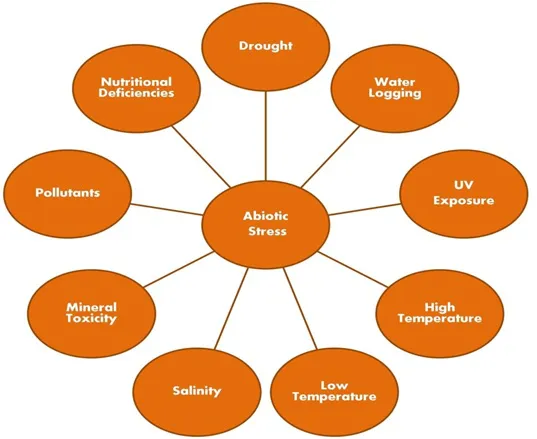
Different types of abiotic stressors posed to plants [Based on: 1, 4, 5].
ABIOTIC STRESS AND PLANT RESPONSES
Abiotic stress is a major factor responsible for hindrance in the full expression of the genetic potential of plants. It triggers a variety of responses in plants, including changes in cellular metabolism, signal transduction, gene expression, plant growth rate, and crop yield [14]. According to Onaga and Wydra, under abiotic stress, membrane receptors in plants perceive different initial stress signals such as changes in membrane fluidity and osmotic effects. Then, signal transduction triggers transcription, which is controlled by different hormones, miRNAs, transcription factor binding proteins, and transcription factors. It activates defense response in plant cells to fix damaged membranes and proteins and to reinstate ion homeostasis in cells (Fig 2) [15]. This defense response includes various changes such as:
- Increased production of lignin and callose for hardening of cell walls in order to increase the mechanical strength of plants.
- Reduced secondary metabolic activities to save energy.
- Induction of changes in proteins involved in growth signalling.
- Elevated transmembrane activity fo...
Table of contents
- Welcome
- Table of Content
- Title
- BENTHAM SCIENCE PUBLISHERS LTD.
- FOREWORD
- PREFACE
- Summary
- List of Contributors
- Abiotic Stress in Plants: An Overview
- Drought and its Effects on Crop Physiology
- Salinity and its Effect on Yield of Field/Horticultural Crops
- Temperature Rising Patterns and Insights into the Impacts of Consequent Heat Stress on Edible Plants
- Physiological Role of Mineral Nutrients and their Uptake during Abiotic Stress
- Nitric Oxide Mediated Modulation of Antioxidative Responses under Salinity Stress in Different Plant Species: A Review
- Reactive Oxygen Species Metabolism and Antioxidant Defense in Plants under Stress
- Role of Melatonin - A Signaling Molecule in Modulation of Antioxidant Defense System in Plants: Amelioration of Drought and Salinity Stress
- Phenylpropanoid Biosynthesis and its Protective Effects against Plants Stress
- Role of Plant Growth Regulators in Abiotic Stress Tolerance
- Genomics, Proteomics and Metabolic Approaches against Abiotic Stress
- CRISPR/CAS9 Technologies to Enhance Tolerance to Abiotic Stress in Crop Plants
Trusted by 375,005 students
Access to over 1.5 million titles for a fair monthly price.
Study more efficiently using our study tools.
Frequently asked questions
Yes, you can cancel anytime from the Subscription tab in your account settings on the Perlego website. Your subscription will stay active until the end of your current billing period. Learn how to cancel your subscription
No, books cannot be downloaded as external files, such as PDFs, for use outside of Perlego. However, you can download books within the Perlego app for offline reading on mobile or tablet. Learn how to download books offline
Perlego offers two plans: Essential and Complete
- Essential is ideal for learners and professionals who enjoy exploring a wide range of subjects. Access the Essential Library with 800,000+ trusted titles and best-sellers across business, personal growth, and the humanities. Includes unlimited reading time and Standard Read Aloud voice.
- Complete: Perfect for advanced learners and researchers needing full, unrestricted access. Unlock 1.5M+ books across hundreds of subjects, including academic and specialized titles. The Complete Plan also includes advanced features like Premium Read Aloud and Research Assistant.
We are an online textbook subscription service, where you can get access to an entire online library for less than the price of a single book per month. With over 1.5 million books across 990+ topics, we’ve got you covered! Learn about our mission
Look out for the read-aloud symbol on your next book to see if you can listen to it. The read-aloud tool reads text aloud for you, highlighting the text as it is being read. You can pause it, speed it up and slow it down. Learn more about Read Aloud
Yes! You can use the Perlego app on both iOS and Android devices to read anytime, anywhere — even offline. Perfect for commutes or when you’re on the go.
Please note we cannot support devices running on iOS 13 and Android 7 or earlier. Learn more about using the app
Please note we cannot support devices running on iOS 13 and Android 7 or earlier. Learn more about using the app
Yes, you can access Environmental Stress Physiology of Plants and Crop Productivity by Tajinder Kaur,Saroj Arora, Tajinder Kaur, Saroj Arora in PDF and/or ePUB format, as well as other popular books in Scienze biologiche & Botanica. We have over 1.5 million books available in our catalogue for you to explore.