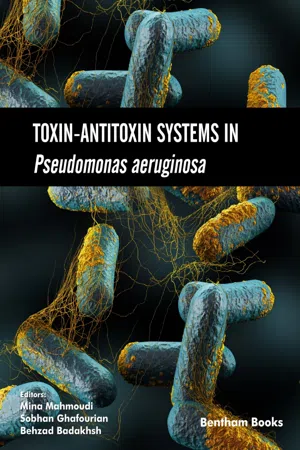
Pseudomonas aeruginosa is known as a persistent bacterial pathogen. Antibiotics are currently the most common bacterial treatment for related infections but cases of microbial resistance are on the rise. Toxin-Antitoxin Systems in Pseudomonas aeruginosa describes one of the most important antimicrobial targets in the bacterium species. The contributors have compiled comprehensive information on the subject. The reference initially acquaints the reader with key topics about P. aeruginosa infection including virulence factors, pathogenicity, epidemiology, laboratory diagnosis and antibiotic resistance. This is followed by detailed chapters on toxin-antitoxin systems which explain their role in the bacterial pathogenesis with reference to P. aeruginosa. The comprehensive information on the subject makes this an ideal reference for newcomers to the field of bacteriology and target discovery. Students of medical microbiology and medical professionals who are interested in the finer details of P. aeruginosa pathogenicity will also be equipped with sufficient information to join the discussion on this topic with fellow researchers.
eBook - ePub
Toxin-Antitoxin Systems in Pseudomonas aeruginosa
- English
- ePUB (mobile friendly)
- Available on iOS & Android
eBook - ePub
Toxin-Antitoxin Systems in Pseudomonas aeruginosa
About this book
Trusted by 375,005 students
Access to over 1.5 million titles for a fair monthly price.
Study more efficiently using our study tools.
Information
Topic
MedicineVirulence Factors of P. aeruginosa and Their Role in Pathogenicity
M. Mahmoudi1, S. Ghafourian1, *, A. Maleki2, B. Badakhsh3
1 Department of Microbiology, Faculty of Medicine, Ilam University of Medical Sciences, Ilam, Iran
2 Clinical Microbiology Research Center, Ilam University of Medical Sciences, Ilam, Iran
3 Department of Gastroenterology, Faculty of Medicine, Ilam University of Medical Sciences, Ilam, Iran
Abstract
P. aeruginosa can cause a variety of infections in different hosts. For this purpose, it regulates several virulence factors depending on the surrounding conditions and environments. As a result, the type and severity of diseases vary from host to host. For instance, it causes acute infection in some patients, while it causes chronic infections in others. On the other hand, it can sometimes be very deadly and sometimes easy to treat. The difference in the behavior of P. aeruginosa is directly related to the expression of key virulence factors. In this chapter, major virulence factors and their roles in pathogenicity that are related to human diseases are comprehensively discussed. These virulence factors including, lipopolysaccharide, adhesions, lectins, alginate, flagella, pigments, biofilm, toxins, enzymes, proteases, etc. It should be noted that recognition and familiarity with virulence factors can be very helpful and effective to understand P. aeruginosa pathogenesis. Therefore, we discussed the structure as well as the manner of virulence factors intervention in P. aeruginosa infections. We hope to create a general idea of P. aeruginosa structure in the minds of the readers at the end of this chapter.
Keywords: Pathogenicity, Structure, Virulence factor.
* Corresponding author S. Ghafourian: Department of Microbiology, Faculty of Medicine, Ilam University of Medical Sciences, Iran; E-mail:[email protected]
As was mentioned earlier, P. aeruginosa is associated with a variety of acute and chronic infections that can happen in immunocompromised and the other patients. Some studies demonstrated that P. aeruginosa is responsible for several fatal diseases, which can occur even in patients with a normal immune system. Accordingly, the ability of P. aeruginosa to create a wide spectrum of diseases must be associated with many virulence factors [1]. However, not all of the virulence factors are available in all isolates. Obviously, the up-regulation and
down-regulation of the virulence factors create different types of isolates. For more clarity , the chronic infection isolates are different in terms of phenotypic features by acute infection isolates [2]. Actually, the acute infection isolates express a lot of virulence factors compare with chronic infection isolates. For instance, during the lung chronic infection in cystic fibrosis (CF) patients, some of the most important virulence factors, which are involved in inflammation, are down-regulated or the lack of them has severely occurred. In detail, during the early (acute) lung infection in CF patients, the majority of toxins and enzymes are secreted [3]. The Lipopolysaccharides (LPS) that are one of the causes of fever in the acute infection are in complete mode. The wild type LPS contains an O-antigen chain, so-called smooth LPS(sLPS) can stimulate the immune system strongly. In addition, the flagella, type IV pili expressed nicely, and a low level of alginate are available in acute lung infection in CF patients.
In contrast, the secretion of virulence factors is decreased in a chronic infection that happens due to the adaption of P. aeruginosa with the lung environments. More precisely, the LPS structure does not contain the O-antigen chain and terms as rough LPS(rLPS). Actually, this is a defective form of LPS. In addition, the lipid A will be deacylated. Despite the auxotrophy can be seen in this mode, some other components such as alginate, suffer with the increasing of their overexpression level. P. aeruginosa isolates that are attended to chronic infection are more readily to form biofilm or construct mucoid mass [4].
Generally, the effect of P. aeruginosa virulence factors can facilitate adhesion and then disrupt the host cell signaling [5]. Hence, they have such putative virulence factors that in some cases cause their host to die.
Therefore, different conditions and environments are involved in the regulation of P.aeruginosa virulence factor genes. In the following, we describe the virulence factors of P. aeruginosa briefly for further illustrating the structure and potential of its pathogenicity.
1. Lipopolysaccharide (LPS)
Perhaps, the LPS could be considered as the most prominent component of the outer membrane or the key virulence factor of P. aeruginosa [6]. The LPS is the common outer leaflet of Gram-negative outer membrane bacteria [4]. The most significant issue about the LPS is its role in the pathogenesis of the bacteria. Therefore, this is physical barrier, which can protect the bacteria from host defense [6]. It is referred as endotoxin and interacts with the host cells as well as antibiotic molecules. The LPS can trigger cell signaling that can lead to cell disruption and bacteremia [7].
Generally, the LPS molecule has three domains that consist of lipid A, core and O-antigen. The lipid A is a hydrophobic domain and it is responsible for the endotoxicity feature of the LPS. Also, the core is a non-repeating oligosaccharide and the O-antigen is the distal polysaccharide [8].
In P. aeruginosa, lipid A is the basic domain, which has a disaccharide backbone containing N- and O-acylated diglucosamine bisphosphate backbone [4-P-β-D- GlcpNII-(1→6)-α-D-GlcpNI-(1→P] that attached to many fatty acid molecules, which leads to the anchor of LPS to the inner membrane. In some cases, the chemical alternation can be happening in the number of primary acyl groups and type of fatty acids. Hence, they will be replaced with primary and secondary acyl groups. The variation in the amount of accessible magnesium is one of the effective reasons for the pattern of acylation in lipid A molecule [6].
In all wild type isolates of P. aeruginosa, lipid A is attached to approximately ten branched oligosaccharides, which named core domain. In addition, the preponderance of fatty acids in lipid A structure is directly associated with the potency of the pathogenicity.
The second domain of LPS is a core that is located next to and after lipid A.
In Gram-negative bacteria, the core domain is divided into two parts including outer core and inner core. The inner core consists of heptose phosphate, ethanolamine heptose phosphate and 2-keto-3-deoxy-octonate (KDO) that is attached to lipidA (α2→6) by the acid susceptible ketosidic bond. The phosphate and KDO have a negative charge and bind to the divalent metal cations. Then, they cause outer membrane stabilization and an obstacle to hydrophobic molecules. The permeability of the cell membrane depends on these cations. For instance, the Ethylenediaminetetraacetic acid (EDTA) as a chelating agent of cations as well as polycationic antibiotics such as polymyxin and aminoglycosides are l...
Table of contents
- Welcome
- Table of Content
- Title
- BENTHAM SCIENCE PUBLISHERS LTD.
- FOREWORD
- PREFACE
- ACKNOWLEDGEMENTS
- List of Contributors
- An Overview of Pseudomonas aeruginosa
- History and Etymology
- Virulence Factors of P. aeruginosa and Their Role in Pathogenicity
- Epidemiology
- Pathogenicity
- Laboratory Diagnosis
- Antibiotic Resistance and Treatment
- Toxin-Antitoxin Systems
- Acquaintance with the Known Toxin-Antitoxin Systems in P. aeruginosa
Frequently asked questions
Yes, you can cancel anytime from the Subscription tab in your account settings on the Perlego website. Your subscription will stay active until the end of your current billing period. Learn how to cancel your subscription
No, books cannot be downloaded as external files, such as PDFs, for use outside of Perlego. However, you can download books within the Perlego app for offline reading on mobile or tablet. Learn how to download books offline
Perlego offers two plans: Essential and Complete
- Essential is ideal for learners and professionals who enjoy exploring a wide range of subjects. Access the Essential Library with 800,000+ trusted titles and best-sellers across business, personal growth, and the humanities. Includes unlimited reading time and Standard Read Aloud voice.
- Complete: Perfect for advanced learners and researchers needing full, unrestricted access. Unlock 1.5M+ books across hundreds of subjects, including academic and specialized titles. The Complete Plan also includes advanced features like Premium Read Aloud and Research Assistant.
We are an online textbook subscription service, where you can get access to an entire online library for less than the price of a single book per month. With over 1.5 million books across 990+ topics, we’ve got you covered! Learn about our mission
Look out for the read-aloud symbol on your next book to see if you can listen to it. The read-aloud tool reads text aloud for you, highlighting the text as it is being read. You can pause it, speed it up and slow it down. Learn more about Read Aloud
Yes! You can use the Perlego app on both iOS and Android devices to read anytime, anywhere — even offline. Perfect for commutes or when you’re on the go.
Please note we cannot support devices running on iOS 13 and Android 7 or earlier. Learn more about using the app
Please note we cannot support devices running on iOS 13 and Android 7 or earlier. Learn more about using the app
Yes, you can access Toxin-Antitoxin Systems in Pseudomonas aeruginosa by Mina Mahmoudi,Sobhan Ghafourian,Behzad Badakhsh, Mina Mahmoudi, Sobhan Ghafourian, Behzad Badakhsh in PDF and/or ePUB format, as well as other popular books in Medicine & Medical Microbiology & Parasitology. We have over 1.5 million books available in our catalogue for you to explore.