The advent of Industry 4.0 has opened a data-rich avenue of predicting and controlling premature degradation of industrial materials. For any industrial construction or manufacturing projects, performing analysis on the structural integrity of materials is crucial for their sustainability.
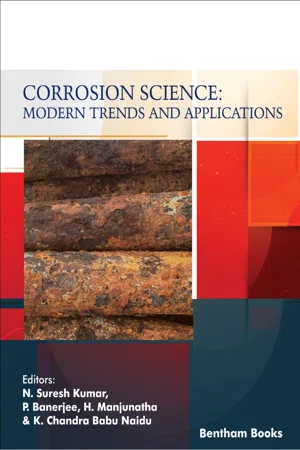
Corrosion Science: Modern Trends and Applications gives scholars a snapshot of recent contributions and development in the field of material corrosion.The book presents 12 chapters that cover topics such as corrosion testing methods, anti-corrosive coating mechanisms, corrosion in different types of products (electronics, polymers), industrial systems (power plants, concrete constructions and hydraulic systems) and corrosion as a result of environmental characteristics (such as marine surroundings). The breadth of topics covered coupled with the reader-friendly presentation of the book make it highly beneficial for students, research scholars, faculty members and R&D specialists working in the area of corrosion science, material science, solid-state science, chemical engineering, and nanotechnology. Readers will be equipped with the knowledge to understand and plan industrial processes that involve measuring the reliability and integrity of material structures which are impacted by corrosive factors.
eBook - ePub
Corrosion Science: Modern Trends and Applications
- English
- ePUB (mobile friendly)
- Available on iOS & Android
eBook - ePub
Corrosion Science: Modern Trends and Applications
About this book
Information
Marine Corrosion
H. Manjunatha1, *, K. Venkata Ratnam1, S. Janardan1, R. Venkata Nadh1, N. Suresh Kumar2, N.V. Krishna Prasad3, S. Ramesh3, K. Chandra Babu Naidu3, T. Anil Babu3
1 Department of Chemistry, GITAM Deemed to be University, Bangalore - 562163, Karnataka, India
2 Department of Physics, JNTU College of Engineering Anantapur, Anantapuramu-515002, A.P., India
3 Department of Physics, GITAM Deemed to be University, Bangalore-562163, Karnataka, India
Abstract
Seawater is a hostile environment not only for people but also for metals and alloys. It is often considered that sea water is the most severe environment to which materials can be exposed. Warmer water accelerates the rate of corrosion due to high temperature and particularly aggressive. In this chapter, marine corrosion, its mechanism, factors affecting corrosion and several methods adopted for the prevention of corrosion are described with an emphasis on marine corrosion inhibitors. Organic compounds containing hetero atoms like O, N, S, etc., along with double and triple bonds are found to be very effective in preventing marine corrosion of alloys and metals. Most of the corrosion inhibitors are found to show inhibition property by getting adsorbed on to the metal surface through the principle of different adsorption isotherms known. The maximum corrosion inhibition efficiency of organic inhibitors is found to be more than 99%. The use of inorganic compounds and paints as corrosion inhibitors is discussed.
Keywords: Corrosion Inhibitors, Factors Affecting Corrosion, Marine Corrosion, Mechanism of Corrosion, Stainless Steel & Alloys.
* Corresponding author H. Manjunatha: Department of Chemistry, GITAM Deemed to be University, Bangalore-562163, Karnataka, India; Tel: +91- 88611 58964; E-mail: [email protected]
1. INTRODUCTION
Corrosion is a 'billion-dollar thief'. Even though it is a natural phenomenon, it results in loss of material, money and life. Metals have a strong crystalline structure, and due to corrosion, they get converted into their salts, making them losing their metallic strength resulting in damage to machinery, structures or equipment in which they are used. Thus, corrosion causes damage to metals and
thereby to society. Corrosion is considered as a most damaging and provocative menace in many countries including India causing approximately a loss of one to five percent in Gross National Product (GNP) of each country as per estimations of NACE (National Association of Corrosion Engineers) [1]. A recent investigation by NACE estimated annual global cost of corrosion to be approximately US $2.5 trillion, which is almost equal to 3.4% of the global GDP [2, 3]. In the US, the total cost of corrosion is more than the US $1.1 trillion [4] annually. The annual corrosion cost of India is more than US $100-billion and that of South Africa; the direct corrosion cost is estimated to be around the US $9.6 billion [2, 3] which may be increased with technology development and usage of metallic substances. This loss of money all over the globe due to corrosion can be reduced up to 35% by applying proper prevention methods. Corrosion also results in loss apart from large economic damage.
For example, an explosion due to corrosion of metallic structure killed over 200 people in Guadalajara, Mexico, in April 1992 [5]. In addition, these fatalities, the series of blasts damaged 1,600 buildings and 1,500 people injured and the total loss due to both direct and indirect effects of corrosion is estimated to be 75 million US dollars [6]. The cost of corrosion is more than the total annual cost of floods, hurricanes, fires, lightning, earthquake and other natural calamities that occur all over the globe annually. Hence, attention is to be given by corrosion, and similarly, the substantial measures may be taken in reducing economic loss and loss of life.
2. WHY DO METALS UNDERGO CORROSION AND WHAT IS THE DRIVING FORCE?
As per Roberge, “A material destructive attack on reacting with the environment is Corrosion” [7]. In general, it is a known fact that most of the metals are unstable in their free state. Extraction of metals from their combined states (a process called Metallurgy) involves the addition of a large amount of heat energy. The metals (Free State) extracted from their ores will be at higher energy state and have a tendency to go into their combined form generally the corrosion products like rust and scale [8, 9]. Thus, they have a natural tendency to revert back to their combined form when exposed to attacking the environment. Thermodynamically, the standard free energy change (ΔG0) decides the relative rate of corrosion of metals, and in general, higher the ΔG0 value, greater will be the corroding tendency and vice versa [10, 11].

In this chapter, we restrict ourselves to marine corrosion, its mechanism, causes, factors affecting marine corrosion and the latest developments in the various ways of preventing it.
3. Marine Corrosion and Its Mechanism
Seawater is an aggressive environment for people, metals and alloys. It is considered often that seawater is the most severe environment to which materials can be exposed. Hot waters speed up the corrosion rate due to high temperature and particularly aggressive. This was the major problem towards the end of the Second World War, which led to Pacific campaigns when military equipment got corroded at an unexpected rate in the tropics [12]. Also, corrosion may be severe in colder waters. Various types of destruction can occur to ships, structures and other equipment used in seawater...
Table of contents
- Welcome
- Table of Content
- Title
- BENTHAM SCIENCE PUBLISHERS LTD.
- PREFACE
- List of Contributors
- Testing the Types of Corrosion
- Anti-Corrosion Coating Mechanisms
- Corrosion in Electronics
- Corrosion of Polymer Materials
- Corrosion and Corrosion Protection in Drinking Water Systems
- Corrosion in Reinforcement Cement Concrete
- Environmental Cracking of High-Strength Aluminum Alloys
- Corrosion of Nuclear Waste Systems
- Microbiologically Influenced Corrosion
- Power Plant Corrosion
- Corrosion in Chemical and Fertilizer Industries
- Marine Corrosion
Trusted by 375,005 students
Access to over 1.5 million titles for a fair monthly price.
Study more efficiently using our study tools.
Frequently asked questions
Yes, you can cancel anytime from the Subscription tab in your account settings on the Perlego website. Your subscription will stay active until the end of your current billing period. Learn how to cancel your subscription
No, books cannot be downloaded as external files, such as PDFs, for use outside of Perlego. However, you can download books within the Perlego app for offline reading on mobile or tablet. Learn how to download books offline
Perlego offers two plans: Essential and Complete
- Essential is ideal for learners and professionals who enjoy exploring a wide range of subjects. Access the Essential Library with 800,000+ trusted titles and best-sellers across business, personal growth, and the humanities. Includes unlimited reading time and Standard Read Aloud voice.
- Complete: Perfect for advanced learners and researchers needing full, unrestricted access. Unlock 1.5M+ books across hundreds of subjects, including academic and specialized titles. The Complete Plan also includes advanced features like Premium Read Aloud and Research Assistant.
We are an online textbook subscription service, where you can get access to an entire online library for less than the price of a single book per month. With over 1.5 million books across 990+ topics, we’ve got you covered! Learn about our mission
Look out for the read-aloud symbol on your next book to see if you can listen to it. The read-aloud tool reads text aloud for you, highlighting the text as it is being read. You can pause it, speed it up and slow it down. Learn more about Read Aloud
Yes! You can use the Perlego app on both iOS and Android devices to read anytime, anywhere — even offline. Perfect for commutes or when you’re on the go.
Please note we cannot support devices running on iOS 13 and Android 7 or earlier. Learn more about using the app
Please note we cannot support devices running on iOS 13 and Android 7 or earlier. Learn more about using the app
Yes, you can access Corrosion Science: Modern Trends and Applications by N. Suresh Kumar,P. Banerjee,H. Manjunatha, N. Suresh Kumar, P. Banerjee, H. Manjunatha in PDF and/or ePUB format, as well as other popular books in Physical Sciences & Physics. We have over 1.5 million books available in our catalogue for you to explore.