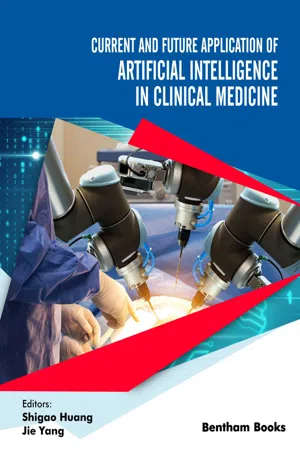
Current and Future Application of Artificial Intelligence in ClinicalMedicine presents updateson the application of machine learning and deep learning techniques in medicalprocedures.. Chapters in the volume have been written by outstandingcontributors from cancer and computer science institutes with the goal of providing updated knowledge to the reader. Topics covered in the bookinclude 1) Artificial Intelligence (AI) applications in cancer diagnosis and therapy, 2) Updates in AI applications in the medical industry, 3) the use of AI in studyingthe COVID-19 pandemic in China, 4) AI applications in clinical oncology(including AI-based mining for pulmonary nodules and the use of AI inunderstanding specific carcinomas), 5) AI inmedical imaging. Each chapter presents information on related sub topics in areader friendly format. The combination of expert knowledge and multidisciplinary approaches highlightedin the book make it a valuable source of information for physicians andclinical researchers active in the field of cancer diagnosis and treatment(oncologists, oncologic surgeons, radiation oncologists, nuclear medicinephysicians, and radiologists) and computer science scholars seeking tounderstand medical applications of artificial intelligence.
eBook - ePub
Current and Future Application of Artificial Intelligence in Clinical Medicine
- English
- ePUB (mobile friendly)
- Available on iOS & Android
eBook - ePub
Current and Future Application of Artificial Intelligence in Clinical Medicine
About this book
Information
Topic
MedicinaSubtopic
Medicina clínicaCurrent Medical Imaging and Artificial Intelligence and its Future
Shigao Huang1, Jie Yang2, 3, Lijian Tan3, Simon Fong2, 4, Qi Zhao1
1 Institute of Translational Medicine, Faculty of Health Sciences, University of Macau 999078, Macau SAR, China
2 Department of Computer and Information Science, University of Macau, Macau, China
3 Chongqing Industry & Trade Polytechnic, Chongqing, China
4 Zhuhai Institutes of Advanced Technology of the Chinese Academy of Sciences, China
Abstract
“Artificial intelligence and medical image” is an auxiliary tool for the computer to complete image classification, target detection, image segmentation, and retrieval and assist doctors in diagnosing and treatment based on medical image through deep learning. This chapter includes the review of Artificial intelligence (AI) and its application in radiology, pathology, eye disease, deontology, dermatology, and ophthalmology, which we have benefited from the use of AI methods. Modern medicine is evidence-based medicine based on experiments. Doctors' diagnosis and treatment conclusions must be based on corresponding diagnostic data. Imaging is an important part of diagnosing, and 80% to 90% of data in the medical industry are derived from medical imaging. Therefore, clinicians have a strong demand for images, and they need to conduct a variety of quantitative analyses of medical images and comparison of historical images to complete a diagnosis. In contrast to this qualitative reasoning, AI is good at identifying complex patterns in the data and providing quantitative assessments in an automated manner. Integrating AI into clinical workflows as a tool to assist physicians allows for more accurate and repeatable radiological assessments.
Keywords: Artificial intelligence, Deontology, Eye disease, Medical imaging, Radiological assessments.
* Corresponding author Shigao Huang: Institute of Translational Medicine, Faculty of Health Sciences, University of Macau 999078, Macau SAR, China; Tel: 853 88222953, Fax: 853 88222953; E-mail: [email protected]
1. INTRODUCTION
Medical fields that rely on imaging data include radiology, pathology, dermatology, and ophthalmology [1], which have been benefited from the use of
AI methods. In radiology, for example, experienced physicians evaluate medical images visually to detect, characterize, and monitor the disease [2]. This assessment is usually based on personal experience and is subjective. In contrast to this qualitative reasoning, AI is good at identifying complex patterns in the data and providing quantitative assessments in an automated manner [3]. Fig. (1) shows AI to screen the medical imaging quickly to find the lesions in the mammography radiation photograph, which is a combination of technology with AI and GSM. Integrating AI into clinical workflows as a tool to assist physicians allows for more accurate and repeatable radiological assessments.
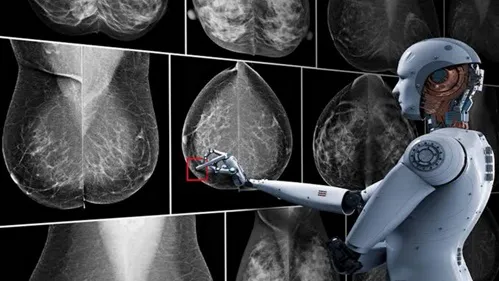
National Cancer Institute sends AI to make smarter mammography. AI mammogram” is a combination of technology with AI and GSM. The purpose of the National Cancer Institute is to extend breast cancer prevention, help to speed up the service, reduce the workload of the staff, which can also help in reducing the costs and increasing the opportunities for Thais to access the service. (Source:https://newsbeezer.com/thailandeng/national-cancer-institute-sends-ai-to-make-smarter-mammography/).
At present, two kinds of AI methods are widely used in medical images. The first is artificial feature engineering, in which features are defined by mathematical equations, such as tumor textures, and can be quantified by a computer program. These artificial features serve as inputs to machine learning models trained to classify patients using clinical decision-making [4]. Although these characteristics are different, they rely on expert definitions and are therefore not necessarily the best quantification of the characteristics currently being used to identify tasks. Besides, predefined features are generally not applicable to imaging model changes, such as computed tomography (CT), positron emission tomography (PET) [5], and magnetic resonance imaging (MRI), and their associated signal-to- noise ratio characteristics. The second approach, a deep learning algorithm, automatically learns feature representations from the data without intervention by human experts. This data-driven approach allows for more abstract feature definitions, making them more informative and generalizable. Therefore, deep learning can automatically quantify the phenotypic characteristics of human tissues and can make substantial progress in diagnosis and clinical care [6].
Another benefit of deep learning is that it reduces the need for artificial preprocessing. Like a trained radiologist, deep learning can identify image parameters and weigh their importance against other factors to make clinical decisions [7].
2. PROCESS OF AI IN MEDICAL IMAGING
At present, more than 90% of medical data is obtained from medical imaging, and medical imaging data has become one of the essential “pieces of evidence” for doctors in diagnosis. AI can be used to help doctors make an accurate diagnosis. In that case, it is the current direction of efforts of many imaging AI explorers, which is of great help to widely improve the accuracy of disease diagnosis and treatment [8]. The following are four steps to achieve AI application in medical imaging.
2.1. Develop Standardized Use Cases
According to a study, the cases of AI used in medical imaging lack the standard inputs and outputs as compared to the algorithms already in use. As the algorithm may need to run on a local server or cloud service, a standard method needs to be developed to accept the input and output processed by the algorithm. Moreover, without the standardized inputs and outputs for AI cases, training and testing to develop standard data sets become more challenging, thus resulting in the output algorithm showing different results for the same case [9].
Ideally, AI cases need to be developed in the same format that can translate human narrative description...
Table of contents
- Welcome
- Table of Content
- Title
- BENTHAM SCIENCE PUBLISHERS LTD.
- PREFACE
- ACKNOWLEDGEMENT
- List of Contributors
- Artificial Intelligence (AI) in Cancer Diagnosis and Prognosis
- Alternative or Auxiliary: Artificial Intelligence Accelerates the Development and Transformation of the Medical Care
- Rethinking Artificial Intelligence in China’s COVID-19 Pandemic
- Artificial Intelligence System and its Application in Clinical Oncology
- Current Medical Imaging and Artificial Intelligence and its Future
- Artificial Intelligence Played an Active Role in the COVID-19 Epidemic in China
- Current Status and Future Outlook of Deep Learning Techniques For Nodule Detection
- Artificial Intelligence-Based Mining of Benign and Malignant Characteristics of Pulmonary Ground-Glass Nodules
- Development of Artificial Intelligence in Imaging and Pathology
Trusted by 375,005 students
Access to over 1.5 million titles for a fair monthly price.
Study more efficiently using our study tools.
Frequently asked questions
Yes, you can cancel anytime from the Subscription tab in your account settings on the Perlego website. Your subscription will stay active until the end of your current billing period. Learn how to cancel your subscription
No, books cannot be downloaded as external files, such as PDFs, for use outside of Perlego. However, you can download books within the Perlego app for offline reading on mobile or tablet. Learn how to download books offline
Perlego offers two plans: Essential and Complete
- Essential is ideal for learners and professionals who enjoy exploring a wide range of subjects. Access the Essential Library with 800,000+ trusted titles and best-sellers across business, personal growth, and the humanities. Includes unlimited reading time and Standard Read Aloud voice.
- Complete: Perfect for advanced learners and researchers needing full, unrestricted access. Unlock 1.5M+ books across hundreds of subjects, including academic and specialized titles. The Complete Plan also includes advanced features like Premium Read Aloud and Research Assistant.
We are an online textbook subscription service, where you can get access to an entire online library for less than the price of a single book per month. With over 1.5 million books across 990+ topics, we’ve got you covered! Learn about our mission
Look out for the read-aloud symbol on your next book to see if you can listen to it. The read-aloud tool reads text aloud for you, highlighting the text as it is being read. You can pause it, speed it up and slow it down. Learn more about Read Aloud
Yes! You can use the Perlego app on both iOS and Android devices to read anytime, anywhere — even offline. Perfect for commutes or when you’re on the go.
Please note we cannot support devices running on iOS 13 and Android 7 or earlier. Learn more about using the app
Please note we cannot support devices running on iOS 13 and Android 7 or earlier. Learn more about using the app
Yes, you can access Current and Future Application of Artificial Intelligence in Clinical Medicine by Shigao Huang,Jie Yang, Shigao Huang, Jie Yang in PDF and/or ePUB format, as well as other popular books in Medicina & Medicina clínica. We have over 1.5 million books available in our catalogue for you to explore.