Christianity Today 2023 Book Award (Academic Theology)
In both biblical studies and systematic theology, modern treatments of the person of Christ have cast doubt on whether earlier Christian descriptions of God--in which God is immutable, impassible, eternal, and simple--can fit together with the revelation of God in Christ. This book explains how the Jesus revealed in Scripture comports with such descriptions of God. The author argues that the Bible's Christology coheres with and even requires the affirmation of divine attributes like immutability, impassibility, eternity, and simplicity.
eBook - ePub
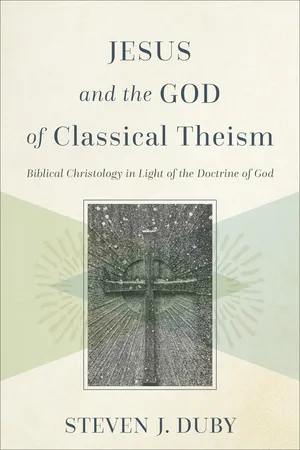
Jesus and the God of Classical Theism
Biblical Christology in Light of the Doctrine of God
- 480 pages
- English
- ePUB (mobile friendly)
- Available on iOS & Android
eBook - ePub
Jesus and the God of Classical Theism
Biblical Christology in Light of the Doctrine of God
About this book
Information
Topic
Theology & ReligionSubtopic
Systematic Theology & Ethics▶ One ◀
Biblical Christology and “Classical Theism”
I. Introduction
The goal in this first chapter is to exhibit how treatments of the Bible’s Christology have called into question older Christian accounts of God and then to begin to sketch a response to such criticisms, though ultimately the response will be developed throughout the subsequent constructive chapters of the book. First, we will consider how various interpreters of Scripture have drawn from christological and trinitarian considerations to express doubts about divine attributes like simplicity, immutability, impassibility, and eternity. Then we will consider how some have argued that traditional concepts and categories themselves (“essence,” “nature,” “substance,” and so on) create problems for understanding the Bible’s portrayal of the person and work of Christ. Along the way, I will draw attention to three common themes already flagged in the introduction of the book: (1) the concern for adequate description of Christ’s relationship to the Father and Spirit, (2) the concern to uphold the unity of the person of Christ, and (3) the concern to affirm the genuineness of Christ’s human life and suffering. After examining these criticisms, we will consider why older theologians (whose primary aim was in fact to interpret Scripture) have thought it fitting to call God simple, immutable, impassible, and eternal in the first place. Then I will respond to worries about traditional metaphysical concepts and categories, rethinking how the conceptual resources of a broadly Aristotelian ontology might be deployed to explicate rather than subvert the Bible’s christological teaching. This will require us to move beyond misunderstandings and caricatures of such concepts while still carefully delimiting their role in exegesis.
II. Christological Challenges to “Classical Theism”
Theologians, historians, and biblical scholars of various traditions have objected to accounts of God that include divine attributes like simplicity, immutability, impassibility, and eternity (often taken to mean “timelessness”). Here key objections raised on christological and trinitarian grounds must be taken into consideration. While an inductive presentation of these objections, proceeding chronologically from one major author to the next, would provide a sense of the historical development of the material, I have thought it more expedient to orient the reader to the material by way of a topical presentation of it. What follows is thus a canvassing of relevant objections organized under the three aforementioned concerns about the relationship of Christ to the Father and Spirit, the unity of the person of Christ, and the genuineness of Christ’s human life and suffering.
First, some writers have argued that Christ’s relationship to the Father and Spirit conflicts with the doctrine of divine simplicity. The doctrine of divine simplicity is often unfamiliar to contemporary Christians and will be explained in more detail below, but for now it is sufficient to note at a general level that it involves a denial of God having any “parts” and an affirmation that there is just one divine intellect and will shared by the three divine persons (rather than three sets of faculties that might be included in what distinguishes one divine person from another). This rejection of multiple intellects and wills in God, taken together with an older habit of calling the divine persons “modes of subsisting” or “subsisting relations,” has become a cause of concern. According to some, such a teaching cannot comport with the Bible’s portrayal of Christ’s distinction from and interaction with the Father and Spirit. Jürgen Moltmann, for example, contends that if the persons are called “modes of being,” they are “degraded”: the “subjectivity of acting and receiving is transferred from the divine Persons to the one divine subject,” reviving the error of Sabellianism. Moltmann affirms that the divine persons exist only in relation to one another, but he emphasizes that they are three divine “subjects” in fellowship together.1 Colin Gunton argues that divine simplicity or an “Augustinian” representation of God’s unity undermines adequate distinction of the divine persons and their mutual “relatedness” that “constitutes” God’s being.2 While Gunton denies that a divine person is an “individual centre of consciousness” with a discrete will, he still insists that the “persons are not relations, but concrete particulars in relation to one another.”3
There are similar concerns among philosophical theologians. Thomas Morris, for example, explores the notion of communion within the Trinity and reasons that calling the persons mere “modes of subsisting” would preclude genuine interpersonal communion.4 William Lane Craig stresses that “on no reasonable understanding of person can a person be equated with a relation.” He asserts that “God is a soul which is endowed with three complete sets of rational faculties, each sufficient for personhood.” On this view, “God, though one soul, would not be one person but three, for God would have three centers of self-consciousness, intentionality and volition.”5 William Hasker also comments that it is “exceedingly difficult to understand what a divine ‘mode of being/subsistence’ can be, given that it is not a person as we now understand that notion.” He contends that this view leads to exegetical and logical problems. It implies that “the Gospels portray for us a single person praying to himself, talking to himself, answering himself, and crying out to himself in protest for having forsaken himself.” By contrast, Hasker proposes that a divine person is a “distinct center of knowledge, will, love, and action.”6
In addition, some authors suggest that the related teaching of the “inseparable operations” of the persons—the Father, Son, and Spirit always exercise the one divine will and power together in God’s outward works—conflicts with the Bible’s description of God’s economic activity. Gunton, though affirming the axiom that the outward works of the Trinity are undivided (opera Trinitatis ad extra indivisa sunt), suggests that construing the persons as relations in an Augustinian manner will lead to neglect of the persons’ distinct “forms of action” in the economy.7 This concern, taken in conjunction with Gunton’s emphasis on the Holy Spirit’s distinct work of empowering the Son in his incarnate ministry,8 raises the question of whether the doctrines of divine simplicity and inseparable operations will yield a Christology that obscures the Son’s personal interaction with the Father and his dependence on the Spirit in the Gospels. Indeed, in view of such concerns, influential evangelical theologian Wayne Grudem has recently advocated abandoning the doctrine of inseparable operations altogether.9
Second, various authors maintain that the unity of the person of Christ in the Scriptures conflicts with certain logical implications of traditional descriptions of God. The nineteenth-century kenoticist Gottfried Thomasius argues that if the Son remains immutable in the incarnation, “if he persists in his trans-worldly position, in the unlimitedness of his world-ruling and world-embracing governance, then the mutual relation of [his divine mode of being and action and his finite human nature]. . . . remains afflicted by a certain duplication.”10 That is,
the divine then, so to speak, surpasses the human as a broader circle does a smaller one; in its knowledge, life and action the divine extends infinitely far over and above the human, as the extra-historical over the temporal, as that which is perfect in itself over that which becomes. . . . The consciousness that the Son has of himself and of his universal governance does not come together as one with the consciousness of the historical Christ—it hovers, as it were, above him; the universal activity which the Son continuously exercises does not coincide with his divine-human action in the state of humiliation. . . . Thus the Logos still is or has something which is not merged into his historical appearance, which is not also the man Jesus—and all this seems to destroy the unity of the person, the identity of the ego; thus there occurs no living and complete penetration of both sides, no proper being-man of God.11
Albrecht Ritschl faults medieval theologians of the Western church in particular for keeping the immutable divine nature at a distance from the person of Christ in his historical work. If the divinity of Christ remains unaffected by the incarnation, then it appears “as if Godhead did not belong to him at all.”12 In their own ways, Thomasius and Ritschl are raising the question of whether within the logic of “classical theism” there must be a divinity above or behind Christ that is never truly united with his humanity. Eberhard Jüngel’s emphasis on the death of God in Christ also brings up this question. Jüngel holds that a traditional doctrine of God would undermine God’s “identification” with the man Jesus. He asks, “How can the divine essence be thought of together with the event of death without destroying the concept of God?” Though conscious of the great “cloud of witnesses” from patristic, medieval, and early Protestant contexts who would disagree, Jüngel reasons that God’s “unity with perishability” in Christ compels us to abandon an understanding of God in which he is complete in himself and unaffected by the world.13 Recent discussions in philosophical theology have touched upon a similar point in relation to the concept of divine “timelessness.” Thomas Senor, for example, has drawn attention to an apparent incompatibility between an entirely “timeless” deity and the temporal existence of Christ. Senor writes that if God the Son is “atemporal,” then he is a person “with a human body whose actions (both the acts and their consequences) are temporally ordered but who is nevertheless timeless.” According to Senor, “this account of the Incarnation is incoherent.”14
Building on the work of Karl Barth, Bruce McCormack has taken a different approach in which he seeks to preserve God’s immutability without compromising the unity of the person of Christ. However, in aiming to uphold God’s immutability and the unity of the person of Christ, McCormack does argue that the doctrine of divine impassibility must be rejected. He posits that God constitutes his own essence by his eternal decision for the incarnation and thus includes in his own essence, in an anticipatory manner, the suffering of the Son. The impetus for this move, at least in my understanding of i...
Table of contents
- iHalf Title Page
- iiiTitle Page
- ivCopyright Page
- vDedication
- viiContents
- xiAcknowledgments
- xiiIntroduction
- xviiAbbreviations
- 1▶ One ◀ Biblical Christology and “Classical Theism”
- 51▶ Two ◀ “The Word Was with God”: The Son’s Eternal Relation to the Father
- 97▶ Three ◀ “Foreknown before the Foundation of the World”: The Son’s Election and Mission
- 141▶ Four ◀ “And the Word Became Flesh”: The Son’s Relationship to His Human Nature
- 193▶ Five ◀ “The Spirit of the LORD Is upon Me”: The Son’s Dependence on the Holy Spirit
- 243▶ Six ◀ “I Have Come to Do Your Will, O God”: The Son’s Obedience
- 315 ▶ Seven ◀ “A Man of Sorrows”: The Son’s Suffering
- 375Conclusion
- 378Bibliography
- 417Index of Authors
- 424Index of Subjects
- 430Index of Selected Greek Terms
- 431Index of Scripture and Other Primary Sources
- 445Cover Flaps
- 446Back Cover
Trusted by 375,005 students
Access to over 1.5 million titles for a fair monthly price.
Study more efficiently using our study tools.
Frequently asked questions
Yes, you can cancel anytime from the Subscription tab in your account settings on the Perlego website. Your subscription will stay active until the end of your current billing period. Learn how to cancel your subscription
No, books cannot be downloaded as external files, such as PDFs, for use outside of Perlego. However, you can download books within the Perlego app for offline reading on mobile or tablet. Learn how to download books offline
Perlego offers two plans: Essential and Complete
- Essential is ideal for learners and professionals who enjoy exploring a wide range of subjects. Access the Essential Library with 800,000+ trusted titles and best-sellers across business, personal growth, and the humanities. Includes unlimited reading time and Standard Read Aloud voice.
- Complete: Perfect for advanced learners and researchers needing full, unrestricted access. Unlock 1.5M+ books across hundreds of subjects, including academic and specialized titles. The Complete Plan also includes advanced features like Premium Read Aloud and Research Assistant.
We are an online textbook subscription service, where you can get access to an entire online library for less than the price of a single book per month. With over 1.5 million books across 990+ topics, we’ve got you covered! Learn about our mission
Look out for the read-aloud symbol on your next book to see if you can listen to it. The read-aloud tool reads text aloud for you, highlighting the text as it is being read. You can pause it, speed it up and slow it down. Learn more about Read Aloud
Yes! You can use the Perlego app on both iOS and Android devices to read anytime, anywhere — even offline. Perfect for commutes or when you’re on the go.
Please note we cannot support devices running on iOS 13 and Android 7 or earlier. Learn more about using the app
Please note we cannot support devices running on iOS 13 and Android 7 or earlier. Learn more about using the app
Yes, you can access Jesus and the God of Classical Theism by Steven J. Duby in PDF and/or ePUB format, as well as other popular books in Theology & Religion & Systematic Theology & Ethics. We have over 1.5 million books available in our catalogue for you to explore.