Of all the gods, gurus, and good people out there, why Jesus? Why follow some ancient carpenter-turned-philosopher from a podunk town in the Middle East? A man whose own people didn't believe in him for the most part. It just doesn't make any sense.
Or does it?
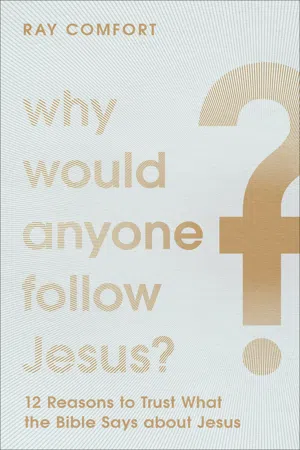
With his signature insight and contagious enthusiasm, Ray Comfort walks you through twelve persuasive reasons to believe that Jesus of Nazareth was who he said he was, did the things the Bible records him doing, and explains why it matters to your life in the 21st century. He covers everything from the virgin birth to Jesus's miracles and teachings, including his hard sayings, his detractors, his exclusive claims, and his commands to his followers. Through it all, Comfort shines a light on how Jesus stands out and stands above every other teacher, prophet, or historical figure out there.
If you struggle to articulate why you follow Jesus to your friends and family, or if you are a skeptic looking for some way to make sense of the whole Jesus thing, this book is for you.
eBook - ePub
Why Would Anyone Follow Jesus?
12 Reasons to Trust What the Bible Says about Jesus
- 208 pages
- English
- ePUB (mobile friendly)
- Available on iOS & Android
eBook - ePub
About this book
Information
Topic
Theology & ReligionSubtopic
Christian Ministry1
Jesus and Intellectual Arguments
Who was Jesus? Was He just a great teacher, or was He the Son of God? Was He the promised Messiah—the one for whom many Jews are still waiting? What if someone told you there is no historical evidence that Jesus even existed? Such a thought removes the wind from the sails of some would-be witnessers. Live Science said of Jesus:
Jesus was the Messiah (Christ), the Son of God who was crucified for the sins of humanity before rising from the dead, according to Christian Gospels and early Christian writings.
According to the Gospels, Jesus, who was born around 4 BC, was able to perform supernatural feats such as healing a wide range of diseases by simply touching people or speaking to them. He supposedly also had the ability to walk on water, instantly create vast amounts of fish and bread, resurrect the dead, rise from the dead himself, calm storms and exorcise demons from people.
The stories told about him have led many scholars to explore these questions: What was Jesus really like? Did he really exist? Today, many of the supernatural feats Jesus is reported to have performed are regarded by scientists as impossible to do—certainly by someone who lived 2,000 years ago.1
This article confirms that some scientists think that the supernatural feats Jesus did are impossible. What a strange thing to say. Anyone can tell you that those feats are impossible to do—today or two thousand years ago when He did them. It’s not possible to walk on water, to calm an angry storm just by telling it to, to multiply loaves and fish, or to raise the dead by speaking to them. But the Bible doesn’t say only that He did the impossible but also that He said things in the same category. His words were seemingly senseless. They were more than wildly strange; they were without precedent—and we will look at many examples in this book.
When someone asks me for evidence that Jesus existed, I ask them a couple of questions. “We mark our yearly time through a numbering system. What number are we up to at present?” When they tell me what year it is, I then ask, “Since when?” The answer is “since Christ.” We mark the years with the BC/AD dating system. The birth of Jesus is the dividing point of history. No other historical figure so impacted humanity that they were given the honor of splitting time in two. Only Jesus. Napoleon, Shakespeare, Caesar, and Joan of Arc were not given that distinction as a birthmark. Yet no one seriously doubts their existence.
We also have the historical records of the four Gospels—Matthew, Mark, Luke, and John. These give us four detailed accounts of Jesus’s birth, life, death, and resurrection.
And then there’s the record of respected historians. An article on History.com recounts, “The first-century Jewish historian Flavius Josephus . . . twice mentions Jesus in Jewish Antiquities, his massive 20-volume history of the Jewish people that was written around AD 93. . . . In one passage of Jewish Antiquities that recounts an unlawful execution, Josephus identifies the victim, James, as the ‘brother of Jesus-who-is-called-Messiah.’”2
The same article describes more evidence, saying the following:
Another account of Jesus appears in Annals of Imperial Rome, a first-century history of the Roman Empire written around 116 A.D. by the Roman senator and historian Tacitus. In chronicling the burning of Rome in 64 A.D., Tacitus mentions that Emperor Nero falsely blamed “the persons commonly called Christians, who were hated for their enormities. Christus, the founder of the name, was put to death by Pontius Pilate, procurator of Judea in the reign of Tiberius.”3
In minutes, we can gather more evidence that Jesus of Nazareth existed than we can of many other historical figures, famous though they may be. Faced with this evidence of His existence, people often start looking around wildly for a detour away from Him. They bring up facts about His life that seem impossible. And one of those pieces of evidence would be His famous words.
Jesus predicted that the heavens and the earth would pass away but that His words would certainly remain (see Matt. 24:35). And two thousand years later, they remain—encapsulated for us in the bestselling book of all time.
No philosopher or historical figure holds a blown-out candle to the brilliance of the words given to us in the Sermon on the Mount. If Jesus didn’t give us the Golden Rule and the many other breathtaking truths in that sermon, who did? And why would anyone not want it to be the person whom these detailed historical records maintain it was? One answer to that question is the biblical one. Jesus was hated because He continually spoke of our moral accountability to God: “The world cannot hate you, but it hates Me because I testify of it that its works are evil” (John 7:7).
And that’s why He is the only figure in history who has been so despised that His name is used as a popular cuss word.
The Virgin Birth Problem
One popular impossibility that sits forever in the doubter’s head and causes many arguments is the virgin birth. The teaching of the Bible is that Jesus was born of a virgin because He came to suffer as a sacrificial Lamb for the sin of the world. The Lamb of God had to be without spot or blemish, so Jesus had to be sinless. If He had been born through the lineage of Adam, He would have inherited sin and had tainted blood. Therefore, Joseph couldn’t be His father. Jesus’s blood had to be pure. Because God was His Father, He had untainted blood.
That’s the why. I’ve given the natural explanation. Then there’s the supernatural explanation, the how. If we can’t accept the virgin birth because we are having a problem with God’s abilities, we need to expand our perspective of His power.
Take for example the human body. Scientists estimate it’s made up of seventy trillion cells, and each cell contains approximately one hundred trillion atoms. If we want to find out how many atoms make up our bodies, we would multiply seventy trillion by one hundred trillion. Here’s my point. God put in order every one of those atoms to make me who I am, and He’s intimately familiar with each atom—from the inside out—because He made it. Having knowledge like that can help us refine our understanding of God’s power, and from there, expand our thoughts of the immensity of His power. God’s power isn’t bound by the possible. It reaches into the realm of the impossible.
When religious leaders came to Jesus with a far-fetched scenario in an attempt to confound Him, Jesus pointed to two errors.
The same day the Sadducees, who say there is no resurrection, came to Him and asked Him, saying: “Teacher, Moses said that if a man dies, having no children, his brother shall marry his wife and raise up offspring for his brother. Now there were with us seven brothers. The first died after he had married, and having no offspring, left his wife to his brother. Likewise the second also, and the third, even to the seventh. Last of all the woman died also. Therefore, in the resurrection, whose wife of the seven will she be? For they all had her.”
Jesus answered and said to them, “You are mistaken, not knowing the Scriptures nor the power of God. For in the resurrection they neither marry nor are given in marriage, but are like angels of God in heaven. But concerning the resurrection of the dead, have you not read what was spoken to you by God, saying, ‘I am the God of Abraham, the God of Isaac, and the God of Jacob’? God is not the God of the dead, but of the living.” And when the multitudes heard this, they were astonished at His teaching. (Matt. 22:23–33)
Jesus told them they were mistaken in two ways: one, they didn’t know the Scriptures, and two, they didn’t know anything about the power of God. In reality, there are no limits to the power of our Creator. If we adopt the biblical view and give Him unlimited power, then we can sit back, relax, and say, “With God nothing will be impossible” (Luke 1:37). This understanding of His power opens the door of reasoning to the virgin birth, the calming of storms, the multiplying of loaves and fish, and the raising of the dead by simply speaking to them.
The Easier Way
But what if you want to do more than simply convince someone that Jesus was born of a virgin? If you want to bring them to Jesus, there’s an easier way. If they say, “I can’t accept the virgin birth,” and we try to address that stubborn denial of the biblical account, we are attempting to climb a mountain we need not climb. They’re scrambling for a detour, and we need to lead them straight back to Him.
Romans 8:7 says that the carnal mind is in a state of enmity toward God, and that “it is not subject to the law of God, nor indeed can be” (emphasis added). In other words, all unregenerate human beings are offended by the moral government of God. This is epitomized in the fact that they use His name in vain. They would never think of using their mother’s name as a cuss word, but they use the holy name of the God who gave them life in the place of a filthy word to express disgust. They despise God:
He who walks in his uprightness fears the LORD,
But he who is perverse in his ways despises Him. (Prov. 14:2)
It is that hard ground upon which we sow. And more often than not, the problem is not that they don’t understand the concept of the virgin birth; it’s that they simply refuse to accept it as truth. Their stumbling block is the sin of unbelief, similar to the unbelief that Zacharias had when the angel of God told him that his elderly wife was going to become pregnant well after she had passed the age of childbearing.
And Zacharias said to the angel, “How shall I know this? For I am an old man, and my wife is well advanced in years.”
And the angel answered and said to him, “I am Gabriel, who stands in the presence of God, and was sent to speak to you and bring you these glad tidings. But behold, you will be mute and not able to speak until the day these things take place, because you did not believe my words which will be fulfilled in their own time.” (Luke 1:18–20)
Zacharias was rightly struck dumb because he insulted the integrity of God. It’s common for unbelievers to say something like “I find it hard to have faith in God.” The question to ask such a person is, “Do you find it hard to have faith i...
Table of contents
- Cover
- Half Title Page
- Title Page
- Copyright Page
- Dedication
- Contents
- Introduction
- 1. Jesus and Intellectual Arguments
- 2. Jesus and Hope
- 3. Jesus and Money
- 4. Jesus and Exclusivity
- 5. Jesus and the Crazy World
- 6. Jesus and Authority
- 7. Jesus and His Accusers
- 8. Jesus and the Greatest Sermon
- 9. Jesus and the Lost
- 10. Jesus and Atheism
- 11. Jesus and His Hard Sayings
- 12. Jesus and His Demand for Love
- Final Word
- Notes
- About the Author
- Back Ads
- Back Cover
Trusted by 375,005 students
Access to over 1.5 million titles for a fair monthly price.
Study more efficiently using our study tools.
Frequently asked questions
Yes, you can cancel anytime from the Subscription tab in your account settings on the Perlego website. Your subscription will stay active until the end of your current billing period. Learn how to cancel your subscription
No, books cannot be downloaded as external files, such as PDFs, for use outside of Perlego. However, you can download books within the Perlego app for offline reading on mobile or tablet. Learn how to download books offline
Perlego offers two plans: Essential and Complete
- Essential is ideal for learners and professionals who enjoy exploring a wide range of subjects. Access the Essential Library with 800,000+ trusted titles and best-sellers across business, personal growth, and the humanities. Includes unlimited reading time and Standard Read Aloud voice.
- Complete: Perfect for advanced learners and researchers needing full, unrestricted access. Unlock 1.5M+ books across hundreds of subjects, including academic and specialized titles. The Complete Plan also includes advanced features like Premium Read Aloud and Research Assistant.
We are an online textbook subscription service, where you can get access to an entire online library for less than the price of a single book per month. With over 1.5 million books across 990+ topics, we’ve got you covered! Learn about our mission
Look out for the read-aloud symbol on your next book to see if you can listen to it. The read-aloud tool reads text aloud for you, highlighting the text as it is being read. You can pause it, speed it up and slow it down. Learn more about Read Aloud
Yes! You can use the Perlego app on both iOS and Android devices to read anytime, anywhere — even offline. Perfect for commutes or when you’re on the go.
Please note we cannot support devices running on iOS 13 and Android 7 or earlier. Learn more about using the app
Please note we cannot support devices running on iOS 13 and Android 7 or earlier. Learn more about using the app
Yes, you can access Why Would Anyone Follow Jesus? by Ray Comfort in PDF and/or ePUB format, as well as other popular books in Theology & Religion & Christian Ministry. We have over 1.5 million books available in our catalogue for you to explore.