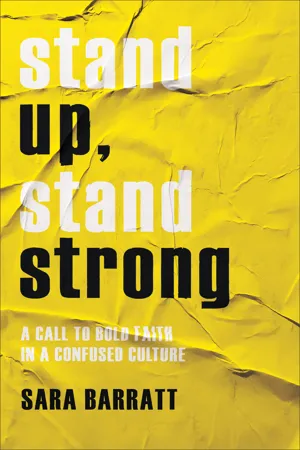
If we live according to the gospel, we're going to make waves. Why? Because the way of Christ is countercultural. It doesn't go with the flow, compromise on truth, or stay silent in the face of injustice--so neither can we. No matter how young or old we are, or how much or how little influence we think we have, God calls us to boldly engage our upside-down culture through the lens of his truth.
With powerful examples from Scripture and stories from teens today and through the centuries, Sara Barratt equips teens to live with a biblical worldview, approach today's hot-button issues with godly wisdom, and influence their generation for the glory of God. Tackling tough topics like sexuality, addiction, identity, media, and much more, Sara offers practical ways to stay rooted in God's truth while engaging culture with the redemptive story of the gospel--no matter the cost.
- 176 pages
- English
- ePUB (mobile friendly)
- Available on iOS & Android
eBook - ePub
About this book
Information
Print ISBN
9780801094415
Part One: Rethinking Normal
1
One Man Flipped the World
(Jesus Changed Everything . . . and Why That Matters Today)
Jesus turned the patterns of the world upside down.
From the beginning of Christ’s life, He began impacting culture—as an ordinary yet extraordinary infant who made kings fear and wise men worship. This baby grew into a man who made the blind see, the lame walk, and the dead live again. Everywhere Jesus went, He created a stir and defied the normal order of people’s lives and ideas. He pushed back against the status quo that shrugged and said, “This is how it’s always been done” to initiate new and better standards defined by the culture of heaven. He made outlandish claims, saying He not only knew the truth but was the truth. Not only that He knew a way to God but was Himself the only way to God.
He was surrounded by followers and fans who later turned into mobs, bloodthirsty soldiers, and betrayers crying out with shouts of “Crucify Him!” and nailing Him to a cross. He breathed His last on that cross with the words “It is finished!” only to do the unthinkable, unimaginable, and incomprehensible three days later: come back to life.
Now, two millennia later, Jesus is still making waves.
The words and message of Christ have spanned the centuries and reached into our generation. Just like every prior generation, we have a decision to make.
We have to decide what to do with Jesus’s words.
Some claim He was just a prophet or well-known teacher. If that were the case, we could take Him or leave Him.
But what if He is who He claimed to be? The very Son of God? The Savior of our souls? The way, the truth, and the life?
That would change everything. In fact, it did change everything. Ever since the empty tomb, the gospel has radically impacted individual lives and entire cultures. What impact does the gospel make on our culture? More to the point, what impact does the gospel make on the way we live in our culture?
As with the people who first experienced Christ’s countercultural message, these gospel implications might rub us the wrong way. To have the boldness and grit to live according to His teaching, we need to fully understand the answers to two questions: First, are the words of Christ true? And second, do they have the authority to tell us how to live our lives?
Life Led by the Gospel
Most Christians would say they believe the gospel.
But not all Christians live like they believe the gospel.
Let’s take a minute to define what I mean by “the gospel.” The message of the gospel opens with a holy God and rebellious people in need of a Savior. When Adam and Eve sinned in the garden of Eden, humanity’s relationship with God shattered and there wasn’t anything we could do to fix it. Instead of leaving us to fend for ourselves, God mercifully set a plan in motion to restore our relationship with Him. When Jesus died on the cross, He took our punishment upon Himself and paid our debt with His own blood, building a bridge over the canyon of our sin. When He rose from the dead, He arose as conqueror over sin, Satan, and death. Because of Christ’s death, but more importantly, because of Christ’s resurrected life, we can have life in Him. His gift of salvation is freely given to all who repent of their sin and believe in Him. The way to relationship with God has been made, but there’s only one way and that’s Jesus.
This gospel—this good news—isn’t like any other news in the world. This news is life changing. The gospel hits deep into the core of a person and flows through every part of life. It shows us the true condition of ourselves—sinners who deserve God’s judgment—and provides the only way of salvation.
Most of us who are Christians will nod and skim past these words. We know the story. But here’s the real question: Do we actually believe it? If we do, it will radically overhaul our lives and revolutionize how we engage the world. If we believe the gospel, it will become impossible for us to live like the rest of society—because our lives will be built on a drastically different foundation.
But too often Christians embrace a watered-down message. We’re content to believe Christ’s death means we can have eternal life—but it doesn’t cross our minds that it should affect how we live here and now. We’re thrilled Jesus loves us enough to save us, but the thought of Him also wanting to change us is uncomfortable. Yet we can’t have it both ways. The truth of the gospel means that Christ’s words do have authority to tell us how to live. That authority changes everything.
Believing the full, undiluted message of the gospel is the first step to living counterculturally. If our view of Christ’s teaching is compromised, we’ll crumble under the pressure to conform instead of standing strong. Shallow convictions lead to shallow living and shallow Christianity, but solid principles and convictions help us obey Christ’s command, “Follow Me.”
What does that look like?
The Gospel Changes Our Life Purpose
Christ’s words are action filled.
“Go into all the world” (Mark 16:15).
“Take up your cross and follow Me” (see Mark 8:34).
The call to follow Christ is not simply a call to believe a set of facts but to live a drastically transformed life. When we accept Christ’s gift of salvation, our life purpose alters, and that changes how we view and live in the culture.
The world defines life purpose mostly in terms of “getting” or “achieving.” While most might view success through the lens of a job, bank account, or relationship status, Jesus tells us “treasures in heaven” (Matt. 6:20; see vv. 19–21) are worth far more. While popular opinion declares happiness is an emotion to be sought by whatever means in whatever way (through relationships, sex, possessions, position, pleasure, entertainment, etc.), Jesus shows us that building His kingdom is the path to true fulfillment.
The gospel changes our life purpose by giving us meaning beyond the transient things of this world. We live for Jesus, not ourselves.
The Gospel Designates a Source for Morality
The Bible shares a jarring declaration: “There is none righteous, no, not one” (Rom. 3:10). The basic idea of morality today says you’re moral if you’re a good person who doesn’t harm others. The flaw with this idea, however, is that it suggests humans can determine what is and is not moral. If we look to ourselves or other people to determine morality, we’ll find an ever-changing definition.
Going back to the Bible, we realize “all have sinned and fall short of the glory of God” (Rom. 3:23). A sinner can’t be an authoritative source for morality. We need a source of morality outside ourselves. Morality is not a concept for us to determine. Jesus, the only sinless person, has already determined it.
The Gospel Defines Truth
How do you know how to live if you don’t know what to believe? How do you know what to believe if you don’t know what’s true? This is the conundrum our culture finds itself in. Truth has been subjected to feelings, and no one knows what’s true anymore.
One of Christ’s most audacious claims was about truth. He didn’t say He had it or He knew it. He said He was truth. “I am the way, the truth, and the life. No one comes to the Father except through Me” (John 14:6). We can have confidence that our Christian message is actually true. Not true because we believe it to be but true whether or not we believe it. Christianity tells the truth about all of reality and the world itself.
In a society that denies the authority of objective truth, we’re called to live according to the gospel’s definition of truth. Because the key player in the gospel—Jesus Christ—isn’t just a bearer of truth, but truth Himself.
The Gospel Reorders Our Priorities
“No one can serve two masters” (Matt. 6:24). Enter again the radical words of Christ, leading us to a crossroads. Throughout the Gospels, the kingdom of God is portrayed as a prize above all else. To those who love possessions, Jesus tells to seek treasures in heaven (see Matt. 6:19–21). To those who crave comfort, He hands a cross (see Mark 8:34–37). To those who long for familiarity, He says, “Don’t look back” (see Luke 9:62). We are to seek first the kingdom of God (Matt. 6:33).
Our daily lives reveal our priorities. Christ? Comfort? Wealth? Security? Success? We can’t serve them all. The heartbeat of the gospel is that Christ died so “that those who live should live no longer for themselves, but for Him who died for them and rose again” (2 Cor. 5:15). The gospel reorders our priorities, placing Christ above all.
The Gospel Realigns Our Authorities
Whether we realize it or not, through the saturation of social media, we’ve given our favorite YouTubers, Instagram influencers, and TikTok stars authoritative voices in our lives. We can all admit to being swayed by the loudest and most prominent voices around us, simply through the permeation of their influence. The gospel realigns these authorities, distinguishing between voices worthy of our respect and those that shouldn’t have influence. We filter all authority through Christ—our supreme authority. We don’t turn to the voices of the world for guidance on how to live, but rather to the words of Scripture.
For authorities designated by God (such as political leaders and law enforcement), we humbly submit to their governance in areas that align with God’s laws. In the words of Christ, we “render to Caesar the things that are Caesar’s” (Mark 12:17). But if earthly authorities ask us to sin, like the apostles forbidden to preach the gospel, we turn to our ultimate authority, declaring we “obey God rather than men” (Acts 5:29). As the Manhattan Declaration proclaims, “We will fully and ungrudgingly render to Caesar what is Caesar’s. But under no circumstances will we render to Caesar what is God’s.”1
The Gospel Infuses Our Hearts with Hope
Because of Christ’s jaw-dropping redemptive work in our lives, we can have hope in the midst of chaos and uncertainty. “Let not let your heart be troubled,” Jesus said in John 14:1 (NASB). In a world gone crazy, we have confidence in His words: “I have overcome the world” (John 16:33). And not only has He overcome this broken place we call earth, He has also secured an eternally perfect place in heaven for those who trust in Him. We have hope that this world is not all there is. One day, every sorrow will be turned to joy (John 16:22), every tear wiped from our eyes, and every broken thing made new (Rev. 21:4–5). No matter what happens in this earthly life, this promise is secure. When we understand this, it radically shifts how we live here and now. Fear and anxiety don’t have to rule our lives, but rather we can live with confidence and hope—our eyes fixed on Jesus, our hearts set on the goal of drawing others to know the hope we have in Him (Heb. 12:1–2).
A World Turned Upside Down
What would happen if we lived a gospel-defined life? How would the world change? How would we change?
As we consider how the gospel affects our lives, we’re presented with a difficult and costly decision. Every day, you and I make a choice between three options:
- We can live in sync with the world. We can disregard the words of Christ, follow secular patterns wherever they lead, or blaze our own path according to personal preferences.
- We can push the issues of the world to the back burner in our minds and retreat from 100 percent following Christ. We can hold biblical beliefs on topics that make us feel good and speak out when it’s uncontroversial. We can settle for an easy life defined by compromise and subtle complicity, believing God’s Word when it’s convenient and comfortable. We’ll be “Christians” but won’t live as followers of Christ.
- We can boldly counter the culture and live according to God’s truth no matter the cost or risk. We can believe the Bible is the inerrant Word of God, mold our lives to its standards, and seek God for strength to live according to His ways.
I don’t know about you, but for me the greatest temptation is the second option—retreat. It’s the easiest choice for those who want to be Christians but also want a comfortable and risk-free life. Retreat is the choice many believers have subconsciously made. We’ve sat back in apathy and comfort and turned our backs on the brokenness instead of engaging the world as Christ commissioned.
Yet each day, we are given the opportunity to make our choice again. So, which path will we ...
Table of contents
- Cover
- Endorsements
- Half Title Page
- Title Page
- Copyright Page
- Dedication
- Contents
- Introduction
- Part One: Rethinking Normal
- Part Two: Tackling the Nitty-Gritty
- Part Three: Generation Change 101
- Conclusion
- Acknowledgments
- Notes
- About the Author
- Back Ads
- Back Cover
Trusted by 375,005 students
Access to over 1.5 million titles for a fair monthly price.
Study more efficiently using our study tools.