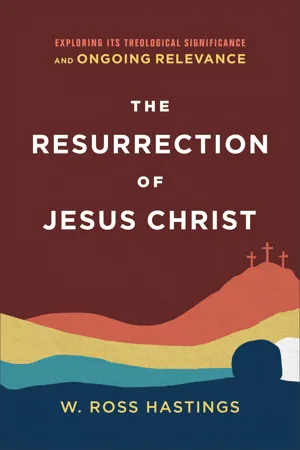
eBook - ePub
The Resurrection of Jesus Christ
Exploring Its Theological Significance and Ongoing Relevance
- 192 pages
- English
- ePUB (mobile friendly)
- Available on iOS & Android
eBook - ePub
The Resurrection of Jesus Christ
Exploring Its Theological Significance and Ongoing Relevance
About this book
The resurrection of Jesus Christ is one of the best-attested facts of history. But believing in the resurrection is one thing. Knowing what it means is another. Although much has been written about the apologetics of the resurrection, little has been written about its theological meaning. This book reveals the hidden depths of the theological significance and ongoing relevance of the resurrection of Jesus Christ for our being, our salvation, Christian life, ethics, and our future hope.
Information
Topic
Theology & ReligionSubtopic
Christian Theology1
The Resurrection as Good History
This [the resurrection of Jesus Christ from the dead] is a historical happening not of the kind that fades away from us and crumbles into the dust, but of the kind that remains real and therefore that resists corruption and moves the other way, forward throughout all history to the end-time and to the consummation of all things in the new creation. Jesus remains live and a real historical happening, more real and more historical than any other historical event, for this is the only historical event that does not suffer from decay and is not threatened by annihilation and illusion.
—T. F. Torrance1
This book is about the theological significance and ongoing relevance of the resurrection of Jesus Christ in the twenty-first century, including and maybe especially in its times of crisis. It seeks to offer a message of defiant hope for the Christian, for the church, for all humanity, and for all creation. The words of Scottish theologian T. F. Torrance above set the tone for the message of this entire book, first because they establish the historicity of the resurrection of Jesus, and second because they express what is at stake in the historical reality that the real person of the Son of God, who became fully and truly human for us and for creation, really died and really rose again from the dead. We can enter into the consequences of that resurrection through faith in Jesus, which brings us into union with Jesus by the fellowship of the Holy Spirit. But this “experience” is not ungrounded subjectivity. Rather, it is grounded in the historical reality that Jesus of Nazareth rose again from the dead, is alive today, and enters into living relationship with every believing person by the power of the Holy Spirit.
This book is primarily about the theological meaning and consequences of the resurrection. All subsequent chapters major on that theme: the theological meaning of the resurrection for our salvation and our being as human persons. This book is about the significance of the resurrection for the atonement, for our justification and sanctification and vocation, for the high priesthood of Jesus, for creation, for science and the arts, and for the future resurrection of humanity and the renewal of creation. It is not intended, therefore, to be a book about the apologetics for the veracity of the resurrection. It assumes the veracity of the bodily resurrection of Jesus. Nevertheless, just to establish confidence in its meaning and consequences, we begin with a brief summary of the evidence that Jesus really did rise from the dead.
Examining the evidence is important simply because the New Testament apostles gladly staked their claim about the truth of the Christian gospel on this historical reality. The fact that the Christian faith is a historical faith, dependent on a historical reality, already provides evidence of the importance of the incarnation and the resurrection of Jesus. Paul, for example, made no bones about the fact that if you could disprove the resurrection, you could toss Christianity aside as a fable not worth following and simply live it up in a hedonistic way: “Let us eat and drink, for tomorrow we die” (1 Cor. 15:32). He based his entire exposition of the gospel and his entire life on the fact that Jesus had risen. He staked his claim about the uniqueness of Jesus Christ precisely on this one historical point because he was convinced that it was true. Paul had, after all, actually encountered the risen Christ and had his view of God and the world upended. The most significant evidence that the resurrection happened is the transformation of the disciples of Jesus, their lifelong commitment to it, and their martyrdom for it. The accusation that they stole the body of Jesus and hid it somewhere is not logically tenable. Nobody allows themselves to be martyred for something they know to be a lie. The swoon theory—that is, the idea that Jesus merely swooned on the cross and then recovered—not only is untenable but also would not and could not have generated the zeal and faithfulness of apostolic witness.
When we fast-forward to the twentieth century, one of the most convincing accounts of the evidence for the real, bodily resurrection of Jesus was that given by the great professor of English literature at both Oxford and Cambridge, C. S. Lewis, who is known best by some for The Chronicles of Narnia. Lewis was baptized in the Church of Ireland but drifted away from the faith. His conversion at the age of thirty-two was due in part to the influence of J. R. R. Tolkien, but a significant cornerstone of his faith came from his investigation into the historicity of the resurrection of Jesus from the dead. And Lewis, like the apostle Paul, knew what was at stake with this claim. One cannot be neutral about Jesus’s claim that he was the Son of God and his promise that he would rise again.
I am trying here to prevent anyone saying the really foolish thing that people often say about [Jesus]: I’m ready to accept Jesus as a great moral teacher, but I don’t accept his claim to be God. That is the one thing we must not say. A man who was merely a man and said the sort of things Jesus said would not be a great moral teacher. He would either be a lunatic—on the level with the man who says he is a poached egg—or else he would be the Devil of Hell. You must make your choice. Either this man was, and is, the Son of God, or else a madman or something worse. You can shut him up for a fool, you can spit at him and kill him as a demon or you can fall at his feet and call him Lord and God, but let us not come with any patronizing nonsense about his being a great human teacher. He has not left that open to us. He did not intend to.2
Lewis went on to say that to “preach Christianity meant primarily to preach the Resurrection.”3 In a letter written in May 1944, Lewis expressed his belief in the veracity and the importance of the resurrection:
It is very necessary to get the story clear. I heard a man say, “The importance of the Resurrection is that it gives evidence of survival, evidence that the human personality survives death.” On that view what happened to Christ would be what had always happened to all men, the difference being that in Christ’s case we were privileged to see it happening. This is certainly not what the earliest Christian writers thought. Something perfectly new in the history of the universe had happened. Christ had defeated death. The door, which had always been locked, had for the very first time been forced open.4
What Can Be Proved?
Any investigation of the resurrection of Jesus must include consideration of the historical sources and documentation; and once the reliability of the documents has been established, consideration must be given to what they record—the empty tomb, eyewitness accounts of Jesus’s postresurrection appearances, and the ongoing witness of the church. How dubious all proposed alternative explanations to what happened (the swoon theory, for example) have been must also be considered. But before we discuss some of these lines of evidence, I want to preface this discussion of apologetics by indicating what it is we can and cannot “prove” about the resurrection. “Proof” is probably the wrong word. We can discover much evidence for the resurrection. We can show that the historical events are best made sense of by the proposal of resurrection. But we cannot offer proof. Proof requires reproducibility. We cannot reproduce the resurrection of Jesus in a laboratory. This is a discussion within the realm of history, not the natural sciences. We can show that the resurrection is a historical fact on the basis of critical realism as it applies to history, but not on the basis of logical positivism. And actually, even science itself functions on the same basis: critical realism rather than logical positivism. Let me explain.
Trying to convince someone of the veracity of the resurrection by seeking to show absolute proof actually reveals an uncritical enculturation to modernity, in which reason and faith are considered to be separate. Seeking proof—as opposed to evidence—is in keeping with a philosophy regarding scientific discovery that arose out of modernity, one known as logical positivism or verificationism. This was an influential school of thought in the philosophy of science that emerged from the Berlin Circle and the Vienna Circle in the late 1920s and 1930s. It asserted that only statements that are verifiable through direct empirical observation or logical proof are actually meaningful. Only scientific knowledge is real knowledge, it was thought. One can easily see how this would make for a rift between theology and science and create the way for scientism of the kind that Richard Dawkins has exhibited in recent times, for example. The resurrection of Jesus accounts well for all the historical evidence, and there is a considerable amount of that historical evidence. But on the basis of the criteria of verificationism, since we cannot reproduce this event, “proof” of the resurrection of Jesus does not exist, and theological knowledge based on it does not exist either.
Enter the philosopher of science Karl Popper (1902–94), who attacked this premise for knowledge and offered falsificationism as a better way of establishing scientific knowledge than verificationism. He exposed true empirical verification as logically impossible. The more realistic aim of science, he suggested, is corroboration of a scientific theory such that there can be reasonable confidence that it accounts for the data and that what is being proposed actually bears a resemblance to reality as it is. Its goal is a rational realism or a scientific realism that recognizes that we have to, at best, settle for strong “truthlikeness” or “corroborated verisimilitude.”5 For example, proposing a theory about what electrons are and where they are situated must involve hypotheses and a model that can be tested. Or stated positively, when all the data has come in, these hypotheses must account well for all the evidence and be self-consistent. But at the end of the day, we cannot assume that the proposed model represents exactly what electrons look like. There remains an element of mystery. No one has actually seen an electron or a gluon. This falsification epistemology makes room for knowledge that is not strictly scientific, such as historical knowledge. On Popper’s account, therefore, the resurrection of Jesus can be considered “scientific” in that it accounts well for all the evidence and because there has been no evidence to render it false.
The evidence for the resurrection does not stand or fall on rationalistic apologetics, therefore. I wish to stress that theology, including resurrection theology, is done by “faith seeking understanding,” or critical realism, and not by logical positivism. Theology functions properly in an epistemological sense when it encounters mystery, responds in faith, and then pursues understanding. The ord...
Table of contents
- Cover
- Half Title Page
- Title Page
- Copyright Page
- Dedication
- Contents
- Acknowledgments
- Introduction
- 1. The Resurrection as Good History
- Part 1: Christ’s Resurrection Has Saving Efficacy
- Part 2: Christ’s Resurrection Has Ontological Significance
- Bibliography
- Subject Index
- Scripture and Ancient Sources Index
- Back Cover
Trusted by 375,005 students
Access to over 1.5 million titles for a fair monthly price.
Study more efficiently using our study tools.
Frequently asked questions
Yes, you can cancel anytime from the Subscription tab in your account settings on the Perlego website. Your subscription will stay active until the end of your current billing period. Learn how to cancel your subscription
No, books cannot be downloaded as external files, such as PDFs, for use outside of Perlego. However, you can download books within the Perlego app for offline reading on mobile or tablet. Learn how to download books offline
Perlego offers two plans: Essential and Complete
- Essential is ideal for learners and professionals who enjoy exploring a wide range of subjects. Access the Essential Library with 800,000+ trusted titles and best-sellers across business, personal growth, and the humanities. Includes unlimited reading time and Standard Read Aloud voice.
- Complete: Perfect for advanced learners and researchers needing full, unrestricted access. Unlock 1.5M+ books across hundreds of subjects, including academic and specialized titles. The Complete Plan also includes advanced features like Premium Read Aloud and Research Assistant.
We are an online textbook subscription service, where you can get access to an entire online library for less than the price of a single book per month. With over 1.5 million books across 990+ topics, we’ve got you covered! Learn about our mission
Look out for the read-aloud symbol on your next book to see if you can listen to it. The read-aloud tool reads text aloud for you, highlighting the text as it is being read. You can pause it, speed it up and slow it down. Learn more about Read Aloud
Yes! You can use the Perlego app on both iOS and Android devices to read anytime, anywhere — even offline. Perfect for commutes or when you’re on the go.
Please note we cannot support devices running on iOS 13 and Android 7 or earlier. Learn more about using the app
Please note we cannot support devices running on iOS 13 and Android 7 or earlier. Learn more about using the app
Yes, you can access The Resurrection of Jesus Christ by W. Ross Hastings in PDF and/or ePUB format, as well as other popular books in Theology & Religion & Christian Theology. We have over 1.5 million books available in our catalogue for you to explore.