Named One of Fifteen Important Theology Books of 2022, Englewood Review of Books
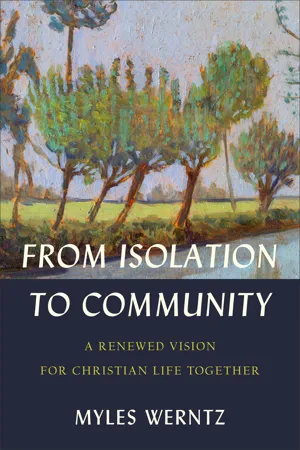
It is no secret that isolation is one of the key ailments of our age. But less explored is the way the church as it is frequently practiced contributes to this isolation instead of offering an alternative. With the help of Dietrich Bonhoeffer, this book argues for a renewed vision of the church community as a theological therapy to cultural, moral, and sociological isolation. It offers an account of how familiar church practices, such as Scripture reading, worship, prayer, and eating, contribute to community formation in the body of Christ.
- 208 pages
- English
- ePUB (mobile friendly)
- Available on iOS & Android
eBook - ePub
About this book
Information
Topic
Teologia e religioneSubtopic
Chiesa cristianaPart One
Isolation and the Structure of the World
One
Life in Isolation, Then and Now
Isolation Everywhere, Everywhere Invisible
Among the most bone-chilling moments in the Bible is the story of Jesus in the garden of Gethsemane, in which we find Jesus—just days removed from the adulation of the crowds—telling his disciples that he is “deeply grieved, even to death” (Mark 14:34). The narrative occasion of this grief is Jesus’s impending arrest and crucifixion, but it is accompanied at all points with an increasing isolation from his disciples, from his family, and from the public. These emotional afflictions of Jesus, we are reminded, are not shadow play: Jesus encounters the reality of creaturely life that is isolation and sin.1 For as Jesus prayed, his disciples slept, and as Jesus died on the cross, he was yet surrounded. When Jesus enters Gethsemane, as his disciples fall asleep both physically and metaphorically, we see him weighed down by the existential condition of being a creature in the fallen world: bearing an isolation and fear common to humanity’s condition.
In this scene in the garden we see Christ bearing our creaturely condition and mending it. The Son who could never be separate from Father or Holy Spirit is, in his flesh, bearing the isolation of humanity. The agony of Gethsemane was not, as some modern interpreters would describe it, the triune God being divided or undergoing abandonment within the triune God. Rather, Christ was, as William Stringfellow would describe it, confronting one of the many emissaries of Death—the persistent reminder that we are frail creatures of dust and will die.2 In this encounter of Christ in the garden, we see that isolation is a theological problem before it is a social one. Being isolated is more than being lonely, for in companionship we find a temporary reprieve; isolation—the condition of being structurally, morally, and spiritually estranged within creation—is a more pervasive theological condition in which a person finds themselves cut off even when surrounded by people.
To say that many modern societies are fundamentally individualistic—built on the premise that you qua you should actualize the fullness of your individuality—is nothing new: this much historians, philosophers, theologians, and cultural critics have been pointing out for years.3 When it is built into structures of advertising, politics, and cultural engagement, this individualism creates cultures in which the cultivated individual—apart from other social bodies—becomes the ideal and, further, comes to believe that social structures that limit this must be removed. This presumption, that we are isolated from one another and must make the best of this, surrounds us both philosophically and culturally: we find it in children’s programming,4 hardwired into the design framework of smartphones,5 and bundled into how we think about disease recovery.6 Once imbibed as a cultural value, this presumption propagates to the point that thinking of a unifying “culture” comes to seem novel, and it has birthed a thousand think pieces on mending social isolation and fragmentation.
How creation emerges out of this problem is not first a question of political societies, one that could be resolved by a nationalist program on the one hand (shoring up our common social identity) or by resorting to a cosmopolitan vision on the other (expanding our economic and political relationships to the whole of the world). For the Christian, human union is restored not solely by acts of political solidarity but by coming together in Christ. This human union that we receive in Christ is exemplified in the body of Christ, in whom enemies are reconciled and opposing fragments of the world are knit together, with what we are as the church becoming the basis for our life amid our neighbors.
As Bonhoeffer writes, the proposal of “solidarity,” either theologically or politically conceived, provides, ironically, too weak a basis for the restoration of communion; what we need is not to be joined in our isolation but to be healed:7 “To bring this about, Jesus calls to repentance, which means he reveals God’s ultimate claim and subjects the human past and present to its reality. Recognizing that we are guilty makes us solitary before God; we begin to recognize what has long been the case objectively, namely that we are in a state of isolation.”8
The irony here is that solidarity offers an important, but limited, sense of union, for solidarity stands with and joins cause with the one who is broken and oppressed but yet stands separate from them, producing in turn new political alternatives that are themselves organized around this principle of isolation but never communion.9 In solidarity, I offer myself to another but cannot fully share with their state, for their oppression can never be identical with my oppression: I may advocate for them and bear witness for them, but I remain divided from their experience of suffering. Solidarity enters into a relationship of advocacy with others but assumes the division of the suffering and the advocate as the basis for the relationship. For Bonhoeffer, God comes to us in and through the very creaturely life in which we operate as isolated beings, offering a vision beyond solidarity: “Thus out of utter isolation arises concrete community, for the preaching of God’s love speaks of the community into which God has entered with each and every person—with all those who in utter solitude know themselves separated from God and other human beings and who believe this message.”10 The undoing of our fractured, divided state of sin occurs hand in hand with being given a new community in which all people are knit together with one another in a very different fashion: the community of the church, Christ’s own body.
In his work on theological education, Willie James Jennings highlights the difficulties of this defragmenting work, particularly for theological communities: in seeking to create whole persons, we ignore the reality of the fragments that we are—fragmentation is not simply something we live amid, but our very state. In training ministers, Jennings argues, we double down on the becoming whole without first contending with the fact that “we creatures live in pieces, and we come to know our redemption in pieces.”11 As Jennings argues, the fragmentation of our world—shaped by the manifold powers of race, money, and colonialization—has left the Western world with the illusion of wholeness, but it is a wholeness that Christians have only by displacing that fragmentation on others.
Here, we must ask questions: What happens when “church” is, as Jennings suggests, largely a mirror of social isolation, not an alternative to it? Returning to the image of Jesus in the garden, surrounded by sleeping disciples, we see that this is to be expected: the church does not remain indefectible as some perfect body of practice, never retreating from its vocation to be the body of Christ in the world. As we saw in the introduction, creation is given as a common gift in which the City of God and the Earthly City are intertwined. While, positively, this intermixing provides points of contact for witness to the world, so that the world might be drawn into the City of God and be saved, this state of permixtum also means that the church will bear the scars of sin common to creation. It is to the ways in which isolation occurs in our church practice that we must turn our gaze.
Church and Regnant Isolation
It remains true, though not without some hyperbole, that the church is the alternative to the world.12 But the key difficulty with naming the church as the embodied alternative to a world beyond the isolation that is the mark of sin is that, in most churches, isolation remains a regnant assumption of how churches work. That is, in many cases, churches are organized not as a community in opposition to isolation but as an organization that amplifies it. The gifts we bring to the church, including the gifts of ourselves and our time, all bear the marks from the time we spend in the world, our minds and bodies conformed to the logics of isolation, our loves forged by Mammon’s many lingering shadows. Saying that what churches do replicates the isolation of the world is not a judgment on our church life so much as it is an acknowledgment that our ways of church bear out the mixed quality of living during time.13
To see how churches do this in practice, we must consider the inner relationship between two social phenomena: crowds and individuals. On the surface, these seem different both in nature and scope. Individuals theologically would seem to be in danger of neglecting the gathered assembly, of forgetting the ways in which friendship forms us as moral beings, while crowds are the un-isolation, the large gathering that doubles down on the presence of other people. But scratching the surface reveals their commonality. If I go to a Black Friday sale, I am there for the sole purpose of getting a great deal on an otherwise overpriced good, and I’d just as soon the other people not be there. In a crowd, the group exists as a group of individuals who are only accidentally related to one another.14 When we begin to examine our church practice in this way, we see that frequently our practices do not attend to isolation but simply aggregate it and then perpetuate it in new ways.
In the next chapter, we will unearth this more carefully, but once we see this relationship between the isolated individual and the crowd, we see that this ethos is embedded everywhere in church:
- It is Communion that we were able to conduct virtually, because we think of the bread and cup as having only individual meaning and doled out in individual portions.
- It is the singing we optionally participate in, in response to a band or choir that does the work for the congregation.
- It is the sermon pitched toward personal application and making meaning out of our preexisting lives, lives that are ours to craft and live.
- It is the Bible study whose meaning, pedagogically, depends on our personal ideas, assessments of truthfulness, and individual applications of that meaning.
- It is a doctrine of justification that treats salvation as that which depends on the agency of the individual.
- It is a view of conscience that requires the believer to make unlimited assessment of the truthfulness or falsehood of doctrines and morals.
With these kinds of activities, even when gathered under the sign of the crowd, the individual is being habituated to know what they are as a sole individual before God, unmediated and unattached. This vision of what we are is, of course, erroneous. As Rowan Williams reminds us, this differentiation and individual agency depend on a shared world in which language, common understandings of nature, and communications of all kinds are possible: it is the abundance of what we share that makes it possible for us to even begin to think that all the riches we have as persons belong solely to the individual.15 But much of our practice as church operates contrary to Williamss insight. And so, if the gospel was only ever about me becoming more of an individual, then the gathered church was only ever a crowd, a group of individuals. And if what the church is can, without remainder, be delivered to the individual, why now do I need to gather at all?
As we shall see shortly, the isolation that church frequently replicates is one with which we are deeply acquainted, one that is habitual and deeply ingrained within us, a mark of the sin that has ruptured our world. Charles Taylor’s thesis about modern persons as “buffered,” isolated individuals who are unaccountable to one another—true self-created individuals—provides us some clarity from a historical vantage point, but the larger theological claim here is that isolation is part and parcel of the ground out of which human society has been growing since nearly the beginning.16 This impulse toward fragmentation and i...
Table of contents
- Cover
- Endorsements
- Half Title Page
- Title Page
- Copyright Page
- Dedication
- Epigraph
- Contents
- Acknowledgments
- Introduction
- Part One: Isolation and the Structure of the World
- Part Two: The New World of Christian Community
- Conclusion
- Index
- Back Cover
Trusted by 375,005 students
Access to over 1.5 million titles for a fair monthly price.
Study more efficiently using our study tools.
Frequently asked questions
Yes, you can cancel anytime from the Subscription tab in your account settings on the Perlego website. Your subscription will stay active until the end of your current billing period. Learn how to cancel your subscription
No, books cannot be downloaded as external files, such as PDFs, for use outside of Perlego. However, you can download books within the Perlego app for offline reading on mobile or tablet. Learn how to download books offline
Perlego offers two plans: Essential and Complete
- Essential is ideal for learners and professionals who enjoy exploring a wide range of subjects. Access the Essential Library with 800,000+ trusted titles and best-sellers across business, personal growth, and the humanities. Includes unlimited reading time and Standard Read Aloud voice.
- Complete: Perfect for advanced learners and researchers needing full, unrestricted access. Unlock 1.5M+ books across hundreds of subjects, including academic and specialized titles. The Complete Plan also includes advanced features like Premium Read Aloud and Research Assistant.
We are an online textbook subscription service, where you can get access to an entire online library for less than the price of a single book per month. With over 1.5 million books across 990+ topics, we’ve got you covered! Learn about our mission
Look out for the read-aloud symbol on your next book to see if you can listen to it. The read-aloud tool reads text aloud for you, highlighting the text as it is being read. You can pause it, speed it up and slow it down. Learn more about Read Aloud
Yes! You can use the Perlego app on both iOS and Android devices to read anytime, anywhere — even offline. Perfect for commutes or when you’re on the go.
Please note we cannot support devices running on iOS 13 and Android 7 or earlier. Learn more about using the app
Please note we cannot support devices running on iOS 13 and Android 7 or earlier. Learn more about using the app
Yes, you can access From Isolation to Community by Myles Werntz in PDF and/or ePUB format, as well as other popular books in Teologia e religione & Chiesa cristiana. We have over 1.5 million books available in our catalogue for you to explore.