Hope for Leaders Facing Burnout and Discouragement
Around the world, discouragement erodes the vitality of organizations. Visionaries often succumb to cynicism. Zealous advocates give up. Leaders coast as their passion for the cause grows cold.
Grounded in research, this book is an invitation for followers of Jesus to sustain hope in long-term service. It's about moving past the false hope of idealism and the faint hope of disillusionment to discover true Christian hope.
You will gain encouragement through the study of the book of Jeremiah woven throughout as the authors explore how the Lord prophetically met and sustained Jeremiah during his lifetime of faithfulness despite literally nothing going as he'd hoped. Glean further inspiration by reading the stories of Christian leaders from around the globe: Zimbabwe, Haiti, Guatemala, Poland, Palestine, the Philippines, India, Zambia, and Lebanon. For this is a moment when we need the global Church's perspective and influence.
Don't give up and don't check out. These are confounding and perilous days, yet God's sustaining presence can bring joy, hope, and encouragement even amid heartache and disappointment.
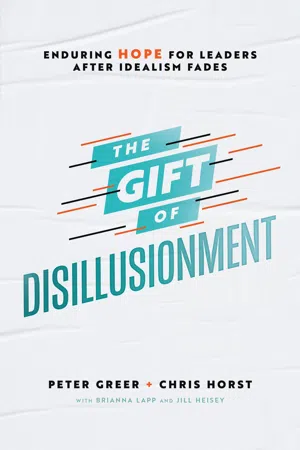
eBook - ePub
The Gift of Disillusionment
Enduring Hope for Leaders After Idealism Fades
- 224 pages
- English
- ePUB (mobile friendly)
- Available on iOS & Android
eBook - ePub
About this book
Information
Topic
Theology & ReligionSubtopic
Christian ChurchChapter 1
Invitation to Hope
Please make the bad news stop.
For most of our lives, we’ve been committed—even passionate—followers of the news and global events. We have valued information as the foundation for involvement. But in the last season—when racial injustice, political polarization, and the moral failures of prominent leaders dominated the headlines—we’ve felt that knowledge drive us not to engagement but to discouragement.
Bad news surrounds us, and it feels as though the frequency and volume of these stories are increasing.
If the headlines tell the whole story, then our world has every reason to lose hope.
As followers of Jesus, it’s particularly painful when we read of people within the faith community whose words and actions betray our faith. Who claim to follow Jesus but use power and position to subjugate, not serve. Duplicity and hypocrisy, #MeToo and #ChurchToo movements, and viciousness from people who pin crosses on their blazers.
In the wake of all this bad news in the world and in our churches, we talked with friends whose faith was faltering. We witnessed the fallout of elevating leaders to a godlike status, only to watch their very human flaws undermine their credibility and leave a trail of destruction—and often a crisis of faith—behind.
At the height of our own discouragement, we uncovered a story about early believers in AD 260. During a deadly plague that inspired a frenzied mass exodus from Athens, Christians rushed into the infected city to care for the sick and dying whom others had left behind. Dionysius, the first bishop of Athens, noted believers’ remarkable willingness to rush toward the dying at the risk of losing their own lives. He commended them for their “unbounded love and loyalty,” their pattern of “never sparing themselves and thinking only of one another. Heedless of danger, they took charge of the sick, attending to their every need and ministering to them in Christ.”1 They put their faith into action through self-sacrifice, and the world was turned upside down.
Does faith in Christ still have the power to prompt sacrificial, world-changing action? Can it still motivate people to battle disease, fight injustice, and alleviate poverty—not just for days or weeks but faithfully for a lifetime? Can it transform our self-centered hearts, making us people who don’t just speak of the good news but live as though it’s a reality?
We often hear about and retell inspiring stories of the way the Church showed up thousands of years ago. But we needed the assurance that these aren’t just “early Church stories.” That beyond the bad news that dominates the headlines, there is an incredible amount of good news in the world today.
To find it, we temporarily closed our newsfeeds and silenced the daily doses of discouraging stories. Jill and Brianna came alongside us to study the biblical virtue of hope as it’s portrayed in the pages of Scripture. We also turned to the wisdom of trusted friends to point us to present-day accounts of the courageous faith, hope, and love of God’s people transforming communities around the world.
Throughout our careers, we have served alongside, partnered with, and admired global leaders who routinely face corrupt governments, religious persecution, natural disasters, and extreme poverty. And while we have had countless conversations with men and women leading and serving in difficult circumstances, until researching this book, we had never overtly asked, “What keeps you there? What sustains your life of service? How have you not given in to discouragement? How do you hold on to hope?” It was time to start asking.
Longing for Hope
In society we see many monetizing and marketing their solutions to hopelessness and despair. Leadership gurus promise easy hacks to resolve our disappointments and deepest struggles. Instagram influencers outline diet and exercise plans guaranteeing a healthier life. Technology companies insist their latest app will decrease our stress and anxiety, bring peace to our relationship challenges, improve our sleep, and make us look younger.
In 2020, “self-care” expanded to a $450 billion industry, forty-five times larger than it was just one decade earlier.2 From Fitbit to candles and from self-help books to meditation apps, we are spending close to half a trillion dollars annually in our attempt to find hope.
But our experience is that these solutions leave us utterly unsatisfied. Our Western cultural obsession with self-improvement is insufficient. Rates of depression, anxiety, stress, and suicidal thoughts continue to increase throughout the United States.3 We are spending more time and money but coming up empty. More than half of Americans say they are more anxious today than they were one year ago.4
Within the Church, the solutions Christians propose are often equally unhelpful. Trite Jeremiah 29:11 memes assuring us our hardships are NBD (“no big deal”) because God has a plan aren’t helpful. “It will all work out” is not just untrue: It is hurtful. We don’t need any more advice amounting to tying theological bows on hardship.
Cultural remedies point us to something we can discover or architect within ourselves: “Look within and find your inner strength.” But the Old Testament prophets and the modern-day leaders we feature in this book describe a very different journey and conclusion: Within is the wrong place to look.
We cannot master our circumstances, engineer our happiness, or find refuge from real pain. We cannot avoid hardship and deep disappointment. We are unable to control all our circumstances.
When everything feels like it’s falling apart, how do we respond? How do we find hope? Where do we turn to navigate the troubles we’ll inevitably encounter in ourselves, in our organizations, and in our service?
The Guides
As we sought to understand what sustains a lifetime of faithful service, we asked our wisest peers, Who are the pioneers responsible for leading organizations and demonstrating “long obedience in the same direction”?5
We sought leaders with a minimum of twenty years of service in their fields and interviewed those who demonstrated staying power, sticking around long enough to experience the thorniest and knottiest difficulties. We intentionally sought leaders who had wounds and setbacks that could have forced them to give up—but who pressed on anyway.
In a world consumed with short-term results, quick fixes, and instant gratification, we wanted to uncover the beauty and strength of long-term commitment. We wanted to understand what builds and sustains leaders of hope and resilience.
We applaud people who serve four years. We admire people who serve forty.
Through in-person conversations or phone interviews, we spent time exploring the underlying beliefs, faith, and practices that sustain the long-term service of these global leaders.
From the streets of Guatemala City to the academy in Wrocław, Poland, from a school in Oklahoma City to a jail cell in Zimbabwe, we can’t wait to introduce you to the leaders we met. These are not stories of sanitized saints or easy wins. They all faced unimaginable struggles and disappointments. They inspired, challenged, and taught us as we explored their stories of running toward need rather than from it, cultivating hopeful communities, and spurring lasting movements.
These stories are not of individual heroism but rather of a God who is present in pain and heartache—a God who doesn’t seem to solve all the problems in the way we might like—yet is enough.6 These leaders pointed us to the inspiration and truth they relied upon in Scripture. Again and again, they referenced Jeremiah, the curious Old Testament prophet who wrote the longest book in the Bible and is known as “The Weeping Prophet.” The prophet and the eponymous book seemed like unlikely authorities on the virtue of hope, but Jeremiah inspired us, too, and provided the framework for this book.
Chapter 6 details Jeremiah’s story. For now, suffice it to say that Jeremiah understood a thing or two about holding on to hope, even when the world fell apart all around him. He delivered God’s truth to people who were lost in self-reliance, nationalism, and the worship of false gods. He continued speaking as the Jews lived as exiles and refugees, their once-enemies now their rulers. As their world came apart, Jeremiah reminded them, and reminds us, where hope can be found.
In a world bombarded with negative news, we need a biblical perspective on enduring hope and stories of courageous service in our world today. And we need the global Church. For too long, global and marginalized communities have been the recipients of international aid and charity, yet seldom are they recognized as teachers and mentors, those rich with wisdom and experience who have much to offer us. It’s far past time to recognize our need to be taught by the witness of the Church beyond, as well as within, our borders. North to South, East to West, we need each other in this journey.
The End of Idealism
Serving in ten different countries across the globe, the group we profile is diverse—in geography, interests, background, gender, culture, and a host of other factors—but in their stories, a consistent pattern emerged. While we will emphasize a single attribute of each leader in the chapters to come, there were glaring similarities in their leadership journeys. Multiple times we listened with delight to the curious repetition of key phrases and ideas.
Almost always, these leaders described beginning their service full of idealism, brimming with hopes and dreams.
Idealists see a need and feel an inner prompt to respond. Not content to merely bemoan injustice or just ponder how to respond, they step out with the courage to do something.
Idealism is rooted in the recognition of what’s wrong in the world and a longing to see it made right. It motivates leaders to take a stand for justice and fight for a cause. It’s a desire to see God’s “will be done on earth, as it is in heaven.”7 At its core, idealism is built on promise and possibility—a vision of what could be.
But sooner or later, our expectations collide with our experiences. We realize there is more complexity, nuance, and challenge than we anticipated. We learn it’s harder to solve problems than we thought. People disappoint us. Teams run into conflict. There are no easy solutions to deeply entrenched problems.
Idealism is also besieged by the pain we experience. From poverty alleviation to racial justice to foster care to missions to education reform, service inflicts wounds. If we love others, we will inevitably experience hurt and disappointment. As lawyer and activist Bryan Stevenson says in his book Just Mercy, ...
Table of contents
- Cover
- Endorsements
- Half Title Page
- Books by Peter Greer and Chris Horst
- Title Page
- Copyright Page
- Dedication
- Contents
- 1. Invitation to Hope
- 2. False Hope
- 3. Faint Hope
- 4. Forgotten Hope
- 5. Upward
- 6. An Unexpected Guide
- 7. Enduring Hope
- 8. Suffering
- 9. Surrender
- 10. Commitment
- 11. Outward
- 12. Justice
- 13. Sacrifice
- 14. Forgiveness
- 15. Onward
- 16. Discernment
- 17. Obedience
- 18. Perseverance
- 19. Community
- Conclusion
- Acknowledgments
- About the Authors
- About HOPE International
- Recommended Resources for Further Study
- Notes
- Back Ads
- Cover Flaps
- Back Cover
Trusted by 375,005 students
Access to over 1.5 million titles for a fair monthly price.
Study more efficiently using our study tools.
Frequently asked questions
Yes, you can cancel anytime from the Subscription tab in your account settings on the Perlego website. Your subscription will stay active until the end of your current billing period. Learn how to cancel your subscription
No, books cannot be downloaded as external files, such as PDFs, for use outside of Perlego. However, you can download books within the Perlego app for offline reading on mobile or tablet. Learn how to download books offline
Perlego offers two plans: Essential and Complete
- Essential is ideal for learners and professionals who enjoy exploring a wide range of subjects. Access the Essential Library with 800,000+ trusted titles and best-sellers across business, personal growth, and the humanities. Includes unlimited reading time and Standard Read Aloud voice.
- Complete: Perfect for advanced learners and researchers needing full, unrestricted access. Unlock 1.5M+ books across hundreds of subjects, including academic and specialized titles. The Complete Plan also includes advanced features like Premium Read Aloud and Research Assistant.
We are an online textbook subscription service, where you can get access to an entire online library for less than the price of a single book per month. With over 1.5 million books across 990+ topics, we’ve got you covered! Learn about our mission
Look out for the read-aloud symbol on your next book to see if you can listen to it. The read-aloud tool reads text aloud for you, highlighting the text as it is being read. You can pause it, speed it up and slow it down. Learn more about Read Aloud
Yes! You can use the Perlego app on both iOS and Android devices to read anytime, anywhere — even offline. Perfect for commutes or when you’re on the go.
Please note we cannot support devices running on iOS 13 and Android 7 or earlier. Learn more about using the app
Please note we cannot support devices running on iOS 13 and Android 7 or earlier. Learn more about using the app
Yes, you can access The Gift of Disillusionment by Peter Greer,Chris Horst in PDF and/or ePUB format, as well as other popular books in Theology & Religion & Christian Church. We have over 1.5 million books available in our catalogue for you to explore.