![]()
1
Introduction with (some) history
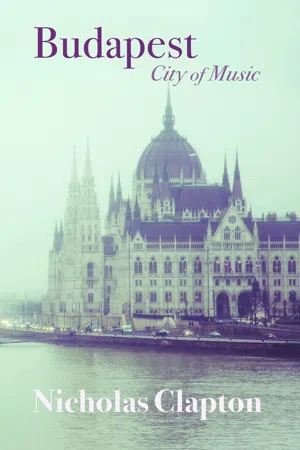
Budapest is a beautiful city, and one of the most beautiful sights there is that to be seen from the number 4 or 6 tram as it rumbles across the Margaret Bridge in the north of the city centre. Going from flat Pest on the Eastern side of the Danube to hilly Buda on the West, a truly glorious sight unfolds before your eyes, especially on a sunny day (there are lots of those), or when all is lit up at night: turn South (downstream) and on the Pest side you will see the needle-like pinnacles of the Országház (Parliament) pointing skywards, while from Buda the huge Royal Palace (Királyi palota), Mátyás templom (King Matthias Church) and a hundred műemlék (listed buildings) peer down, with Víziváros (Water Town) huddled beneath. Joining them is the famous Lánchíd (Chain Bridge).
Real picture postcard stuff, but there is one very strange thing about it: so much of it is new, or at least comparatively so. The parliament building was finished in 1902, the palace was last rebuilt after the Second World War, the church last restored in 1896,2 and so on. Even the Chain Bridge, the oldest permanent bridge across the Danube in Budapest, and designed by an Englishman, William Tierney Clark, was only opened in 1849. Though the earliest settlement in the area dates from the Stone Age, Budapest has been so battered, despoiled, bombed, machine-gunned and generally laid waste that I sometimes think it’s amazing that it’s there at all. The depredations of Mongol, Turk, Nazi and Soviet have made sure that there is no equivalent to the Tower of London, Notre Dame or Cologne Cathedral: the history of the city is hidden.
Some old buildings have disappeared altogether; others remain, but only in part. A prime example of the latter is the Royal Palace itself, which now does not resemble in any visible way the first royal residence on that site, built from about 1247 to 1265, during the reign of King Béla IV. From about this time we have evidence of lively musical goings-on in Buda: in 1279 the Synod of Buda forbade congregations from listening to minstrels.3 This regős tradition dated back to pre-Christian times, so one wonders at the effectiveness of these priestly strictures.
Physical remains of the palace only survive from century, as is revealed by a visit to the fascinating Budapest History Museum (Budapesti Történeti Múzeum), in building E of the present-day palace complex. There are considerable ruins here from building begun in the 1350s under King Lajos I (‘the Great’); in 1361, during this reign, Buda became Hungary’s capital. He was succeeded by King Zsigmond (Sigismund) of Luxemburg, who ruled over Hungary for half a century from 1387 to 1437, and during whose reign the famous Minnesänger, Oswald von Wolkenstein (1377–1445), visited Hungary several times in the king’s service.4 Zsigmond greatly enlarged the palace, and his chapel partly survives, the oldest musical monument here. It is a really hard-to-find jewel hidden in the very bowels of the History Museum and hence of the Castle Hill itself. The twists and turns of the various passages on the way to it are distinctly disorientating, especially to someone like me who has no sense of direction! It is well worth persevering, however. Not all of Zsigmond’s structure, the immediate precincts of which also housed a school and musicians, survives, but after the fall of Communism the under-chapel became ‘The Chapel of Every Magyar, rededicated in honour of St. István, 18 August 1990’. Extraordinarily enough, it was only rediscovered after the Second World War, having been buried for at least the fourth time.5
In other ways the history of the city is not hard to find at all. Hungarians, thanks to a very good education system that is only now beginning to fall apart (the depredations of the European Union may prove as destructive as those of any barbarian), know a lot about their history, and are proud of it. There are tablets and plaques all over the city to figures ‘famous in Hungary’ who are often virtually unknown anywhere else, musicians included. In Budapest, what’s more, there are museums of practically everything: telephones, sewage, the fire brigade … It is on the sometimes dirty and crumbling walls of buildings and in the occasionally still dusty and rather deserted display cases of museums that a lot of history can be found.
The Fire Brigade Museum, surprisingly, has one important exhibit for the musically inclined: a reconstruction (naturally) of the oldest known water-organ in Europe. There is another such in the museum at Aquincum, northwest of Budapest, where the remains were actually dug up – Aquincum was the capital of the Roman province of Pannonia Inferior for about two centuries. Hungary was on the very edge of the Roman Empire at its most extended, the Danube forming a natural boundary. Except for a few forts on the eastern bank, notably ones called Transaquincum (near the Margaret Island) and Contra Aquincum (near the Elizabeth Bridge, the next one south from the Chain Bridge), the Romans never really established themselves on the Pest side of the river. There they encountered the mysterious Jazyges, a nomadic tribe who from time to time caused them a lot of trouble. The organ in the Aquincum museum doesn’t look very like the one the Fire Brigade Museum has, Hungarians are very fond of arguing. I’ve heard a replica actually being played: a rather wheezy and altogether peculiar sound.
I am certainly not enough of a museum ‘wonk’ to recommend visiting them to look at one thing, but I would recommend, to the musically-interested visitor as to anyone else, a good long session in the Magyar Nemzeti Múzeum (Hungarian National Museum). Here the whole history of the country is traced in room after room of beautiful exhibits. It’s not interactive (thank God, I say), but it is very rewarding to anyone prepared to work a bit. Like most foreigners, I knew very little about Hungary when I first came to Budapest over a decade ago, and this place was a real eye-opener to the richness of Hungary’s history and culture. The Carpathian basin, in which Hungary sits, is basically a plain bisected by rivers and surrounded by mountains: altogether a wonderful bit of ‘natural geography’, and the peoples that have inhabited it over the centuries have been many and various.
So have their musically-related remains. As you wander, not too distractedly I hope, from room to room, you can spot, amongst others, a lovely Roman bas-relief of Orpheus (in the Lapidarium downstairs by the cloakroom and the loos) and Avar double-pipes in a case of shamanic artefacts (1st Floor, Room 8: the Avars were one of a succession of peoples to live in Hungary between the Romans and the Magyars. When you stand in front of the pipes, they play – a wonder of modern technology, and distinctly unnerving when in the Museum on a quiet, gloomy winter’s afternoon).6
On the Second Floor, don’t miss the intricately moulded stove-tile with a bagpipe-player on it from the time of the great Hungarian Renaissance. This period of growing economic development and cultural sophistication reached its apogee during the reign of King Matthias (Mátyás) Corvinus, from 1458 to 1490. Mátyás was married to Beatrice d’Este, herself an accomplished harpist and a pupil of the great theorist Johannes Tinctoris (c1435–1511), who dedicated his Terminorum musicae diffinitorium (c1473), the first music dictionary, to her. By this time, the choir of the Royal Chapel numbered about 40, boys and men, and was so good as to rival those of the Burgundian court and the Pope.7 In October 1483, Pope Sixtus IV sent his friend and former master of the Papal Chapel Bartolommeo de Maraschi, Bishop of Città di Castello, on a diplomatic mission to the Hungarian court. In the midst of delicate negotiations, the bishop found time to comment that King Mátyás ‘has a choir the better of which I have not yet seen. It resembles the one we had (at the papal court) before the devastation of the plague … [The king] had a high mass sung in his chapel … I had to realise with embarrassment that they have surpassed us in the things that belong to divine worship.’8 Many foreign musicians also worked at Matthias’ court, including the Flemish composer Jacques Barbireau (c1408–91), the outstanding Italian lutenist Pietro Bono (1417–97), and the once-famous singer-composer Johannes Stockem (1445–c1500), thought to have been resident there between 1481 and 1487.9 There is also a possibility that Josquin was a visitor in the 1480s.10 After the death of Mátyás, such high standards persisted: Willaert may have been in Buda in the late 1510s,11 and the Silesian composer Thomas Stoltzer (c1480–1544) was, from 1522, master of the Royal Chapel to King Lajos II, who lost his life at the disastrous Battle of Mohács (1526), the beginning of more than 150 years of Ottoman rule over most of Hungary.
For the musically-inclined, object-spotting in the National Museum continues to be rewarding. In the same case as the tiles is a seventeenth-century harpsichord belonging to Count István Thököly (1623–70), a nobleman from Felvidék (modern Slovakia), and further along, from the second half of the eighteenth century, a large and beautiful green-and-gold bookcase from the library of the Castle at Vágtapolca12 housing a lovely collection of musical instruments. Opposite this there is a baryton13 made for Haydn’s employer, Prince Miklós Eszterházy, that shares its display case with a beautifully decorated harp, said to have belonged to Marie Antoinette. Other exhibits worth looking out for include Mozart’s travelling clavichord, a wonderful Empire-style ‘giraffe’ piano by Pest maker Wilheim Schwab, a Broadwood grand that belonged successively to Beethoven and Liszt, and, in Room 13, medals presented to the composer Károly Goldmark (1830–1915, nowadays only remembered for a few works such as the ‘Rustic Wedding’ Symphony, the opera Die Königin von Saba and his virtuosic Violin Concerto – he wrote very good songs and chamber music), and one for Liszt on his golden jubilee as a performer in 1873. Beside these is an almost madly ornate asztaldísz (table centre) presented to Ferenc Erkel (1810–93, composer of the Hungarian national anthem and a major figure in Budapest’s musical life for half of the nineteenth century) by the instrument makers of Pest on 16 December 1888, the 50th anniversary of his conducting debut. The last rooms have heart-felt ‘farewells’ to the Communist regime, including a lump of the barb-wired boundary fence that formerly separated Hungary from Austria.
Of all the cataclysms to affect Budapest, the fall of Buda to the Ottoman Turks in 1541 was perhaps the greatest, at least until the end of the Second World War, since not only was it destroyed physically, but also culturally. During this period, the Ottomans had their own music, of course, the presence of which was noticed in, for example, woodcuts of the period.14 The century and a half of domination by a non-Western culture goes part way to explain why Budapest had, for example, no public theatres until the late eighteenth century, and no specifically dedicated opera house until the late nineteenth. The centre of all matters Hungarian moved elsewhere: Pozsony, modern-day Bratislava, became the seat of government of a country, often called ‘Royal Hungary’, ruled by a foreign dynasty, the Habsburgs – Holy Roman Emperors, rulers (at that time) of Austria, the Low Countries, Spain and half of Italy, and one of the most powerful regnant families in Europe. Hungarian culture as such survived best in Transylvania, nominally under Ottoman suzerainty, but internally self-governing. This was the home of probably the greatest Hungarian musician of the Renaissance, Bálint Bakfark (1507–76). An extremely skilled lutenist, his compositions and transcriptions of vocal music for that instrument are still daunting to players and listeners alike, but well worth the trouble. A member of the entourage of the fejedelem (ruler)15 of Transylvania, János Zápolya (who also called himself King of Hungary), travelled widely in Europe, becoming very famous and dying in Padua in 1576. In Polish, there still exists the saying ‘to turn to the lute after Bakfark’, as a paradigm of great daring.
Buda again suffered heavily from bombardment on the way to being freed from Turkish rule in 1686. There weren’t many people left there either, and Pest was little better off. Public musical performance first returned under the aegis of the church: the records of the Jesuits in Buda speak of a positive organ being played and some kind of instrumental group performing at a ceremony to mark the first anniversary of the return to Christian rule on 2 September 1687, and in subsequent years.16 On Easter Day 1688, a choral Mass was performed in the Mátyás templom in Buda.17
As the eighteenth century progressed, so did musical activity. By 1719, there was an official Guild of Musicians, giving the profession a stability it had previously lacked. In 1727, the first music-school in Buda was opened, in what is now Fő utca in the Víziváros. The church remained the centre of public musical life, church music libraries surviving from this period indicating that the repertoire performed included music from both contemporary Italy – Albinoni, Bonporti, Caldara and Perti – and from the Habsburg capital Vienna, with works by composers like Fux and Reutter.18 Professional musicians supplemented their income by playing in inns, and the medieval Hungarian tradition of tower musicians, attached to the city watch, also survived, its members jealously guarding their status.
This was all fairly small-scale stuff, however, not least since Pest-Buda remained a small place.19 Even in 1799, the combined population was only a little over 50,000, though the trading city of Pest had by this date, and for the first time, outstripped the old royal seat up on the hill. Vienna, the Habsburg capital, had at this date well over a quarter of a million inhabitants, London nigh on a million.20 Pest-Buda was, however, bigger than Pozsony, and a definite change in the relative fortunes of the two cities came in 1783. In that year the Emperor Joseph II decided to remove to Buda the Helytartótanács (Lieutenancy Council) of Hungary, responsible for the administration of the country and presided over by the Palatine (see pp 15–16). At the same time the Hungarian Treasury and the Military High Command was transferred, all three bodies taking over buildings vacated by recently suppressed religious orders. This resulted in a major removal of the nobility.
During this period at last, public secular performance in Pest-Buda began to acquire permanent homes. In 1776, the first public theatre opened in Pest, followed by one in Buda in 1783. The Castle District (Vár) remained theatreless until 1787. All of these theatres were German-language, but the Várszínház (Castle Theatre – now the oldest surviving theatre in Budapest) also staged Hungarian-language performances from 1790. In 1793 there was a significant coincidence: Pest audiences heard ...