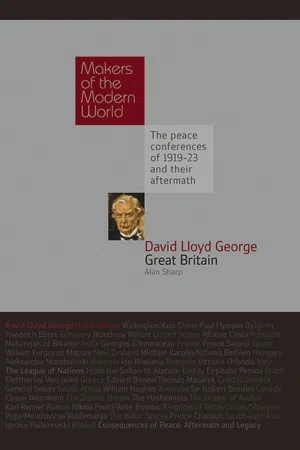
David Lloyd George (1863-1945). The end of the First World War saw Britain at the height of its power. Its fleet and air force were the largest in the world. Its armies had triumphed in the Middle East and spearheaded the final attacks in Western Europe that had driven the defeated Germans to seek an armistice. Britain now had to translate this military victory into the achievement of its war aims and future security and prosperity. Its main negotiator at the forthcoming peace conference would be its prime minister, the ebullient and enigmatic David Lloyd George, the "Welsh Wizard" and "the man who had won the war." Lloyd George's energy had maintained the war effort through the dark days of 1917 and early 1918, but now he anticipated, with relish, the prospect of winning the peace. Few were better equipped. He was a skilled and accomplished negotiator with the knack of reconciling the apparently irreconcilable. His admirers, of whom there were many, pointed to his brilliant and agile mind, his rapid grasp of complex questions and his powers of persuasion. His critics, who were also numerous, distrusted his sleight of hand, fleetness of foot and, frankly, his word. His six months in Paris in 1919, as he pitted his wits against formidable world leaders like Woodrow Wilson and Georges Clemenceau, were among the most enjoyable but exhausting of his life. This study investigates the extent to which Lloyd George succeeded in his aims and evaluates the immediate and longer-term results of his negotiations for Britain.
- English
- ePUB (mobile friendly)
- Available on iOS & Android
eBook - ePub
About this book
Information
I
The Life and the Land
1
The Rising Star
William Orpen’s Peace Conference portrait of David Lloyd George shows a vibrant, genial, smiling figure, with a bristling moustache and a shock of white hair. It conveys much of the wit, energy, vitality and sheer exuberance of a man who was revelling in the excitement of the largest and most significant peace conference of the 20th century. The premiership of his country, a major – perhaps the leading – role in the Paris negotiations at the end of a war that he was credited with winning, were hardly predictable as the fate of someone born in relatively humble circumstances in Chorlton-on-Medlock near Manchester on 17 January 1863. His schoolmaster father, William George, died in 1864, leaving his mother, Elizabeth, pregnant with his brother William, his elder sister, Mary Ellen, and 18-month-old David. They moved to Llanystumdwy, near Caernarvon, North Wales, finding a home with Elizabeth’s brother, Richard Lloyd, a shoemaker and pastor in the nearby Baptist chapel in Criccieth.
Uncle Lloyd was a huge figure in David’s life even beyond his death in February 1917. All that is best in life’s struggle I owe to him first he told his wife, Maggie. He gave him his name and steeped him in Welsh identity and language, education, non-conformist religion, oratory, Liberalism and radical politics, and provided him with a moral compass. Yes – how often have I kept straight from the very thought of the grief I might give him. Perhaps it would be unwise to overstate this aspect. Many of those who came into contact with him later might have found it ironic that Davy Lloyd’s first public appearance was singing ‘Cofia, blentyn, ddwed y gwir’ (‘Remember, child, to speak the truth’). David provided evidence of all these influences, organising, at 12, a strike of his schoolmates, who refused to recite the Anglican catechism for visiting local gentry. The strike lasted until brother William cracked. From that time onwards David had an enduring dislike of the predominantly English rural landowners in Wales and sympathy for their estate workers.
The 1880 Burials Act permitted Nonconformists to conduct burials in parish graveyards, using their own rites. The rector of Llanfrothen persuaded the donor of additional land for the graveyard to stipulate that only Anglican burials would be permitted. Robert Roberts wished to be buried beside his daughter, with a Methodist service. The rector refused permission. Lloyd George advised the family to break into the graveyard, conduct their service and bury Roberts. The rector sued them for trespass. Lloyd George persuaded the jury to find for his clients, but the judge, misinterpreting the verdict, found for the rector. The appeal to the High Court was successful, gaining the young lawyer much publicity.
Uncle Lloyd had belief in his nephew’s ability: It has often struck me how remarkable his confidence has been in my some time or other doing great things. He determined that David should follow the law.1 Articled in 1877 to the firm of Breeze, Jones and Casson in Portmadoc, he qualified as a solicitor in 1884 – though his third class honours suggested no enthusiasm for things academic. He opened a practice in Criccieth that year and, in January 1888, after a courtship in which his radical, Baptist background was not entirely acceptable to his prospective in-laws, he married Margaret Owen, a local farmer’s daughter. Maggie can have had few illusions about his determination to succeed in politics. Even before their marriage he told her: My supreme idea is to get on … I am prepared to thrust even love itself under the wheels of my Juggernaut, if it obstructs the way. Those ambitions were not modest. He visited the House of Commons in 1881, declaring: I will not say but that I eyed the assembly in a spirit similar to that in which William the Conqueror eyed England at his visit to Edward the Confessor, as the region of his future domain. Oh vanity!2
He approached his goal in a systematic way, honing his oratorical skills, getting his name well-known in the local press both in terms of his legal practice, particularly in his defence of poachers, and his involvement in political controversies. Never one to avoid confrontations with the Establishment, whether the Anglican church or the local squires, his success in the Llanfrothen burial case in 1888 came at a particularly opportune time, helping him to be nominated as the Liberal candidate for the constituency of Caernarvon Boroughs.
In 1889 he was elected as an alderman on the new Caernarvon county council, but his major breakthrough came in April 1890, when, at the age of 27, following the death of the Conservative MP, he won the ensuing by-election by 18 votes. He would defend the seat 13 times, somewhat precariously in the early years, and remain continuously as the MP for Caernarvon Boroughs until, perhaps rather sadly, he took a peerage in January 1945. It had been offered kindly by the Prime Minister, his old friend Winston Churchill, to spare Lloyd George another electoral campaign, which was not guaranteed to be successful. He accepted, not from love of titles, which he despised and cheerfully bestowed or sold as Prime Minister, but because he hoped to influence the second Paris Peace Conference as a distinguished elder statesman. Churchill himself would not follow the same path, preferring to remain the great commoner and, in the event, Lloyd George’s death in March would have spared him a new election.
The young radical
Lord Salisbury was the Conservative Prime Minister when the youngest MP in the House began his career on the opposition back benches. A colleague described him as being ‘of small stature, slight figure and primitive raiment, his personal appearance … not impressive; his early speeches in the House of Commons were, with a thin thread of argument, incoherent declamations …’.3 He was often dubbed ‘the little man’, usually, though not universally, with affection. His height (about five foot six) was perhaps perceived to be less because of his broad shoulders and large head. No matter what his male colleagues thought of his appearance, his attraction to women was both obvious and potentially dangerous (his less affectionate nickname was ‘the Goat’). If Maggie had not reluctantly appeared by his side in court in 1909 when, following insinuations that he was about to be cited in a divorce case, he successfully sued the People newspaper for libel (possibly perjuring himself in the process), his career might have been over.4
In 1892 Gladstone won the general election and became Prime Minister for the fourth, and final, time and Lloyd George became a vociferous campaigner for Welsh causes. When it became clear that these, particularly the disestablishment of the Anglican church in Wales, were not the main priority of Lord Rosebery, who replaced Gladstone as Prime Minister in 1894, Lloyd George resigned, temporarily, the party whip and, although not the main cause of the Liberal defeat in the 1895 general election, he did not endear himself to the party leadership.
‘Lloyd George is a very able man and will go far. It is a pity however that he is so provincial in his views.’
JOSEPH CHAMBERLAIN
JOSEPH CHAMBERLAIN
Another former Liberal maverick, Joseph Chamberlain, now Colonial Secretary in Salisbury’s new government, believed ‘Lloyd George is a very able man and will go far. It is a pity however that he is so provincial in his views.’5 There was a real danger that he would become typecast as a Welsh nationalist and radical rebel without much interest in the wider social, imperial and defence issues that were becoming increasingly important at the turn of the century. His record in the ten years of Conservative rule from 1895 to 1905, however, indicated a growing maturity of attitude and broadening of his awareness of questions beyond Wales and rural affairs. He became an accomplished speaker in the House, attacking the government effectively on its 1896 Agricultural Land Rating Bill and its 1897 Education Bill (which was withdrawn) but, significantly, he also spoke in some debates on foreign affairs and imperial questions, whilst his membership of a Commons select committee on old age pensions whetted his interest in social problems.
His rough reception by Liberals in Newport, South Wales, in January 1896 revealed their resentment about domination by North Wales with its aspirations for the Welsh language and identity and helped to convince him that his political future should be on a British rather than a purely Welsh stage. He did not neglect Wales, however, and his championing of the striking workers in a protracted industrial dispute in the Penrhyn slate quarries linked his Welsh roots with new interests in labour relations and social welfare. He further widened his horizons, travelling in Europe and South America.
Domestic tensions
The new MP, Maggie and their growing family – they had four children, Richard born in 1889, Mair in 1890, Olwen in 1892, and Gwilym in 1894 – moved to a succession of flats and houses in London but Maggie preferred Criccieth and Lloyd George found himself often alone. Being cited as the father of Mrs Catherine Edwards’ illegitimate child in 1897 cannot have helped their marriage, even though the court found him innocent of any blame. In August 1897 he complained to Maggie: I have more than once gone without breakfast. I have scores of times come home in the dead of night to a cold, dark and comfortless flat without a soul to greet me. I am not the nature either physically or morally that I ought to have been left like this … You have been a good mother. You have not – and I say this now not in anger – not always been a good wife. Their marriage survived, in name at least, until her death in 1941, and their drift apart was gradual, indeed Kenneth Morgan suggests that the family was at its closest in the early years of the new century. Another child, Megan, was born in 1902 but the death of their eldest daughter, Mair, in 1907 from peritonitis after an emergency operation for appendicitis, accelerated their growing estrangement. Lloyd George blamed Maggie for allowing Mair’s operation to be performed at home and himself because he believed she had hidden her illness to avoid disappointing his expectations of success in her matriculation examination. He later told Frances Stevenson that they each had their poignant grief but could not go to each other for sympathy and understanding.6 Maggie rarely smiles in their later family photographs and Lloyd George sought comfort elsewhere.
A recent study suggests cautiously that ‘it seems quite likely that he was a serial adulterer’. His son, Richard, admittedly not a friendly witness, was less coy: ‘He carried on, adventure following adventure, with many hair’s breadth escapes. For years he remained unscathed, protected by his wife from the consequences of his excesses.’ There were, however, two really important women in his life, Maggie, the mother of his five children and nursemaid to his constituency, and Frances Stevenson, who came first as a summer companion and tutor for Megan in 1911 and then, in 1912 became his private secretary, knowing that this also meant becoming his lover. In 1911 Frances was a 23-year-old graduate in French from Royal Holloway College, teaching at Allenswood School in Wimbledon, where the girls nicknamed her ‘Pussy’. Coincidentally she had been a friend of Mair’s at school and, when Maggie wrote to their old headmistress seeking a recommendation for a temporary governess for the summer of 1911, she contacted Frances. Given what would follow, Maggie’s part in introducing Frances into the equation was ironic.7
For over 30 years Lloyd George and Frances lived, as discreetly as possible, in a parallel marriage. This could be complicated, sometimes producing scenes from a French farce with people being shuffled about the house to avoid unwanted meetings. In 1936 he holidayed with Frances and her (their?) daughter Jennifer in Jamaica.8 Maggie and Megan sailed to join him. At church, the minister prayed for their safe arrival and the congregation sang ‘For those in peril on the sea’. Frances, preparing to leave, was understandably ambivalent, much to his amusement – You ought to have seen your face. In October 1943, she became his second wife. As she herself recorded ‘Our real marriage had taken place thirty years before.’9
The Boer War
The Second Boer War, fought between October 1899 and May 1902, changed Lloyd George’s career and the development of the United Kingdom. He became much better known – at some risk to himself when his condemnation of the war and sympathy for the Boers, coupled with the fact that he was attacking Chamberlain in his own fiefdom, led to him fleeing a public meeting in Birmingham in December 1901 disguised as a policeman. Lloyd George was not opposed to the British Empire, indeed he claimed in 1901: I also am an imperialist. I believe in Empire but his definition of empire was one based on consent, self-government for the colonies, and involved British responsibilities.10
He opposed the war in South Africa as the immoral, expensive and unnecessary result of Chamberlain’s bungled diplomacy. Yet, demonstrating a facility that typified much of his career, he developed political friendships with Liberal Imperialists like Rosebery and Edward Grey and repaired his relationship with Herbert Asquith, at the same time as he was building links with the radical editors like C P Scott of the Manchester Guardian or A G Gardiner of the Daily News and attracting approaches from Keir Hardie’s socialists. His ability to rub along with colleagues of widely differing views was one of his great strengths.
Salisbury won the ‘khaki’ election of 1900 but the longer term effects of the war harmed him and his party. Many volunteered for military service, but what this unintended census of the population revealed were striking deficiencies in health and education. Almost half the potential recruits were rejected on medical grounds, highlighting both the consequences of industrialisation and urbanisation and the need for drastic reform. Equally, Britain’s diplomatic isolation and the inadequate performance of its armies undermined the confident, perhaps complacent, pragmatic approach of Salisbury to foreign policy and ushered in a new era of men like Chamberlain, who believed that more dynamic methods were required, involving more formal commitments. They wanted Britain to join the Triple Alliance of Germany, Austria-Hungary and Italy. When, in the course of alliance negotiations in 1898 and 1901, Germany overplayed its hand and demanded too much too soon from Britain in terms of European commitment, Britain drifted away. Eventually, the 1904 Anglo-French and 1907 Anglo-Russian ententes moved it closer to the orbit of the rival Franco-Russian Dual Alliance.
Salisbury’s government concluded the Boer War with a generous peace in 1902, but its high costs – in soldiers’ lives, nearly 6,000 killed and 16,000 dead of disease, in financial terms, over £222 million, and morally, with the scandal of 20,000 Boer deaths from disease in the concentration camps into which families had been forced in order to counter the Boers’ guerrilla tactics – all undermined its support. Subsequent difficulties, such as controversy over the cheap indentured Chinese labour introduced into South Africa, attacked by Lloyd George as equivalent to slavery, added to the government’s unpopularity.
Balfour’s contentious 1902 Education Bill, which offended Nonconformists by the subsidies offered to Anglican and Catholic schools, allowed Lloyd George not only to become a major opposition spokesman, but also to demonstrate his ingenuity by his clever policy under which the Welsh counties agreed to assist the church schools – but only if the government repaired their buildings to a proper standard. He was again ready to engage with opponents in the hope of finding compromises, establishing a good personal relationship with Bishop Edwards of St Asaph, the bête noire of many Welsh liberals.
When Chamberlain split the Conservatives in 1903 by proposing to end free trade and create a system of tariffs and imperial preference, Lloyd George was among the leading defenders of a Liberal article of faith, though his subsequent career demonstrated that he was no true believer. All this, and his attacks on the government’s 1904 Licensing Bill, helped to promote Lloyd George as an outstanding figure amongst the younger generation of Liberal politicians. When, in December 1905, Arthur Balfour, who had succeeded his uncle Robert Salisbury as premier in 1902 (whence the expression ‘Bob’s your uncle’) unexpectedly resigned, the new Liberal Prime Minister, Henry Campbell-Bannerman, offered Lloyd George a cabinet post as President of the Board of Trade. He would not relinquish cabinet rank for almost 17 years until his resignation as Prime Minister in October 1922.
The old order changes
Britain, in late 1905, faced increasing challenges to its trading, industrial and naval pre-eminence. France and Russia were old rivals, Germany and the United States were important new competitors, whilst Japan’s unforeseen victory over Russia in the war of 1904–5 announced its presence as a major regional player. The world power balance was becoming ever more complex and patterns of cooperation and competition were increasingly fluid. Britain’s traditional imperial rivalry with France seemed to be undergoing a transformation as a result of the entente concluded in 1904, but this process had not yet been extended to France’s ally, Russia, Britain’s opponent in the Great Game, played out on the frontiers of India, for the control of expanses of Asia.
As with most European states, Britain’s population had increased enormously in the 19th century, with the 15 million of 1815 now approaching 45 million. Unlike most of Europe, however, the majority of Britain’s population lived in cities, employed in industry rather than agriculture. Britain had pioneered industrialisation, but it now faced the inevitable problems of the first in the field, as later competitors equipped themselves with more modern plant, employing more scientific ...
Table of contents
- David Lloyd George: Great Britain
- Contents
- Acknowledgements
- Prelude: Paris 1919
- Part I: The Life and the Land
- 1. The Rising Star
- 2. The Man Who Won the War
- Part II: The Paris Peace Conference
- 3. Paris
- 4. Making Germany Pay
- 5. Redrawing the Map of Europe
- 6. The Imperial Settlement
- Part III: The Legacy
- 7. Coping with the Aftermath
- 8. Keeping out the Welshman
- Conclusion
- Notes
- Chronology
- Bibliographical Note
- Bibliography
- Picture Sources
Trusted by 375,005 students
Access to over 1.5 million titles for a fair monthly price.
Study more efficiently using our study tools.
Frequently asked questions
Yes, you can cancel anytime from the Subscription tab in your account settings on the Perlego website. Your subscription will stay active until the end of your current billing period. Learn how to cancel your subscription
No, books cannot be downloaded as external files, such as PDFs, for use outside of Perlego. However, you can download books within the Perlego app for offline reading on mobile or tablet. Learn how to download books offline
Perlego offers two plans: Essential and Complete
- Essential is ideal for learners and professionals who enjoy exploring a wide range of subjects. Access the Essential Library with 800,000+ trusted titles and best-sellers across business, personal growth, and the humanities. Includes unlimited reading time and Standard Read Aloud voice.
- Complete: Perfect for advanced learners and researchers needing full, unrestricted access. Unlock 1.5M+ books across hundreds of subjects, including academic and specialized titles. The Complete Plan also includes advanced features like Premium Read Aloud and Research Assistant.
We are an online textbook subscription service, where you can get access to an entire online library for less than the price of a single book per month. With over 1.5 million books across 990+ topics, we’ve got you covered! Learn about our mission
Look out for the read-aloud symbol on your next book to see if you can listen to it. The read-aloud tool reads text aloud for you, highlighting the text as it is being read. You can pause it, speed it up and slow it down. Learn more about Read Aloud
Yes! You can use the Perlego app on both iOS and Android devices to read anytime, anywhere — even offline. Perfect for commutes or when you’re on the go.
Please note we cannot support devices running on iOS 13 and Android 7 or earlier. Learn more about using the app
Please note we cannot support devices running on iOS 13 and Android 7 or earlier. Learn more about using the app
Yes, you can access David Lloyd George by Alan Sharp in PDF and/or ePUB format, as well as other popular books in History & Political Biographies. We have over 1.5 million books available in our catalogue for you to explore.